
Apr 9, 2026
Discover what transfrontier parks are, how 13 TFCAs in Southern Africa work, and why they offer the most rewarding eco-tourism and conservation travel experiences.
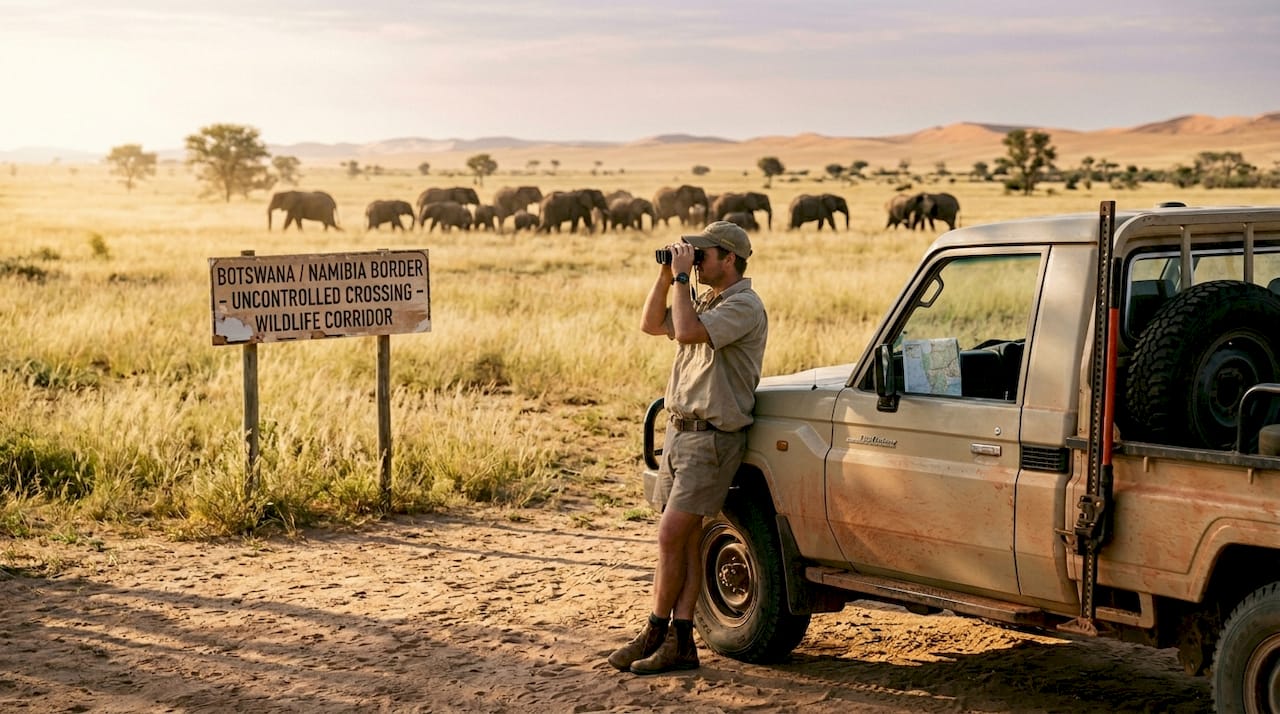
Transfrontier parks: conservation and adventure across borders
TL;DR:
Transfrontier parks span multiple countries, enabling wildlife migration and ecological connectivity.
They involve complex governance models like treaties, joint bodies, and community co-management.
These parks enhance biodiversity, tourism, and community livelihood through cross-border conservation efforts.
Wildlife doesn’t carry a passport. Yet for decades, conservation efforts were carved up by political borders, forcing animals into fragmented patches of protected land. A transfrontier park, also known as a Transfrontier Conservation Area or TFCA, is a region that crosses country boundaries, integrating protected areas and multiple resource-use zones into one vast ecological whole. In Southern Africa, these remarkable landscapes represent some of the most exciting frontiers in both conservation and eco-tourism. This guide explains what transfrontier parks are, how they actually work, and what they mean for your next adventure across the region.
Table of Contents
What is a transfrontier park?
How transfrontier parks work: Governance and cooperation
Transfrontier parks in Southern Africa: Examples and impact
Eco-tourism and community benefits in transfrontier parks
Why transfrontier parks are the future of African travel and conservation
Explore transfrontier wonders with Secret Namibia
Frequently asked questions
Key Takeaways
Point | Details |
|---|---|
Cross-border conservation | Transfrontier parks connect wildlife and landscapes across multiple nations for greater ecosystem health. |
Collaborative management | Governance and operations rely on international treaties and shared planning. |
Tourism opportunities | Travelers can experience seamless, responsible eco-tourism and unique wildlife movements. |
Community involvement | Local communities benefit through jobs, cultural exchange, and conservation partnerships. |
What is a transfrontier park?
Imagine standing in Botswana, watching an elephant herd drift silently into Zambia without a fence in sight. That’s the essence of a transfrontier park. A TFCA spans two or more countries, integrating both formally protected areas and surrounding resource-use regions into a single, functioning ecosystem. The borders don’t disappear on paper, but for wildlife and conservation management, they effectively dissolve.
The concept grew out of a simple ecological truth: animals, water systems, and plant communities don’t respect political lines. Migratory species like elephants, wild dogs, and lions need enormous ranges to survive. Fragmenting those ranges with hard borders leads to genetic isolation, habitat loss, and conflict with local communities. Transfrontier parks were designed to fix exactly that.
Key goals of a transfrontier park include:
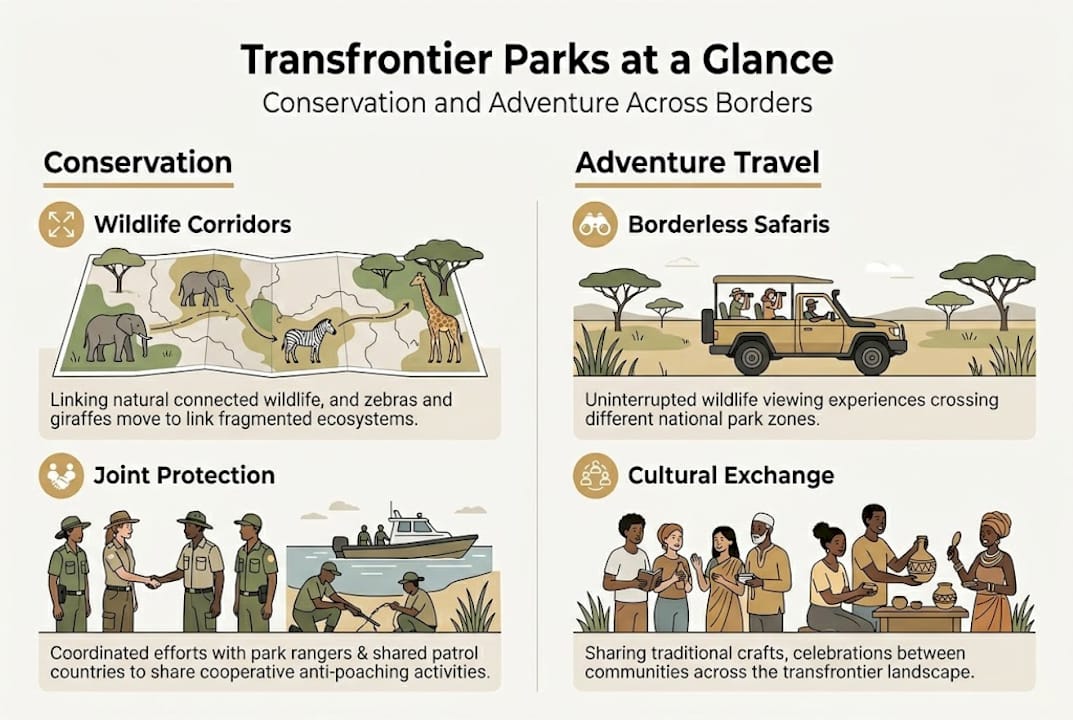
Wildlife migration corridors that allow free movement between ecosystems
Ecological connectivity to maintain healthy, genetically diverse populations
Shared resource management across communities and governments
Peacebuilding between neighbouring nations through cooperative conservation
Sustainable tourism that benefits both wildlife and local people
Here’s a quick comparison of how transfrontier parks differ from conventional national parks:
Feature | National park | Transfrontier park |
|---|---|---|
Jurisdiction | Single country | Two or more countries |
Wildlife corridors | Limited by borders | Cross-border and continuous |
Governance | National authority | Joint management structures |
Tourism scope | Within one country | Multi-country experiences |
Conservation scale | Regional | Continental |
If you’re drawn to luxury, wildlife, and wonder in Southern Africa, understanding TFCAs is the first step to appreciating just how extraordinary this region’s wild spaces truly are.
How transfrontier parks work: Governance and cooperation
Understanding the concept is only the start. The secret lies in how these parks are practically stitched together across countries. Building a transfrontier park is not a single event. It’s a long, layered process involving legal agreements, ecological planning, and deep social negotiation.
At the foundation, countries sign treaties or Memoranda of Understanding, establish ecological corridors, and create co-management structures like special purpose vehicles (SPVs) to coordinate governance across borders. SPVs are essentially joint bodies that bring together government agencies, conservation organisations, and community representatives to make decisions collectively.
Here’s how the process typically unfolds:
Political agreement between neighbouring governments, often facilitated by regional bodies like SADC (Southern African Development Community)
Legal framework established through bilateral or multilateral treaties
Ecological assessment to identify corridors, buffer zones, and sensitive habitats
Fence removal or modification to allow wildlife movement while managing livestock conflicts
Community consultation to address land rights, livelihoods, and cultural heritage
Joint management plans developed and implemented by co-management bodies
A comparison of governance models shows just how varied the approaches can be:
Governance model | Description | Example |
|---|---|---|
Treaty-based | Formal bilateral agreement | Great Limpopo TFCA |
MOU-based | Less formal, flexible cooperation | Early KAZA development |
SPV model | Joint body with operational authority | Peace Parks Foundation partnerships |
Community co-management | Local communities hold formal roles | /Ai-/Ais-Richtersveld TFCA |
The SADC Protocol on Wildlife Conservation and the Peace Parks Foundation have been instrumental in pushing this agenda forward across the region. The Foundation has provided technical expertise, funding, and diplomatic facilitation for multiple TFCAs.
Challenges remain real. Differing national laws, land tenure disputes, and varying conservation priorities can slow progress dramatically. Trust between governments and communities takes years to build. But when it works, the results are genuinely spectacular.
Pro Tip: When planning a multi-country safari, ask your operator specifically about which TFCAs your route crosses. Knowing the governance structure helps you understand the conservation story unfolding around you.
Transfrontier parks in Southern Africa: Examples and impact
With a sense of how they’re built, you’ll appreciate the scale and influence of real transfrontier parks across Southern Africa. The numbers alone are staggering.
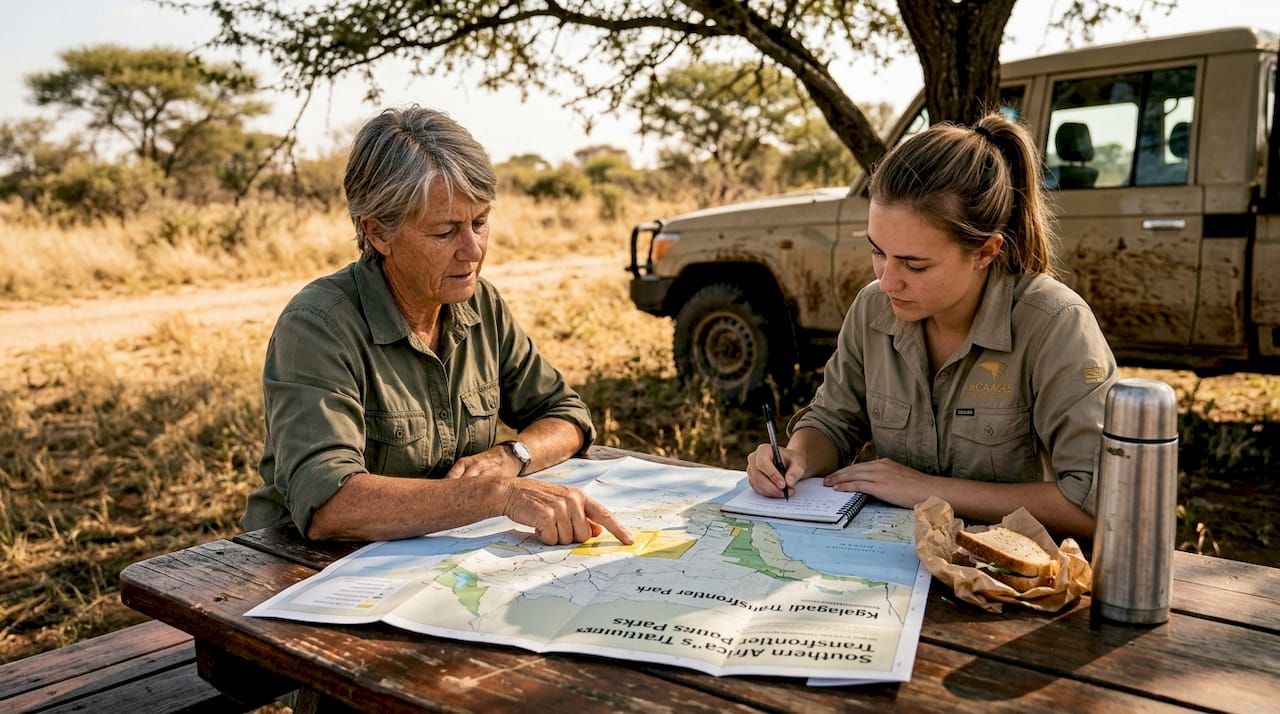
As of April 2025, 13 formalized TFCAs exist across Southern Africa, including iconic areas like KAZA, Great Limpopo, and /Ai-/Ais-Richtersveld. Together, they represent one of the most ambitious conservation experiments on the planet.
TFCA | Countries involved | Approximate size | Flagship wildlife |
|---|---|---|---|
KAZA | Botswana, Zimbabwe, Zambia, Namibia, Angola | 520,000 km² | Elephants, lions, wild dogs |
Great Limpopo | South Africa, Mozambique, Zimbabwe | 35,000 km² | Big Five, hippos |
/Ai-/Ais-Richtersveld | South Africa, Namibia | 6,000 km² | Desert-adapted species, fish eagle |
Maloti-Drakensberg | South Africa, Lesotho | 8,000 km² | Bearded vulture, eland |
“KAZA alone covers 520,000 km² across five countries, making it one of the largest terrestrial conservation areas on Earth. It is home to the world’s largest elephant population.”
Parks like Kruger National Park form the South African anchor of the Great Limpopo TFCA, while Chobe National Park sits at the heart of KAZA. These aren’t just parks anymore. They are nodes in a living continental network.
The benefits extend well beyond wildlife:
Biodiversity gains from restored migration routes and larger gene pools
Reduced poaching through coordinated anti-poaching operations across borders
Tourism growth as visitors can now experience multi-country wildlife journeys
Diplomatic value as shared conservation builds goodwill between nations
Community income from tourism concessions, guiding, and hospitality
For the eco-conscious traveller, visiting a TFCA means your trip directly supports one of the most meaningful conservation frameworks in the world.
Eco-tourism and community benefits in transfrontier parks
Knowing where these parks are and their aims, let’s explore how they offer unforgettable and sustainable adventures for travellers and locals alike. Transfrontier parks aren’t just about animals. They represent a fundamentally different approach to how tourism and conservation can work together.
TFCAs enable seamless tourist movement and nature-based enterprises, with facilities like the Sendelingsdrift border crossing in /Ai-/Ais-Richtersveld allowing travellers to move between Namibia and South Africa within the park itself. That kind of experience, crossing a river into a new country without leaving the wilderness, is genuinely extraordinary.
Communities living inside or adjacent to TFCAs benefit in concrete ways:
Employment as guides, rangers, lodge staff, and community monitors
Business opportunities through craft markets, cultural tourism, and hospitality
Land rights recognition through formal community conservancy models
Cross-border collaboration between communities that share cultural heritage
Revenue sharing from tourism concessions that fund local development
The Peace Parks Foundation’s involvement in 10 TFCAs focuses specifically on rewilding, anti-poaching, tourism development, and community empowerment, showing how conservation and human wellbeing can genuinely reinforce each other.
For travellers, the payoff is a richer, more immersive experience. You might track lion across a border at dawn, spend an afternoon with a community guide learning about traditional land use, and watch a sunset over a river that marks no boundary at all. If you’re planning a safari in Southern Africa, a TFCA itinerary offers something few other destinations can match.
Pro Tip: Seek out lodges and operators with active links to Africat conservation or similar programmes. Guides who are personally involved in conservation work bring a depth of knowledge and passion that transforms a game drive into something truly memorable.
Why transfrontier parks are the future of African travel and conservation
For a long time, conventional wisdom treated national parks as self-contained sanctuaries. Fence them, protect them, and the wildlife inside will thrive. TFCAs fundamentally challenge that thinking. Isolation, it turns out, is its own kind of threat.
The integrated management and governance frameworks underpinning Southern Africa’s TFCAs show that conservation at scale requires political courage, not just ecological science. Poaching syndicates don’t stop at borders. Climate change doesn’t either. Only coordinated, cross-border responses can address these threats meaningfully.
What’s equally important is the shift in how communities relate to wild spaces. TFCAs, at their best, give local people a genuine stake in conservation outcomes. That changes everything. When a community earns income from wildlife tourism, the elephant becomes an asset rather than a threat.
For travellers, understanding the key safari differences in Southern Africa means recognising that a TFCA visit is not just a holiday. It’s participation in something larger. These parks take patience to fully appreciate. Legal, social, and ecological layers take more than one trip to truly understand. But that depth is precisely what makes them so rewarding.
Explore transfrontier wonders with Secret Namibia
If exploring Africa’s wildest horizons calls to you, crossing those boundaries has never been more rewarding or more accessible with the right guide beside you.

At Secret Namibia, we specialise in crafting journeys that go beyond the ordinary. Whether you’re drawn to luxury Namibia safaris that weave through multiple TFCAs, or you’re looking for deeply ethical conservation safaris that put your travel spend directly into protecting wild spaces, we have the expertise to make it happen. Our all-inclusive luxury safari options are designed for travellers who want seamless, meaningful experiences across Southern Africa’s most magnificent landscapes. Get in touch and let us plan your transfrontier adventure.
Frequently asked questions
What is the main difference between a national park and a transfrontier park?
A national park is managed by a single country, while a transfrontier park spans two or more countries for shared conservation and wildlife management. The key distinction is the cross-border governance and the ecological connectivity that TFCAs provide.
How many transfrontier parks exist in Southern Africa?
As of April 2025, 13 formalized TFCAs exist across Southern Africa, ranging from the enormous KAZA spanning five countries to smaller but equally significant parks like /Ai-/Ais-Richtersveld.
Can tourists cross borders inside transfrontier parks without a visa?
Most TFCAs offer simplified crossings at select points like Sendelingsdrift, but standard visa requirements still apply. Always check entry and exit requirements for each country before your trip.
What activities are popular in transfrontier parks?
TFCAs support nature-based tourism including wildlife viewing, cross-border trekking, guided eco-tours, and community cultural experiences. Many parks also offer exceptional birdwatching, photographic safaris, and conservation volunteering opportunities.
Recommended
RELATED
Safari Guides
Oct 30, 2025
Understanding What is Included in Luxury Safaris
Explore what is included in luxury safaris, from exclusive accommodations to bespoke experiences that cater to discerning travelers.
Feb 24, 2026
Why Namibia Adventures Matter: An In-Depth Look
Discover why Namibia adventures are essential for luxury travelers seeking unique, immersive experiences in nature and wildlife exploration.
Feb 23, 2026
What to Expect on a Luxury Safari: A Comprehensive Guide
Discover what to expect on a luxury safari and gain a deeper understanding of the unique experiences that await you in the wild.
Feb 22, 2026
Understanding Namibia Safari Costs Explained
Explore Namibia safari costs explained to uncover what influences pricing and what it means for your adventure.
Feb 21, 2026
Understanding the Role of Safari Experts in Wildlife Travel
Explore the role of safari experts and gain a comprehensive understanding of how they enhance wildlife travel experiences for all types of travelers.
Feb 20, 2026
Guide organisation safari all inclusive : vivez l'aventure de vos rêves
Découvrez notre guide organisation safari all inclusive étape par étape pour planifier un voyage inoubliable au cœur de la nature.