
2026年8月16日
Discover Namibia's unique animals, from desert-adapted elephants to cryptic meerkats. Explore their remarkable adaptations and habitats.
Namibia’s most remarkable unique animals: a wildlife guide
Nowhere on Earth quite prepares you for Namibia. The oldest desert on the planet, a coastline shrouded in Atlantic fog, salt pans that shimmer to the horizon, and river systems that flood the north each year — this is a country of dramatic contrasts, and its wildlife reflects every one of them. Desert-adapted elephants and lions, black rhino, the gemsbok (Namibia’s national animal), cheetah, pangolin, meerkat, Namaqua chameleon, Hartmann’s mountain zebra, and the fog-basking Namib Desert beetle are the headline acts — each one shaped by an environment that demands extraordinary solutions to survive.
Here is your quick-reference list before the full profiles:
Desert-adapted elephant — walks up to 70 km a day for water; Damaraland and Kunene region
Desert-adapted lion — scavenges marine mammals on the Skeleton Coast; Kunene and Skeleton Coast
Black rhino — critically endangered browser; Palmwag concession and Etosha National Park
Gemsbok (oryx) — Namibia’s national animal; tolerates body temperatures fatal to most mammals; Namib Desert and Etosha
Cheetah — largest free-ranging population outside formal parks; farmlands and private reserves
Pangolin — nocturnal, heavily trafficked, rarely seen; Kavango-Zambezi and Etosha surrounds
Meerkat — sentinel-system foragers; Kalahari and southern Namibia
Namaqua chameleon — colour-shifting desert specialist; Namib coastal gravel plains
Hartmann’s mountain zebra — cliff-navigating grazers; Naukluft and Damaraland highlands
Namib Desert beetle (Onymacris spp.) — harvests fog on its back; coastal Namib near Swakopmund
If you have one priority, make it the desert-adapted elephant or black rhino in Damaraland — nowhere else on Earth offers encounters with these species in such raw, open terrain.
Key takeaways
Namibia’s desert-adapted and endemic wildlife is the product of ancient aridity, vast unfenced ranges, and a conservation model that gives communities a direct stake in protecting it.
Point | Details |
|---|---|
Prioritise desert specialists | Desert-adapted elephant, black rhino, and desert lion are Namibia’s most distinctive species; Damaraland and Kunene give the best access. |
Conservancy model drives recovery | Formalised in 1998, communal conservancies have restored wildlife populations by linking local livelihoods directly to conservation outcomes. |
45% of land under conservation | Namibia’s coverage of national parks, private concessions, and community conservancies creates landscape-scale corridors for wide-ranging species. |
May–October is prime season | Dry-season waterholes concentrate big mammals; desert specialists are active year-round but easier to track in cooler months. |
Secretnamibia for conservancy trips | Secretnamibia arranges private conservancy and concession-based safaris, including fly-in access to remote desert destinations. |
Table of Contents
Why Namibia produces so many unique animals
Profiles of Namibia’s most unique and desert-adapted species
Where to see Namibia’s unique animals: parks and private reserves
The rarest animals in Namibia and how you can help
How Namibia’s conservancy model changed wildlife outcomes
How to plan a wildlife-focused Namibia trip to see these species
Key physical and behavioural adaptations of Namibia’s unique animals
Ethical wildlife viewing in Namibia: what responsible visitors do differently
Why Namibia feels genuinely different as a wildlife destination
Plan your Namibia wildlife safari with Secretnamibia
Sources
Why Namibia produces so many unique animals
The short answer: extreme aridity, enormous unfenced ranges, and a coastline unlike anywhere else in Africa. Namibia’s wildlife diversity spans 644 bird species (13 endemic), 217 mammal species (26 endemic), and roughly 28% of its 256 reptile species found nowhere else on Earth. That level of endemism is not accidental.
Five habitat types drive it:
Namib Desert — the world’s oldest desert, where fog replaces rain as the primary moisture source and beetles, geckos, and sidewinding adders have evolved fog-harvesting or sand-swimming behaviours
Skeleton Coast — cold Benguela Current upwelling creates a fog belt and a marine food chain that sustains brown hyena, black-backed jackal, and, remarkably, lions that scavenge Cape fur seal colonies
Damaraland and Kunene — rugged, semi-arid mountains and dry riverbeds where elephants and rhinos have developed water-efficient physiologies and expanded home ranges
Etosha salt pan — a vast mineral flat surrounded by mopane woodland; the pan’s waterholes concentrate species in the dry season in a way few parks anywhere can match
Kavango-Zambezi wetlands — the northern floodplains bring lush seasonal habitat for pangolin, hippo, wild dog, and a staggering array of waterbirds
The ecological driver connecting all five is aridity combined with scale. Namibia places a significant portion of its land under conservation management, a figure that includes national parks, private concessions, and community conservancies. That coverage creates landscape-scale corridors where animals can move freely, which is precisely why desert specialists here have the space to develop the extraordinary adaptations that make them worth travelling across the world to see.
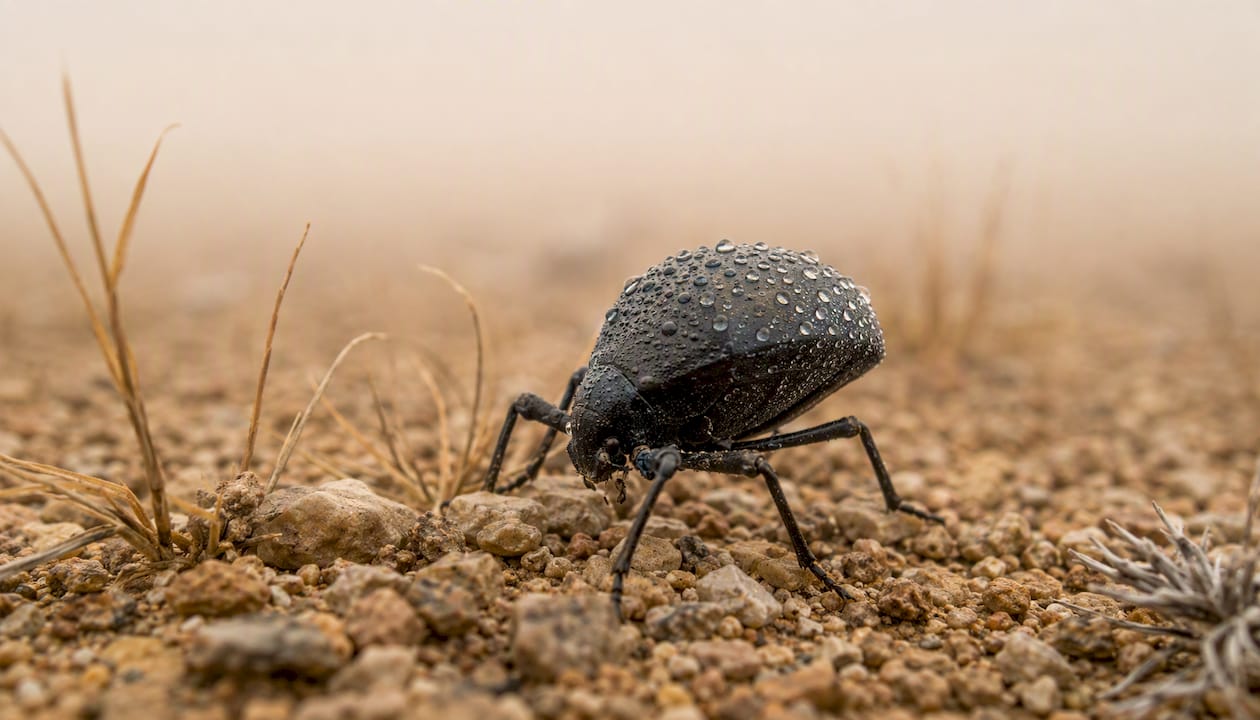
The fog factor deserves a special mention. Along the coastal Namib, Atlantic fog rolls inland on roughly 60 days a year, and entire communities of invertebrates and reptiles have built their survival around it. The Namib Desert beetle tilts its body into the wind to condense droplets on its back. Peringuey’s adder buries itself in dune sand and ambushes prey from below. These are not curiosities — they are evolutionary solutions to one of the harshest environments on the planet.
Profiles of Namibia’s most unique and desert-adapted species
Wildlife of Namibia is defined as much by what animals do as by what they look like. The profiles below focus on the single most distinctive trait for each species, paired with where you can realistically see them.
Species | Where to see | Unique adaptation | Typical habitat | Conservation status | Best season / tip |
|---|---|---|---|---|---|
Desert-adapted elephant | Damaraland, Kunene | Walks up to 70 km/day for water; wider feet for sand | Dry riverbeds, rocky desert | Not separately listed (African elephant: Vulnerable) | May–October; guided riverbed walks |
Desert-adapted lion | Kunene, Skeleton Coast | Coastal scavenging; enormous home ranges | Desert plains, coastline | Critically small population | Year-round; concession-only access |
Black rhino | Palmwag, Etosha NP | Browser; uses dense bush for cover; nocturnal in heat | Thornbush, rocky terrain | Critically Endangered (IUCN) | May–September; tracker-led |
Cheetah | Farmlands, private reserves | Fastest land animal; hunts by day | Open savanna, farmland | Vulnerable (IUCN) | Dry season; dawn drives |
Gemsbok (oryx) | Namib Desert, Etosha | Tolerates core body temp of 45°C; counter-current cooling | Desert, semi-arid plains | Least Concern | Year-round |
Pangolin | Kavango-Zambezi, Etosha surrounds | Keratin scales; rolls into a ball; nocturnal | Woodland, savanna | Critically Endangered (IUCN) | Night drives, year-round |
Meerkat | Kalahari, southern Namibia | Sentinel alarm system; immune to some venoms | Semi-arid scrub | Least Concern | Morning; habituated groups |
Namaqua chameleon | Coastal Namib gravel plains | Colour shifts for thermoregulation, not camouflage | Gravel desert | Least Concern | Morning; Living Desert tours |
Hartmann’s mountain zebra | Naukluft, Damaraland | Navigates cliff faces; narrower hooves than plains zebra | Rocky highlands | Vulnerable (IUCN) | Year-round; morning drives |
Namib Desert beetle | Coastal Namib near Swakopmund | Fog-basking: condenses water on textured back | Coastal dune fields | Not assessed | Early morning fog days |
Desert-adapted elephant
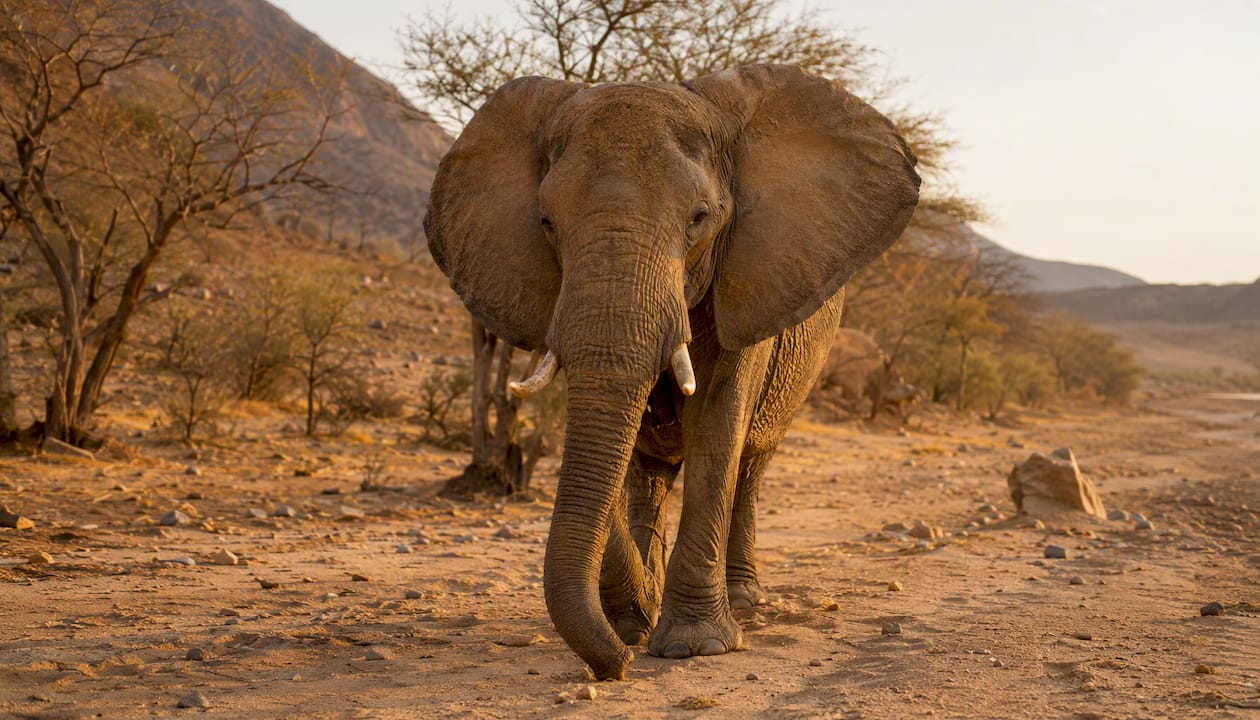
These are not a separate subspecies, but their behaviour has diverged so dramatically from savanna elephants that they function almost as a different animal. They travel extraordinary distances along dry riverbeds, extract moisture from vegetation when surface water disappears for weeks, and have developed broader, softer foot pads that distribute weight across loose sand. Damaraland and the Kunene region are the places to find them, and a guided riverbed walk with a local tracker turns what could be a distant sighting into something genuinely intimate.
Desert-adapted lion
The desert lions of Kunene and the Skeleton Coast are among the rarest large predators on Earth. Small prides roam territories measured in thousands of square kilometres, and some individuals have been documented scavenging Cape fur seals directly from the beach — a behaviour recorded nowhere else for lions. Access requires a concession permit or a guided stay at a specialist camp; you cannot simply drive in and hope.
Black rhino
Namibia holds one of the world’s most significant populations of black rhino (Diceros bicornis), concentrated in the Palmwag concession and Etosha National Park. Tracking them on foot with a ranger and a local tracker is a genuinely rare experience — trackers document individual animals by spoor and avoid vehicle habituation to reduce poaching risk. The Palmwag concession runs dedicated rhino monitoring programmes, and a stay at Desert Rhino Camp puts you directly inside that work.
Cheetah
Namibia hosts one of the largest free-ranging cheetah populations on the continent, and the majority live outside formal parks on commercial farmland. The WWF notes that human-wildlife conflict is a persistent pressure, which is why conservancy-linked cheetah programmes that compensate farmers for livestock losses have been so significant for the species’ survival here. Dawn game drives on private reserves give the best sighting chances — cheetah hunt in daylight and are active in the cool of early morning.
Gemsbok (oryx)
The gemsbok is Namibia’s national animal, and it earns that status. Its ability to tolerate a core body temperature of 45°C — using a counter-current heat exchange system in its nasal passages to cool blood before it reaches the brain — makes it one of the most physiologically remarkable large mammals in Africa. You will see gemsbok almost anywhere in Namibia, from the red dunes of Sossusvlei to the open pans of Etosha, their long straight horns cutting a silhouette that is instantly recognisable.
Pangolin
Seeing a pangolin in the wild is genuinely rare, and Namibia is one of the better places to try. These nocturnal, scale-covered mammals are among the most heavily trafficked animals on Earth, which makes every sighting a privilege. Night drives in the Kavango-Zambezi region and around Etosha’s eastern edges offer the best odds. Their defence — rolling into a tight ball — is effective against most predators but catastrophically ineffective against humans, which is the core of their conservation problem.
Meerkat
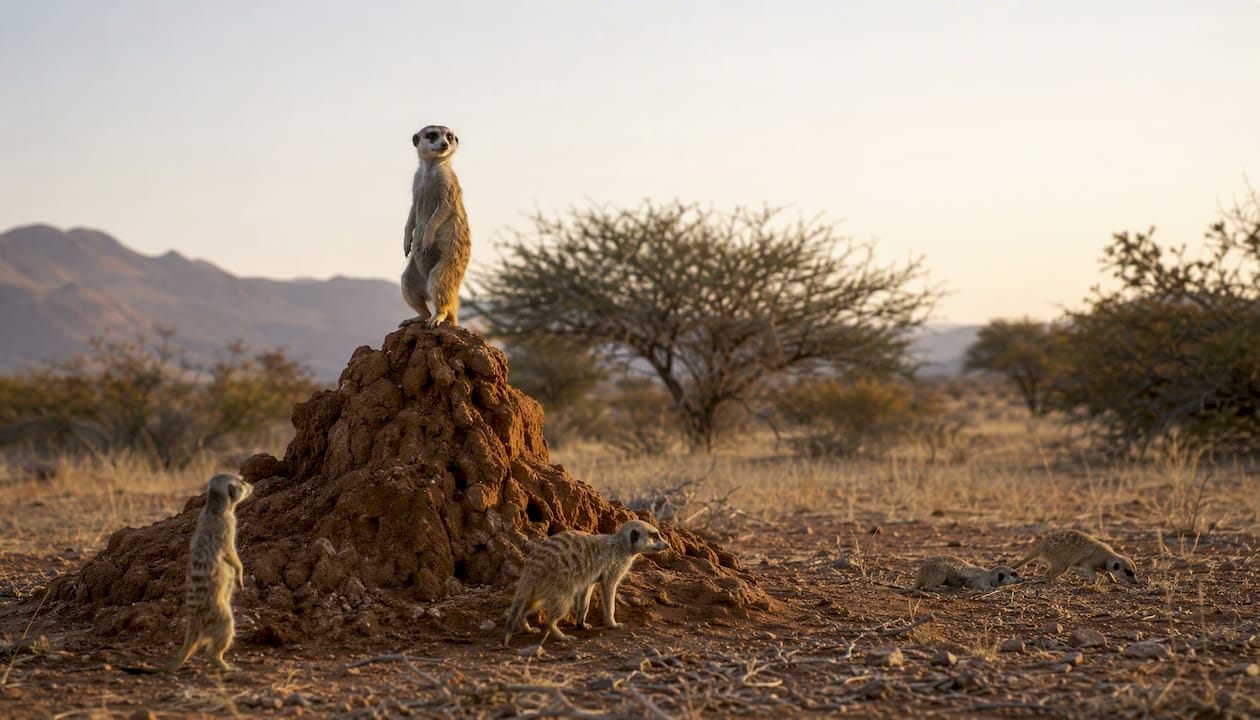
Watching a meerkat colony emerge at dawn, the sentinels climbing the nearest termite mound to scan for raptors while the rest forage below, is one of the most entertaining wildlife spectacles in southern Africa. Habituated groups in the Kalahari and southern Namibia allow close approach, and their immunity to certain scorpion venoms and snake toxins makes them fascinating subjects for anyone interested in animal behaviour.
Namaqua chameleon
Most people assume chameleons change colour for camouflage. The Namaqua chameleon (Chamaeleo namaquensis) does it primarily for thermoregulation — darkening its skin in the cold morning air to absorb heat, then lightening as the day warms. Living Desert tours from Swakopmund and Walvis Bay are the most reliable way to find them on the coastal gravel plains, usually in the first two hours after sunrise.
Hartmann’s mountain zebra
Narrower hooves and a more agile build than their plains cousins allow Hartmann’s mountain zebra to navigate the rocky escarpments of the Naukluft and Damaraland highlands with surprising confidence. They are classified as Vulnerable by the IUCN, and Namibia holds the core of their global range. Morning drives in the highlands, when they descend to drink, give the best views.
Namib Desert beetle
The fog-basking behaviour of Onymacris beetles has been studied by materials scientists and engineers for its potential applications in water collection technology. On fog mornings near Swakopmund, you can watch them tilt their bodies into the wind and collect droplets that run down to their mouthparts. It is a small thing, but it is one of the most elegant adaptations in the natural world.
Pro Tip: Hire a specialist Living Desert guide from Swakopmund for small desert endemics — they know exactly which dune slipfaces to check for Peringuey’s adder tracks and which gravel plains hold Namaqua chameleons at first light. Standard park drives will not find these animals.
Where to see Namibia’s unique animals: parks and private reserves
The best wildlife experiences in Namibia are rarely the ones you stumble upon. They are the ones you plan around specific habitats and species, often with access to private concessions that standard park entry simply cannot provide.
Top locations at a glance:
Etosha National Park — black rhino at floodlit waterholes, gemsbok, lion, cheetah, elephant; best May–October
Palmwag concession (Damaraland) — desert rhino tracking on foot, desert-adapted elephant, desert lion; year-round with specialist guides
Skeleton Coast — desert-adapted lion, brown hyena, Cape fur seals, coastal birds; fly-in access recommended
Kunene region — desert elephant herds in dry riverbeds, desert lion prides; remote, requires guided concession access
Namib Desert / Sossusvlei region — gemsbok, Hartmann’s mountain zebra, Namaqua chameleon, Namib Desert beetle; Living Desert tours from Swakopmund
Kavango-Zambezi (Bwabwata NP and surrounds) — pangolin, wild dog, hippo, endemic waterbirds; wet season transforms the floodplains
Kalahari (southern Namibia) — meerkat colonies, black-maned Kalahari lion, gemsbok; year-round
Private reserves and concessions: why they matter
National parks give you access. Private reserves and community concessions give you experience. The distinction is significant. Inside Etosha, you drive on public roads with other vehicles and stop at shared waterholes. Inside a private concession like Palmwag or the Skeleton Coast concession, you have exclusive access to vast tracts of wilderness, the ability to go off-road, and the services of trackers who have spent years reading the specific landscape you are in.
Private reserves in Namibia typically offer:
Exclusive game drives with no other vehicles, allowing extended time with a sighting
Walking safaris and tracking — the only way to find desert rhino or read elephant spoor in a dry riverbed
Fly-in access to remote areas that road travel cannot reach in a reasonable timeframe
Conservation participation — many concessions run ranger programmes, game counts, and anti-poaching patrols that guests can observe or contribute to
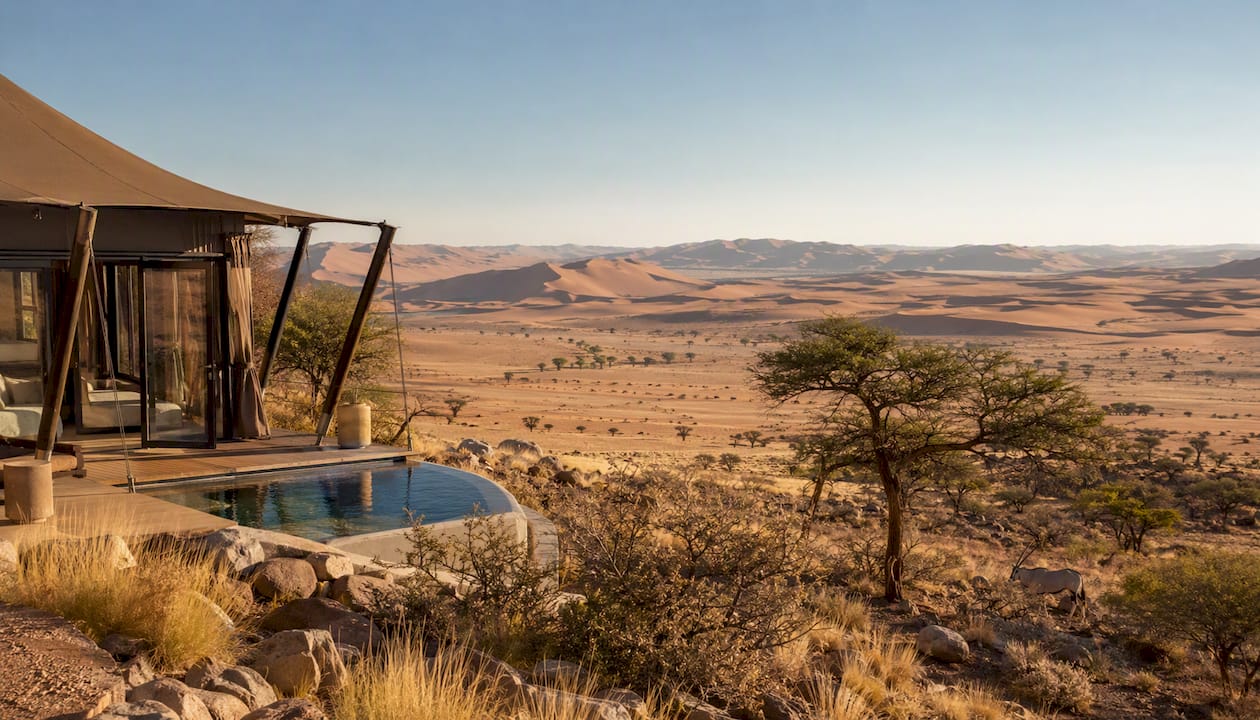
Accommodation in these concessions ranges from tented camps with open-air showers and canvas walls to architecturally striking lodges built from local stone and reclaimed timber. The design philosophy across Namibia’s best properties tends toward understated luxury: nothing that competes with the landscape, everything that frames it. For a curated overview of top lodge options, the luxury safari lodges guide covers the properties worth considering across different regions.
The rarest animals in Namibia and how you can help
Black rhino, pangolin, and desert-adapted lion are the three species where visitor choices make the most direct difference. Black rhino remain Critically Endangered despite Namibia’s conservation successes; pangolin are among the most trafficked mammals globally; and desert lion populations in Kunene are so small that individual animals are named and tracked by researchers.
The threats are specific: poaching for horn and scales, retaliatory killing by farmers protecting livestock, and drought compressing prey availability for lions into ever-smaller areas. Climate pressure is making the desert harder, not easier, for these animals.
Concrete actions you can take as a visitor:
Choose conservancy-based or concession-based tours where your fees fund ranger salaries, game counts, and anti-poaching patrols directly
Stay at joint-venture lodges where a portion of revenue flows to the local community — this creates an economic argument for wildlife that competes with poaching income
Buy crafts and produce from conservancy community markets rather than roadside vendors with no conservation link
Follow your guide’s instructions on approach distances and vehicle positioning — habituation to vehicles can increase poaching risk for individually known animals like desert rhino
Donate to vetted programmes such as Save the Rhino Trust Namibia or the Cheetah Conservation Fund, both of which operate directly in the field
Pro Tip: Ask your lodge or tour operator which specific conservancy their fees support and what percentage goes directly to community programmes. Reputable operators will answer this without hesitation. If they cannot, that tells you something important.
How Namibia’s conservancy model changed wildlife outcomes
The single most important conservation innovation in Namibia’s recent history is the communal conservancy system, formalised in 1998. Before it, wildlife on communal land had little value to local communities — it competed with livestock, damaged crops, and occasionally killed people, with no economic return. The conservancy model changed that by giving communities legal rights over wildlife and the revenue it generates, creating a direct financial incentive to protect rather than eliminate it.
The results have been significant. Rhino, elephant, and lion populations have recovered in areas where they had been locally extirpated. Communities conduct their own game counts, run anti-poaching patrols, and manage tourism concessions. The MEFT documents that Namibia’s 644 bird species include 13 endemics, and its 217 mammal species include 26 found nowhere else — figures that reflect the health of a system where wildlife has genuine economic value at the community level.
Conservation by the numbers: Namibia places a significant portion of its land under conservation management, combining national parks, private reserves, and community conservancies into landscape-scale corridors.
How conservancies work in practice:
Local communities elect a conservancy committee that governs wildlife management and tourism revenue
Joint-venture agreements with lodge operators bring infrastructure investment and guaranteed income streams
Game counts and camera trap networks provide data that feeds into national population assessments
Tourism revenue funds schools, clinics, and water infrastructure — making conservation tangibly beneficial to daily life
When you choose a conservancy-linked itinerary, you are not just buying a wildlife experience. You are funding the system that makes those animals worth protecting.
How to plan a wildlife-focused Namibia trip to see these species
The single most important planning decision you will make is choosing conservancy or private concession-based itineraries over standard park-only routes. Desert specialists — rhino, desert lion, desert elephant — have enormous home ranges and leave subtle signs that disappear quickly in arid conditions. Local trackers read those signs in ways that no amount of self-drive experience can replicate.
Sample itinerary options:
4 days, Damaraland focus — desert rhino tracking at Palmwag, desert elephant in the Huab riverbed, Twyfelfontein rock art; fly in from Windhoek
5 days, Etosha and surrounds — black rhino at floodlit waterholes, cheetah on dawn drives, gemsbok and lion at the pan; self-drive or guided
6 days, Skeleton Coast and Kunene — desert lion with a specialist guide, Cape fur seal colonies, coastal brown hyena; fly-in only for remote sections
7 days, combined north and south — Sossusvlei for gemsbok and Namaqua chameleon, Etosha for big mammals, Damaraland for desert specialists
Packing essentials:
High-SPF sun protection and a wide-brimmed hat (desert sun is unforgiving)
Quality binoculars — 8x42 or 10x42 for open plains; essential for spotting gemsbok at distance
Camera with a 400mm+ lens for wildlife; a wide-angle for landscapes
Lightweight layers — desert mornings drop sharply even in summer
Dust-proof bag for camera gear on gravel roads
Timing: May through October is the prime window for most big-game viewing. Waterholes concentrate animals in the dry season, and cooler temperatures mean animals are active longer into the morning. The Kavango-Zambezi wetlands are best visited November through April when the floodplains fill and waterbirds arrive in numbers.
Pro Tip: For remote desert specialists, fly-in safaris are not a luxury — they are a practical necessity. A flight from Windhoek to Palmwag takes 90 minutes; the same journey by road takes the better part of a day on corrugated gravel tracks. The time you save goes directly into the field.
Key physical and behavioural adaptations of Namibia’s unique animals
What separates Namibia’s wildlife from what you will find elsewhere in Africa is not just rarity — it is the specificity of adaptation. Each species has solved the desert’s problems in a different way.
Desert-adapted elephant: Reduced body mass compared to savanna populations, broader foot pads, and a learned knowledge of dry-season water sources passed between generations. Calves learn the routes; the knowledge is cultural as much as genetic.
Desert-adapted lion: Extended home ranges (some prides cover over 1,000 km²), reduced pride sizes, and documented dietary flexibility that includes marine mammals. Their coats tend to be slightly paler than savanna lions, likely a heat-reflection adaptation.
Black rhino: A prehensile upper lip that grasps and strips branches — the defining difference from white rhino, which graze with a wide, flat mouth. Black rhino are browsers, which means dense thornbush is habitat, not obstacle.
Cheetah: The only cat that cannot fully retract its claws, giving it the grip of a sprinter’s spikes. Its enlarged nasal passages allow rapid oxygen intake during a chase that can reach 112 km/h but lasts only 20–30 seconds before the animal overheats.
Gemsbok: The counter-current carotid rete — a network of fine blood vessels in the nasal passages — cools arterial blood before it reaches the brain, allowing the body temperature to rise to levels that would cause brain damage in most mammals.
Pangolin: Keratin scales cover everything except the belly and inner limbs. When threatened, the animal curls into a ball so tight that a lion cannot prise it open. The scales are the same material as human fingernails.
Meerkat: A dark patch of skin around the eyes reduces glare, functioning like a built-in pair of sunglasses. Their immune system tolerates scorpion venom that would hospitalise a human.
Namaqua chameleon: Independently mobile eyes give 360-degree vision without moving the head. The colour-change mechanism is controlled by chromatophores in the skin, responding to temperature and social signals rather than background colour.
Hartmann’s mountain zebra: A dewlap (a fold of skin under the throat) distinguishes them from plains zebra. Their hooves are harder and narrower, shaped for rocky terrain rather than soft grassland.
Namib Desert beetle: The textured surface of its back — a pattern of hydrophilic bumps and hydrophobic troughs — passively collects fog droplets and channels them toward the mouth. Engineers have studied this structure for applications in water harvesting in arid regions.
Ethical wildlife viewing in Namibia: what responsible visitors do differently
Namibia’s wildlife is extraordinary precisely because it has been given space. Keeping it that way depends partly on how visitors behave in the field.
Distance and approach: Never pressure your guide to get closer than they judge appropriate. For desert rhino in particular, vehicle habituation increases poaching risk — animals that associate vehicles with safety are easier targets. The National Geographic field reports on desert rhino tracking make clear that responsible operators deliberately limit vehicle exposure for this reason.
Off-road driving: In the Namib Desert, a single vehicle track can persist for decades. Stay on designated tracks unless your guide explicitly directs otherwise in a licensed concession area.
Flash photography: Avoid flash at night drives. It disorients nocturnal animals and can cause dangerous stress responses, particularly in pangolin and aardvark.
Noise and patience: Desert specialists are often located by sound — a distant alarm call, the crunch of gravel under a heavy foot. Silence in the vehicle dramatically increases your chances of a meaningful sighting.
Feeding: Never offer food to any wild animal, including meerkat. Habituated animals that associate humans with food lose their natural wariness and often end up in conflict situations that result in their removal or death.
Supporting the right operators: Choose operators who are members of the Namibia Tourism Board and who can demonstrate a direct link to a registered conservancy. The sustainable stays guide is a useful starting point for identifying properties with genuine conservation credentials.
Why Namibia feels genuinely different as a wildlife destination
There is a quality to Namibia’s silence that you do not find anywhere else in Africa. Standing in a dry riverbed in Damaraland at first light, with fog still clinging to the mountains and the spoor of an elephant pressed into the sand at your feet, you understand something about scale and solitude that no amount of reading prepares you for. The animals here have not been compressed into a small park and habituated to a convoy of vehicles. They have space — real, geological space — and their behaviour reflects it. A desert lion here is not performing for tourists. It is simply living, on its own terms, in one of the harshest environments on Earth. That is what makes Namibia worth the journey.
Plan your Namibia wildlife safari with Secretnamibia
Secretnamibia arranges conservation-focused safaris built around the species and habitats covered in this guide — not generic itineraries, but trips designed around what you actually want to see and the conservancies best placed to deliver it.
Two clear options: enquire for a private conservancy trip to Palmwag, Kunene, or the Skeleton Coast, where joint-venture lodges channel revenue directly to local communities and ranger programmes; or browse curated itineraries that combine Etosha’s waterhole drama with the raw remoteness of Damaraland. Every itinerary includes specialist guide access, and fly-in options are available for the most remote desert destinations. When you travel through a conservancy-linked property, your stay funds the game counts, anti-poaching patrols, and community infrastructure that keep these animals wild. Enquire about your Namibia safari and tell the team which species are on your list.
Sources
Tracking Namibia’s desert rhinos in the storms of a decade — National Geographic
Lessons on the Community Conservancy Model for Wildlife Protection in Namibia — Sage Journals
Their resilience is a lesson to us all: desert lions take to the sea — The Namibian
Recommended
相关
萨法里指南
2025年10月30日
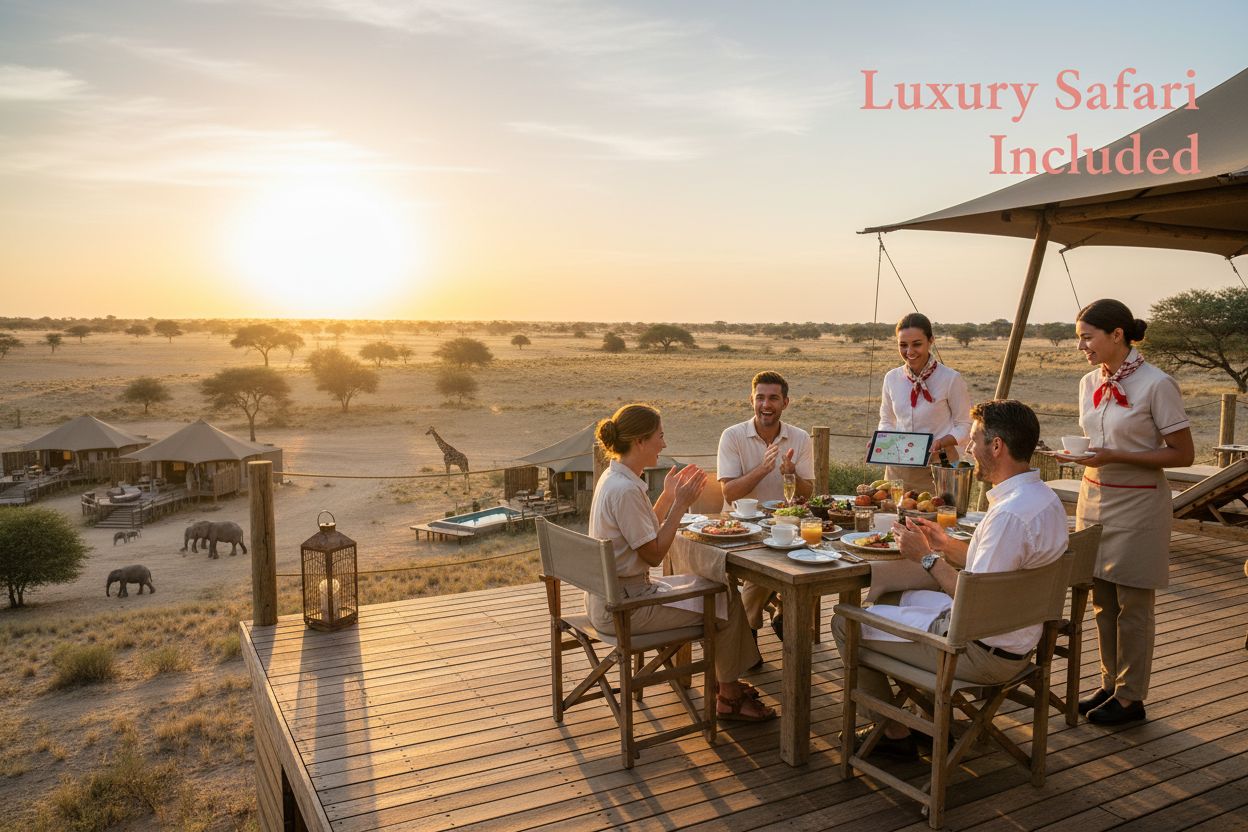
Understanding What is Included in Luxury Safaris
Explore what is included in luxury safaris, from exclusive accommodations to bespoke experiences that cater to discerning travelers.
2026年2月24日
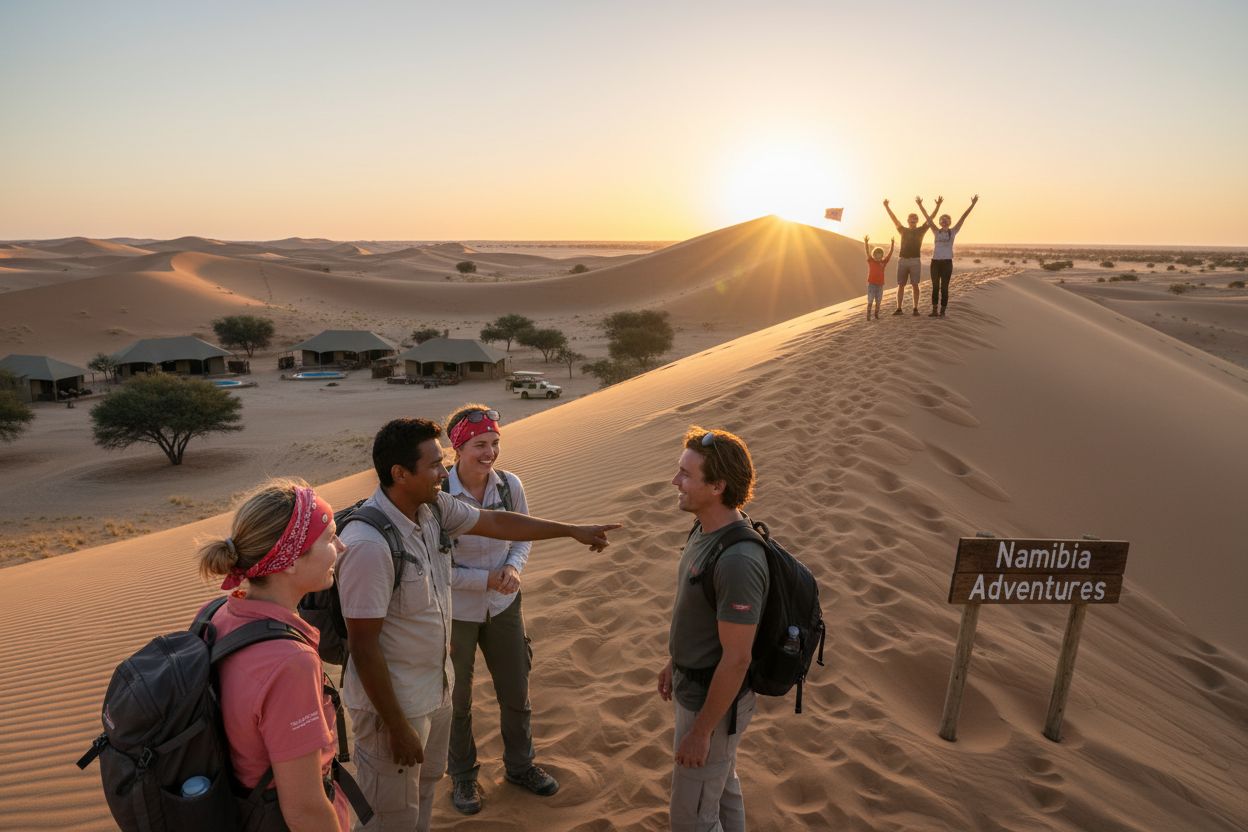
Why Namibia Adventures Matter: An In-Depth Look
Discover why Namibia adventures are essential for luxury travelers seeking unique, immersive experiences in nature and wildlife exploration.
2026年2月23日
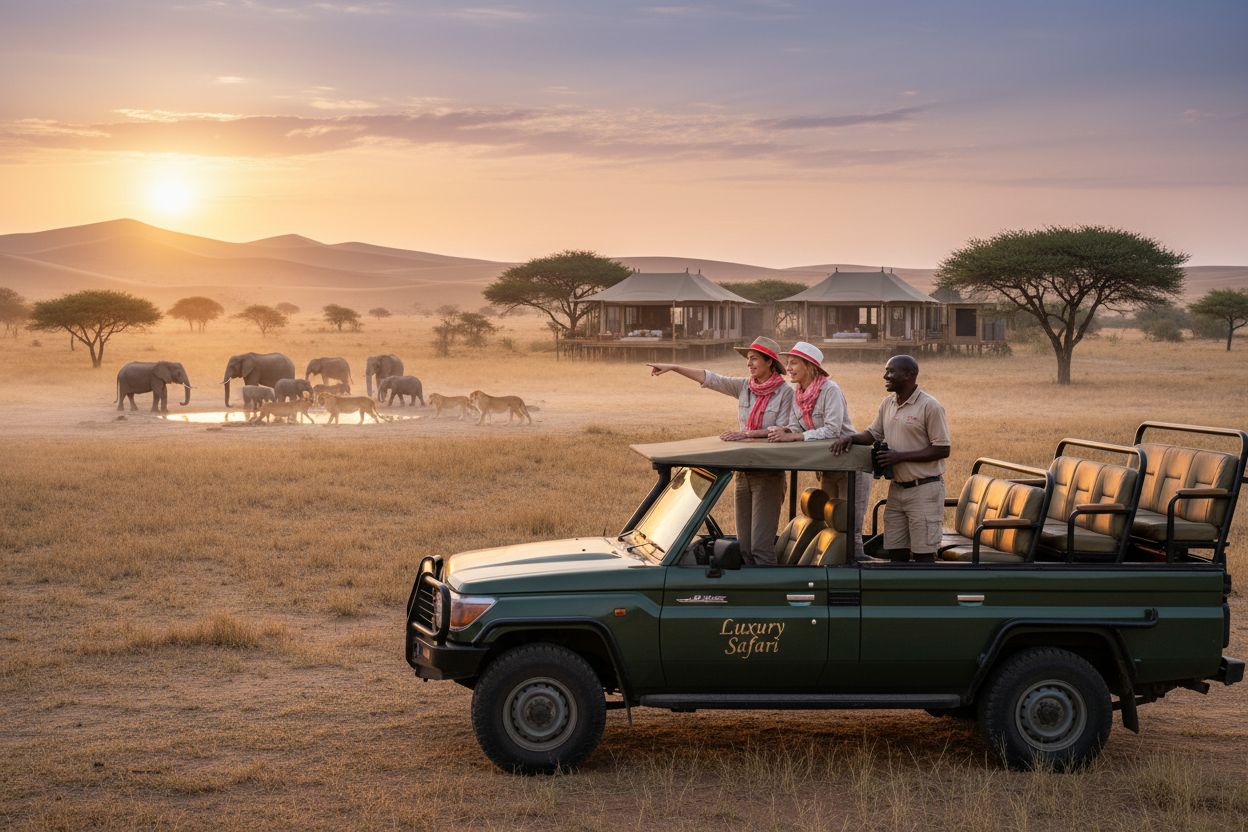
What to Expect on a Luxury Safari: A Comprehensive Guide
Discover what to expect on a luxury safari and gain a deeper understanding of the unique experiences that await you in the wild.
2026年2月22日
Understanding Namibia Safari Costs Explained
Explore Namibia safari costs explained to uncover what influences pricing and what it means for your adventure.
2026年2月21日
Understanding the Role of Safari Experts in Wildlife Travel
Explore the role of safari experts and gain a comprehensive understanding of how they enhance wildlife travel experiences for all types of travelers.
2026年2月20日
Guide organisation safari all inclusive : vivez l'aventure de vos rêves
Découvrez notre guide organisation safari all inclusive étape par étape pour planifier un voyage inoubliable au cœur de la nature.