
Aug 15, 2026
Explore Africa's best safari locations, from the Serengeti's migrations to gorilla trekking in Rwanda, for unforgettable luxury adventures.
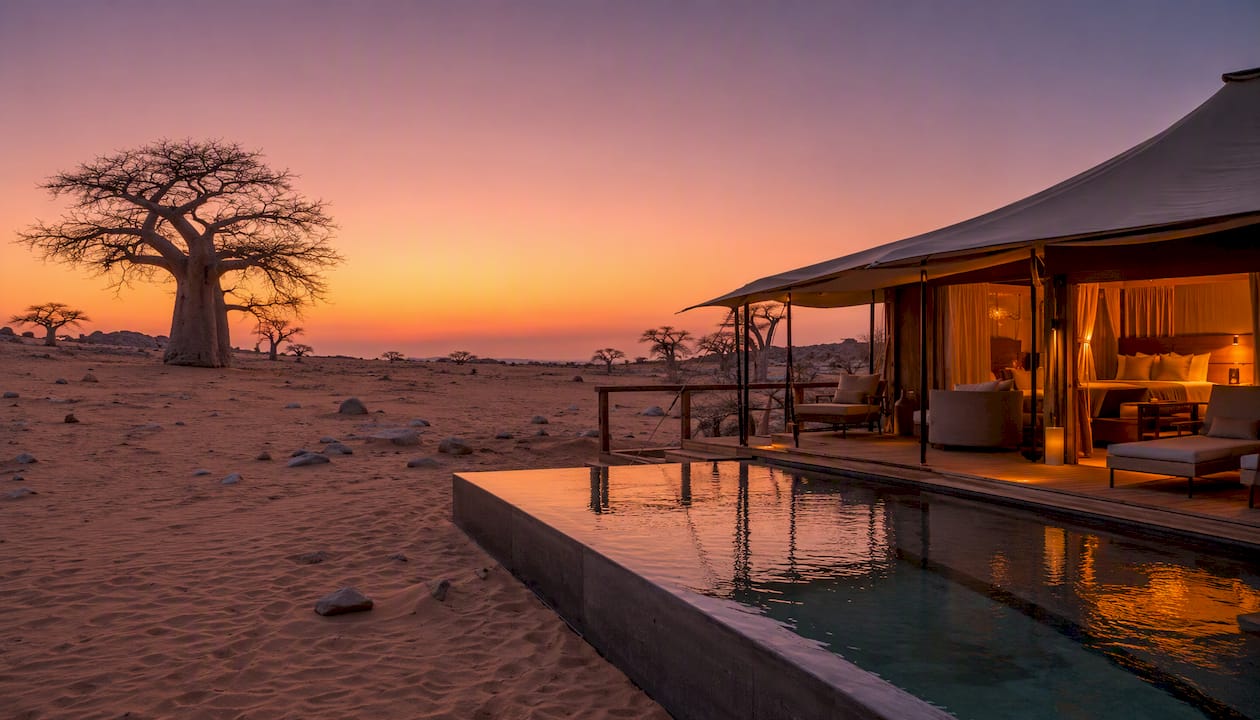
Top safari locations for luxury and adventure travellers
Africa’s finest wildlife destinations form a shortlist that serious travellers return to again and again: the Serengeti for sheer migration spectacle, the Masai Mara for river crossings and predator density, Ngorongoro Crater for concentrated Big Five viewing, the Okavango Delta for water-based exclusivity, Chobe for elephant theatre, Kruger for accessible self-drive value, Etosha for dramatic waterhole encounters, and the mountain forests of Rwanda and Uganda for gorilla trekking unlike anything else on the continent. For Namibia specifically, Secretnamibia is the specialist for bespoke private-reserve and luxury fly-in itineraries across this remarkable country.
Here is a quick-reference shortlist to orient your planning:
Serengeti National Park, Tanzania — the Great Migration’s heartland, vast open plains, and year-round Big Five sightings across approximately 14,700 sq km
Masai Mara National Reserve, Kenya — the definitive address for Mara River crossings (July–September) and extraordinary predator density
Ngorongoro Crater, Tanzania — a collapsed volcanic caldera that functions as a natural Big Five enclosure, compact and photogenic
Okavango Delta, Botswana — Africa’s inland delta, celebrated for mokoro trips, walking safaris, and a strict low-volume tourism model
Chobe National Park, Botswana — home to some of the continent’s largest elephant concentrations and superb sunset river cruises
Kruger National Park, South Africa — the most logistically accessible Big Five destination, with self-drive roads and world-class private reserves on its borders
Etosha National Park, Namibia — a salt-pan ecosystem where waterholes become natural theatres for wildlife viewing
Volcanoes NP (Rwanda) / Bwindi (Uganda) — the only places on earth where you can track mountain gorillas on foot through ancient forest
Key takeaways
Africa’s best safari locations each serve a different travel priority, and matching destination to goal is the single most reliable way to plan a trip you will want to repeat.
Point | Details |
|---|---|
Match destination to goal | Migration spectacle points to Serengeti or Masai Mara; exclusivity points to Okavango Delta or Namibia private reserves. |
Budget shapes your options | Luxury private safaris run —; mid-range group itineraries typically cost — per person. |
Book peak season early | Mara river-crossing camps and gorilla permits sell out 8–12 months ahead; plan long-lead bookings for July–September. |
Health prep is non-negotiable | Hepatitis A/B, typhoid, and malaria prophylaxis are standard; yellow fever certificates may be required depending on routing. |
Secretnamibia for Namibia | Secretnamibia specialises in bespoke private-reserve and fly-in luxury itineraries across Namibia and Southern Africa. |
Table of Contents
How do you choose the best safari location for your priorities?
What makes the Serengeti one of the world’s great safari spots?
Is the Masai Mara better than the Serengeti?
Ngorongoro Crater — a compact Big Five theatre
Why is the Okavango Delta so special for luxury safaris?
Chobe National Park — elephant country and river safaris
Kruger National Park — self-drive value and private-reserve luxury
Etosha National Park — Namibia’s waterhole theatre
Gorilla trekking in Rwanda and Uganda — a different kind of safari
Why Namibia stands out — and what Secretnamibia offers
What to expect on safari — daily rhythm, safety, and health
How much does an African safari cost?
Why bespoke private-reserve safaris appeal to affluent travellers
Plan your Namibia safari with Secretnamibia
Sources
How do you choose the best safari location for your priorities?
The single most useful decision rule: match your destination to your primary experience goal, not to a ranked list. A migration spectacle and a gorilla trek are incomparable experiences, and the “best” destination is the one that delivers what you actually came for.
Work through this checklist before you book:
Great Migration spectacle — Serengeti (year-round presence, calving January–February in the south) or Masai Mara (river crossings July–September)
First-time Big Five efficiency — Tanzania’s Northern Circuit (Serengeti, Ngorongoro, Tarangire) is the highest-probability 7-day itinerary for first-timers
Water-based and walking safaris — Okavango Delta, where mokoro trips and guided walks define the experience
Malaria-free family travel — private reserves bordering Kruger in South Africa’s Limpopo and Mpumalanga provinces offer malaria-free options with excellent infrastructure
Gorilla trekking — Volcanoes National Park (Rwanda) for the smoothest logistics, or Bwindi Impenetrable Forest (Uganda) for a wilder, more remote experience
Remote luxury and exclusivity — Okavango Delta private concessions or Namibia’s private reserves, where vehicle density is deliberately kept low
Questions worth asking your operator before you book
Before committing to any itinerary, put these to your planner:
What is the vehicle-to-guide ratio on game drives?
Are off-road drives and night drives permitted in this reserve?
Is this a national park or a private concession, and what does that mean for exclusivity?
What are the conservancy or concession fees on top of accommodation?
How far is the nearest airstrip, and is the transfer by charter or road?
What is the cancellation and rebooking policy for peak-season dates?
Are gorilla or chimpanzee permits already secured, or is that my responsibility?
Which months does this camp close, and what is the shoulder-season trade-off?
Red flags to watch for
Vague answers about park fees vs conservancy fees (they are separate costs that add up fast)
No mention of vehicle limits per sighting or per game drive
Transfer logistics described as “flexible” without a named airstrip or road time
Why private game reserves change the equation
Private reserves and concessions operate outside national park rules. That means night drives, off-road tracking, walking safaris with armed guides, and a single vehicle per sighting. Vehicle density drops dramatically. For Namibia’s private reserves, Secretnamibia’s private reserve planning expertise is specifically built around these advantages.
Pro Tip: If you are torn between two destinations, ask your operator which one has fewer vehicles per sighting during your travel window. That single metric predicts photographic quality and emotional impact better than any ranking.
What makes the Serengeti one of the world’s great safari spots?
Tanzania’s Serengeti covers approximately 14,700 sq km of open savanna, making it one of Africa’s largest national parks and the reason vehicle density stays manageable even during peak migration days. The ecosystem supports the full Big Five alongside cheetah, wild dog, and hundreds of bird species.
Best for: Great Migration year-round, wide-angle plains photography, predator action, and first-time luxury safaris.
Calving season (January–February): Southern Serengeti and Ndutu area; thousands of wildebeest calves born within weeks, drawing lion, cheetah, and hyena in spectacular numbers
River crossings (July–October): Northern Serengeti near the Mara River; the most dramatic and photographed wildlife event on the continent
Year-round Big Five: Lions, leopard, elephant, buffalo, and rhino (black rhino in lower numbers) present throughout the ecosystem
Access: Fly into Kilimanjaro International Airport or Julius Nyerere International (Dar es Salaam), then connect to Arusha. From Arusha, charter flights reach Serengeti airstrips in roughly 45–60 minutes. Road transfers from Arusha take 6–8 hours and are generally reserved for budget itineraries.
Accommodation: Permanent luxury lodges on the central plains, seasonal mobile camps that follow the migration north, and private concession tented camps with butler service and private plunge pools.
Pro Tip: Position yourself in the southern Serengeti (Ndutu) for calving, the central Seronera area for year-round predator density, and the far north (Kogatende) for river crossings. Booking the same trip across two zones gives you two entirely different experiences.
Is the Masai Mara better than the Serengeti?
The Masai Mara covers roughly 1,500 sq km, a fraction of the Serengeti’s size, which concentrates wildlife and vehicles alike. For river crossings, there is nowhere better on earth. For year-round migration presence and solitude, the Serengeti wins.
Best for: Mara River crossings (July–September), lion and leopard photography, and travellers who want maximum predator density in a compact area.
Prime season (July–September): Wildebeest cross the Mara River in their hundreds of thousands; crossings can happen multiple times a day and are entirely unpredictable, which is part of the drama
Predator density: The Mara’s lion prides and leopard population are among the most studied and photographed in Africa
Private conservancies: Areas like Olare Motorogi and Naboisho sit adjacent to the reserve and charge additional daily fees of additional daily fees of about $100 to $170 per person on top of accommodation, but they deliver dramatically lower vehicle density and permit night drives
Access: Fly into Nairobi’s Jomo Kenyatta International Airport, then take a 45-minute charter flight to one of several Mara airstrips. Road transfers from Nairobi take approximately 5–6 hours.
Accommodation: Public reserve camps (busy, no night drives), private conservancy camps (quieter, full guiding privileges), and luxury tented lodges with river frontage.
The honest comparison: if you have one trip and want the crossing spectacle between July and September, book the Mara. If you want a longer migration window, lower vehicle counts, and a more varied landscape, the Serengeti’s scale works in your favour. Peak Mara lodges and conservancy inventory can close 8–12 months ahead of the July–September high season, so plan accordingly.
Ngorongoro Crater — a compact Big Five theatre
The Ngorongoro Crater is a collapsed volcanic caldera roughly 19 km across, sheltering a self-contained ecosystem of grassland, forest, and soda lake. Wildlife cannot easily leave, which means density is extraordinary: lion, elephant, buffalo, hippo, and one of Africa’s last remaining populations of black rhino all share this single bowl of landscape.
Best for: Guaranteed Big Five viewing in a single day, photographic convenience, and travellers combining it with the Serengeti on a Northern Circuit itinerary.
Seasonality: The crater is accessible year-round. The short rains (November–December) bring lush green scenery and fewer visitors; the dry season (June–October) concentrates animals around the crater floor’s water sources
Access: Approximately 3 hours by road from Arusha, or a short charter flight to Manyara airstrip followed by a road transfer. Most visitors combine it with the Serengeti on a 7–10 day Northern Circuit
Accommodation: Crater rim lodges with dramatic views into the caldera, and camps in the Ngorongoro Conservation Area; note that overnight stays inside the crater floor are not permitted
Pro Tip: Descend into the crater as early as possible, ideally at first light. The crater floor gets busy by mid-morning, and the best predator activity happens in the cool hours before 9 AM.
Why is the Okavango Delta so special for luxury safaris?
The Okavango Delta is an inland delta in northern Botswana, fed by the Okavango River and spreading across a vast floodplain that fills seasonally, peaking between June and August. It is one of the few places in Africa where water-based game viewing, mokoro (dugout canoe) trips, and guided walking safaris combine with a strict low-volume tourism policy that keeps the experience genuinely intimate.
Best for: Water-based game viewing, walking safaris, intimate photography, and travellers who prioritise exclusivity above all else.
Flood season (June–August): Water levels peak, islands emerge, and wildlife concentrates on higher ground; mokoro trips through papyrus channels are at their finest
Green season (November–March): Fewer visitors, lower rates, lush vegetation, and exceptional birding
Access: Fly into Maun, then take a charter flight (15–45 minutes depending on camp location) to a bush airstrip. There are no road options for most camps; the fly-in model is part of what keeps the Delta exclusive
Accommodation: Private concession camps with 6–12 guests maximum, luxury tented suites on raised platforms, and mobile camps that shift with the water
Botswana’s deliberate low-volume, high-value tourism policy means top Delta lodges are priced at premium lodge pricing ranging from approximately $1,200 to $2,500 per person per night. High-end travellers consistently accept that premium in exchange for private vehicles, walking safaris with expert guides, and the near-certainty of having a sighting entirely to themselves.
Pro Tip: Combine the Okavango with Chobe National Park on a single Botswana itinerary. The two parks are a short charter flight apart and offer completely different ecosystems: water and papyrus versus riverine woodland and open floodplain.
Chobe National Park — elephant country and river safaris
Chobe sits in northern Botswana, bordering Zimbabwe and Zambia, and is famous for the largest elephant population of any national park in Africa. The Chobe River frontage is the defining feature: during the dry season (May–October), tens of thousands of elephants converge on the river, and boat safaris bring you within metres of herds drinking and swimming.
Best for: Large elephant herds, sunset river cruises, accessible day trips from Victoria Falls, and travellers wanting a short, high-impact add-on to a longer itinerary.
Dry season (May–October): Animals concentrate along the river; boat safaris deliver extraordinary elephant and hippo encounters
Wet season (November–April): Wildlife disperses into the interior; the Savuti area becomes productive for predator sightings
Access: Kasane is the gateway town, a short road transfer from Victoria Falls (Zimbabwe/Zambia side). Many travellers combine a Victoria Falls stop with 2–3 nights in Chobe
Accommodation: Riverside lodges in Kasane, private concession camps in the Chobe Enclave, and day-trip options from Victoria Falls hotels
Pro Tip: Book your river cruise for late afternoon. The golden light between 4 PM and sunset is extraordinary for photography, and elephant herds are at their most active along the bank in the final hours of daylight.
Kruger National Park — self-drive value and private-reserve luxury
Kruger is South Africa’s flagship national park, covering nearly 20,000 sq km with a paved road network, well-maintained rest camps, and reliable Big Five sightings. It is the most logistically accessible major safari destination in Africa, reachable from Johannesburg by a 4–5 hour drive or a 45-minute flight to Hoedspruit or Phalaborwa.
Best for: Self-drive safaris, accessible Big Five sightings, family travel, and travellers who want the option of malaria-free private reserves nearby.
Dry season (May–September): Vegetation thins, animals concentrate around waterholes, and sightings are at their most reliable
School holiday periods: Kruger’s public rest camps fill quickly; book SANParks accommodation well in advance for South African school holidays
Private reserves (Sabi Sands, Timbavati): Bordering Kruger with open fences, these reserves offer off-road drives, night drives, and Sabi Sands is particularly celebrated for its leopard sightings
Malaria-free options: Several private reserves in the Eastern Cape (Shamwari, Kariega) offer Big Five safaris without malaria risk, ideal for families with young children
Access: Johannesburg O.R. Tambo International is the main hub. Drive to Kruger’s southern gates in 4–5 hours, or fly to Hoedspruit (Eastgate Airport) for the central and northern sections.
Accommodation: SANParks rest camps (excellent value, self-catering), private lodges in bordering reserves (full board, guided), and luxury tented camps with private plunge pools.
Pro Tip: Self-drive the public roads for the first two days to get your eye in, then book a guided drive with a private reserve tracker for the final two days. The combination gives you independence and the specialist access that guarantees leopard and wild dog sightings.
Etosha National Park — Namibia’s waterhole theatre
Etosha is built around a vast salt pan visible from space, surrounded by semi-arid savanna that forces wildlife to concentrate at a network of permanent waterholes. This is Namibia’s most celebrated national park and one of the most distinctive safari ecosystems on the continent, where the pale, shimmering pan creates a backdrop unlike anything in East or Southern Africa.
Best for: Easy, high-yield wildlife watching from waterhole hides, birding, value-for-money safaris, and travellers combining it with Namibia’s desert landscapes.
Dry season (May–October): Animals visit waterholes in extraordinary numbers; lion, elephant, black rhino, giraffe, and gemsbok are all reliably seen
Wet season (November–April): The pan floods partially, migratory birds arrive in vast flocks, and the landscape turns green and dramatic
Access: Windhoek’s Hosea Kutako International Airport is the main entry point; Etosha’s Anderson Gate is roughly 4.5 hours by road, or a short charter flight to Mokuti or Ongava airstrips
Accommodation: SANParks rest camps (Okaukuejo, Halali, Namutoni) with floodlit waterholes, private lodges on Etosha’s borders (Ongava, Andersson’s), and self-drive-friendly options throughout
For deeper planning on Etosha, Secretnamibia’s Etosha National Park guide covers seasonal timing, accommodation tiers, and the best self-drive routes in detail.
Pro Tip: The floodlit waterhole at Okaukuejo rest camp is one of Africa’s great nocturnal wildlife experiences. Black rhino visit regularly after dark, and the viewing platform is open all night. Bring a jacket — desert nights are cold.
Gorilla trekking in Rwanda and Uganda — a different kind of safari
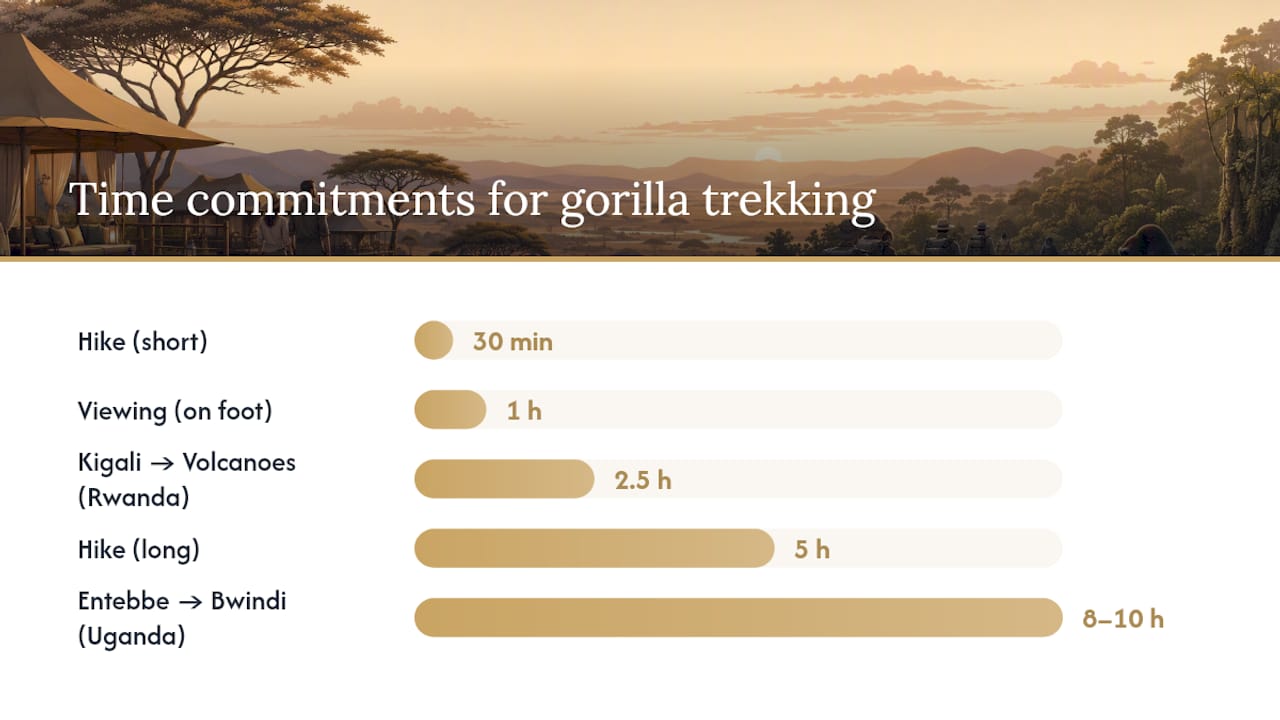
Gorilla trekking in Volcanoes National Park (Rwanda) or Bwindi Impenetrable Forest (Uganda) is not a vehicle-based safari. You hike through dense mountain forest, sometimes for 30 minutes, sometimes for 5 hours, until your guide locates a habituated gorilla family. Then you spend one hour on foot, at close range, watching them. It is one of the most moving wildlife encounters available anywhere.
Best for: Close primate encounters, conservation-focused travellers, and anyone who wants to add a profoundly different experience to a savanna safari itinerary.
Dry seasons (June–September and December–February): Trails are drier and easier to navigate; these are the preferred trekking windows
Wet seasons (March–May and October–November): Permits are easier to secure, rates are sometimes lower, and the forest is extraordinarily lush, though trails can be muddy and steep
Rwanda (Volcanoes NP): Fly into Kigali International Airport; the park is roughly 2.5 hours by road. Rwanda offers the smoothest logistics for gorilla permits, and the country’s stability and infrastructure make it the most accessible option
Uganda (Bwindi): Fly into Entebbe International Airport; transfers to Bwindi take 8–10 hours by road or a short charter flight to Kihihi or Kisoro airstrips. The experience is wilder and more remote
Accommodation: High-end forest lodges and luxury tented camps near trek headquarters; several properties offer private gorilla family allocations for exclusive groups
Permits: Gorilla permits are limited, expensive, and sell out fast. Rwanda’s permits require booking well in advance through the Rwanda Development Board; Uganda’s through the Uganda Wildlife Authority. Both countries restrict the number of visitors per gorilla family per day
Pro Tip: Combine gorilla trekking with a savanna safari by pairing Volcanoes NP with Akagera National Park (Rwanda’s Big Five park) or extending into Tanzania’s Northern Circuit. The contrast between forest trekking and open-plains game drives makes for a genuinely complete Africa experience.
Why Namibia stands out — and what Secretnamibia offers
Namibia is unlike anywhere else in Africa. The light here is extraordinary: golden at dawn over the Namib’s ancient dunes, silver-white at midday across Etosha’s salt pan, and deep amber at dusk when gemsbok silhouettes stretch across the horizon. It is a country of vast, unhurried space, where private reserves offer a level of exclusivity that even Botswana’s Delta camps rarely match.
Secretnamibia specialises in exactly this: bespoke itineraries built around Namibia’s private reserves, fly-in camps, and self-drive routes, crafted for travellers who want the country on their own terms.
A sample 10-day Namibia luxury itinerary
Days 1–2: Windhoek arrival, central Namibia orientation and private reserve night drive
Days 3–4: Sossusvlei and the NamibRand Nature Reserve — dune photography at first light, private NamibRand concession with exclusive access to star-dark skies
Days 5–6: Fly north to Damaraland; desert-adapted elephant tracking and ancient rock art
Days 7–9: Etosha National Park — waterhole hides, private lodge on the park boundary, night drives for black rhino
Day 10: Return to Windhoek, depart
Accommodation highlights: Private suites with unobstructed desert views, open-air showers, conservation-linked camps where a portion of every night’s rate funds anti-poaching patrols and community employment programs.
Practical transfer tips:
Fly into Hosea Kutako International Airport (Windhoek); most luxury itineraries use a mix of charter flights and private road transfers
Self-drive is genuinely viable on Namibia’s gravel roads if you are comfortable with 4x4 vehicles; Secretnamibia’s self-drive safaris include detailed route notes and 24-hour support
Internal charter flights between Windhoek, Sossusvlei, and Etosha save significant road time and are standard on luxury itineraries
Pro Tip: If you are combining Namibia with Botswana, fly directly from Windhoek to Maun (Okavango gateway) rather than routing through Johannesburg. It saves a full travel day and keeps the itinerary flowing.
What to expect on safari — daily rhythm, safety, and health
The classic safari day starts before dawn. You are out of camp by 6 AM, the air still cold, with a flask of coffee and a guide who has been reading animal tracks since 5 AM. The first two hours are the most productive: predators are active, light is soft, and the bush is quiet. By 10 AM you are back at camp for breakfast and a rest through the midday heat. The afternoon drive begins around 3:30 PM and runs to sunset or beyond on night drives.
Safety on game drives:
Stay in the vehicle unless your guide instructs otherwise
Keep voices low near wildlife; sudden noise changes animal behaviour
Never stand up or lean out of an open vehicle near predators
Follow your guide’s instructions without question; they read animal body language you will not yet recognise
Photography tips by ecosystem:
Open plains (Serengeti, Etosha): Wide-angle lenses for landscape context; telephoto for predator close-ups at waterholes
Water-based (Okavango): A waterproof bag for your gear; mokoro trips are low and slow, ideal for eye-level shots
Forest trekking (Bwindi, Volcanoes): Fast lenses (f/2.8 or wider) for low-light forest conditions; leave the tripod behind
Health preparation: Standard travel health guidance includes routine vaccines plus hepatitis A/B and typhoid as recommended by your physician. Yellow fever certificates may be required depending on your routing through certain countries. Malaria prophylaxis is recommended for most East and Southern African destinations; some private reserves in South Africa’s Eastern Cape are malaria-free, which matters significantly for families travelling with young children.
Accessibility: Kruger’s paved road network and rest camps are the most wheelchair-accessible option in Africa. Several private lodges in South Africa have adapted rooms and vehicles. Gorilla trekking is physically demanding and not suitable for travellers with significant mobility limitations.
How much does an African safari cost?
Safari pricing breaks into three clear brackets, and understanding what drives cost within each bracket is more useful than any single price point.
Cost brackets sourced from Travo’s first-timer safari guide:
What drives the price up
Lodge standard: The single biggest lever. Moving from a public rest camp to a private concession lodge can triple the daily rate
Private concession fees: Kenya’s Masai Mara conservancies add roughly $100–$170 per person per day on top of accommodation; Botswana’s concession model is built into lodge pricing
Internal charter flights: A fly-in to the Okavango Delta adds significant cost per leg; road transfers are cheaper but add travel time
Peak season premiums: July–September in the Mara and June–August in the Okavango command the highest rates of the year
Park conservation fees: Kruger’s SANParks daily conservation fee runs in the around $25 per person per day; these are separate from accommodation
Sample itineraries with rough cost ranges
5-day migration-focused (Masai Mara, mid-range): Nairobi arrival, 4 nights in a private conservancy camp during July–September crossings. Roughly $2,500–$3,500 per person, including flights from Nairobi and conservancy fees.
7-day Tanzania Northern Circuit (mid-range to luxury): Arusha base, Tarangire, Serengeti (2–3 nights), Ngorongoro. This is the most-booked 7-day African safari itinerary, combining Big Five efficiency with migration presence. Roughly $3,500–$6,000 per person depending on camp standard.
10-day Namibia private-reserve circuit (luxury): Windhoek, NamibRand, Damaraland, Etosha. See Secretnamibia’s step-by-step Namibia itinerary guide for a detailed breakdown of stops and logistics.
Money-saving tips:
Travel shoulder season (May–June or October–November) for 15–25% lower rates with minimal wildlife trade-off
Mix one high-end camp with one mid-range camp in the same trip; you preserve the signature luxury nights without paying peak rates throughout
Choose parks with internal road access over fly-in-only destinations when budget is a constraint
Why bespoke private-reserve safaris appeal to affluent travellers
There is a moment that defines the private-reserve experience, and it has nothing to do with the Big Five checklist. It is 5:30 AM, the desert air is cold enough to see your breath, and your guide has stopped the vehicle on a ridge above a dry riverbed. Below, a leopard is dragging a kill into a camelthorn tree. There are no other vehicles. There is no radio chatter. Just you, the guide, and an animal doing exactly what leopards have done in this landscape for thousands of years.
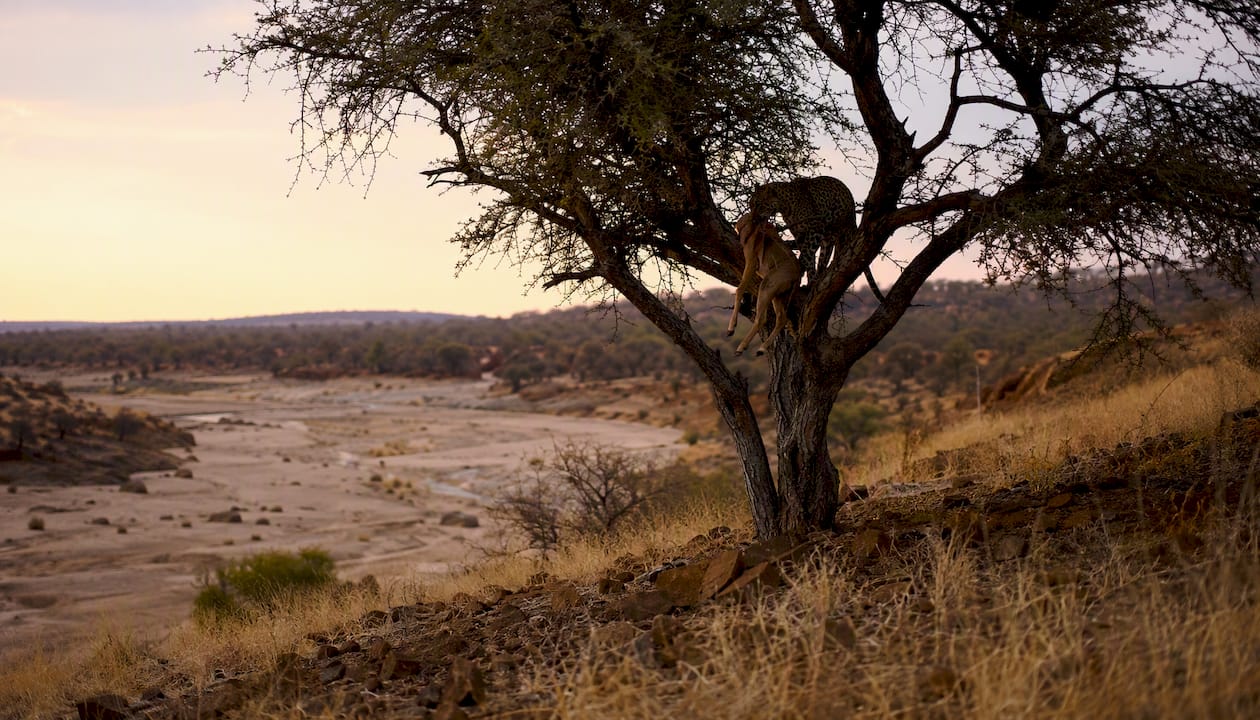
That is what private reserves actually sell: not just access, but unmediated access. The guide-to-guest ratio is higher. The vehicle goes off-road. Night drives are permitted. The pace is yours, not the park’s schedule. For travellers who have done a national park safari before, the upgrade to a private concession is rarely described as incremental. It tends to feel like a different activity altogether.
The practical value compounds too. Private guides build relationships with their guests over 3–5 days, learning what you want to photograph, how early you are willing to rise, whether you prefer a walking safari or a vehicle. That personalisation is not available in a shared-vehicle national park setting, regardless of how good the park is. For Namibia specifically, the private-reserve model also carries a conservation dimension: concession fees and lodge revenues fund anti-poaching operations and community employment in areas where the alternative land use would be livestock farming.
The marginal cost of a private reserve over a public park is real. So is the marginal experience.
Plan your Namibia safari with Secretnamibia
Secretnamibia builds bespoke Namibia safari itineraries for travellers who want more than a standard package. Whether you are drawn to a fly-in luxury safari across private desert reserves, a self-drive adventure through Etosha and the Namib, or an all-inclusive family itinerary with expert guides at every stop, the planning process starts with your priorities, not a pre-set route.
Every itinerary is built around private reserve access, conservation-linked accommodation, and the kind of personalised guiding that turns a good safari into a genuinely memorable one. Enquiry is straightforward: share your travel dates, group size, and experience goals, and the team will return a tailored itinerary with accommodation options, transfer logistics, and transparent pricing.
To start planning your Namibia safari, send an enquiry to Secretnamibia and request a sample itinerary for your preferred travel window.
Sources
Recommended
RELATED
Safari Guides
Oct 30, 2025
Understanding What is Included in Luxury Safaris
Explore what is included in luxury safaris, from exclusive accommodations to bespoke experiences that cater to discerning travelers.
Feb 24, 2026
Why Namibia Adventures Matter: An In-Depth Look
Discover why Namibia adventures are essential for luxury travelers seeking unique, immersive experiences in nature and wildlife exploration.
Feb 23, 2026
What to Expect on a Luxury Safari: A Comprehensive Guide
Discover what to expect on a luxury safari and gain a deeper understanding of the unique experiences that await you in the wild.
Feb 22, 2026
Understanding Namibia Safari Costs Explained
Explore Namibia safari costs explained to uncover what influences pricing and what it means for your adventure.
Feb 21, 2026
Understanding the Role of Safari Experts in Wildlife Travel
Explore the role of safari experts and gain a comprehensive understanding of how they enhance wildlife travel experiences for all types of travelers.
Feb 20, 2026
Guide organisation safari all inclusive : vivez l'aventure de vos rêves
Découvrez notre guide organisation safari all inclusive étape par étape pour planifier un voyage inoubliable au cœur de la nature.