
2026年4月10日
Discover how seasonal migration shapes wildlife encounters on Namibia safaris. Learn which species move, when to visit, and how to plan the ultimate luxury safari.
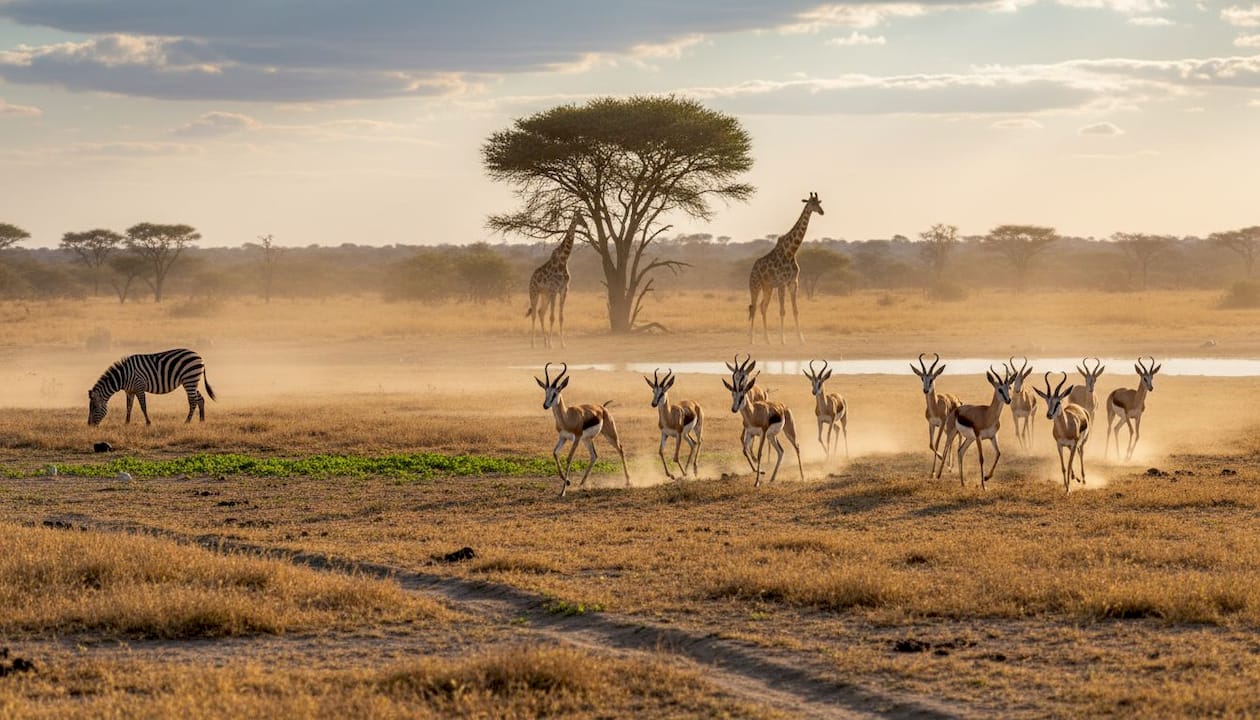
Seasonal migration: wildlife wonders for Namibia safaris
TL;DR:
Namibia’s wildlife migration is subtle, strategic, and driven by environmental cues.
Viewing migrations requires knowledge and patience to observe animals’ energy-efficient movements.
Understanding these patterns enhances safari experiences and supports conservation efforts.
Namibia’s wildlife doesn’t stand still, and neither should your expectations. While most safari-goers picture dramatic river crossings when they hear the word migration, Namibia tells a far more nuanced and equally thrilling story. Across its vast drylands, hundreds of thousands of animals shift between habitats each year in response to rainfall, plant growth, and temperature, creating wildlife spectacles that reward the well-informed traveller. Understanding seasonal migration) as the cyclical, large-scale movement of animals between habitats is the single most powerful tool you can bring to a Namibia safari. This guide breaks down exactly how it works, which species you’ll encounter, and how to time your journey for maximum impact.
Table of Contents
Defining seasonal migration: nature’s annual journey
How animals migrate in Namibia’s safari heartlands
Why seasonal migration matters for your safari experience
The ecological and conservation significance of migration
Why Namibia’s seasonal migration is often misunderstood
Plan your next adventure with migration in mind
Frequently asked questions
Key Takeaways
Point | Details |
|---|---|
Migration shapes safari experiences | Seasonal animal movements determine the best times and hotspots for wildlife encounters in Namibia. |
Not all migration is obvious | Namibia’s migrations are often subtle, driven by energy conservation and resource tracking—not only dramatic treks. |
Timing is everything | Planning your safari around migration cycles maximizes your chance for unforgettable sightings. |
Migration supports conservation | Understanding animal movements is crucial for ecosystem health and sustainable tourism in Namibia. |
Defining seasonal migration: nature’s annual journey
At its core, seasonal migration is nature’s answer to scarcity. Animals migrate cyclically) in response to environmental factors like food, water, and weather, moving between habitats as resources rise and fall with the seasons. In Namibia’s context, this is less about epic distances and more about strategic, energy-efficient repositioning across a landscape that swings between extreme aridity and surprising abundance.
The mechanics behind migration are driven by what ecologists call push-pull forces. A “push” occurs when resources in a current location decline, think dry waterholes and withered grasses. A “pull” draws animals toward areas of fresh growth, cooler temperatures, or reliable water. In Namibia’s drylands, push-pull mechanisms are especially tied to internal biological cues and external environmental triggers, including phenology (the timing of plant growth in response to rain), moonlight cycles, and temperature shifts.
Here are the key drivers that set Namibia’s migrations in motion:
Rainfall and plant flush: The first rains trigger explosive grass and shrub growth, drawing herbivores to fresh, nutrient-rich vegetation.
Water availability: Seasonal waterholes fill and dry in predictable patterns, concentrating or dispersing wildlife accordingly.
Temperature regulation: Cooler highland areas attract species during the heat of summer, while warmer lowlands offer refuge in winter.
Internal biological cues: Hormonal changes linked to day length and moonlight signal animals to begin moving, even before visible environmental changes occur.
One of the most common misconceptions is that migration always means vast distances or dramatic crossings. In Namibia, many migrations are subtle, covering tens rather than hundreds of kilometres, but they are no less ecologically significant.
“The most fascinating migrations are often the ones you have to look closely to notice. In Namibia, the land rewards patience and knowledge over spectacle.”
Pro Tip: Timing your visit to coincide with the first green flush after rains, typically November to January, gives you the best chance of witnessing animals in active, purposeful movement across Namibia’s landscapes.
How animals migrate in Namibia’s safari heartlands
With the basis for migration understood, it’s time to look at how Namibia’s most charismatic wildlife actually moves across the land. The species you encounter on a Namibia safari are not randomly distributed. Their locations are the result of finely tuned seasonal strategies refined over thousands of years.
Antelope like springbok, kudu, and eland shift their feeding strategies dramatically based on the green season’s plant growth. During the dry season, these animals conserve energy by reducing movement and relying on browse and dry grasses. As rains arrive and fresh growth appears, they adopt a “head-up” grazing posture, actively seeking out the most nutritious new shoots across wider areas. This behavioural shift is one of the most rewarding things to observe on a guided game drive.
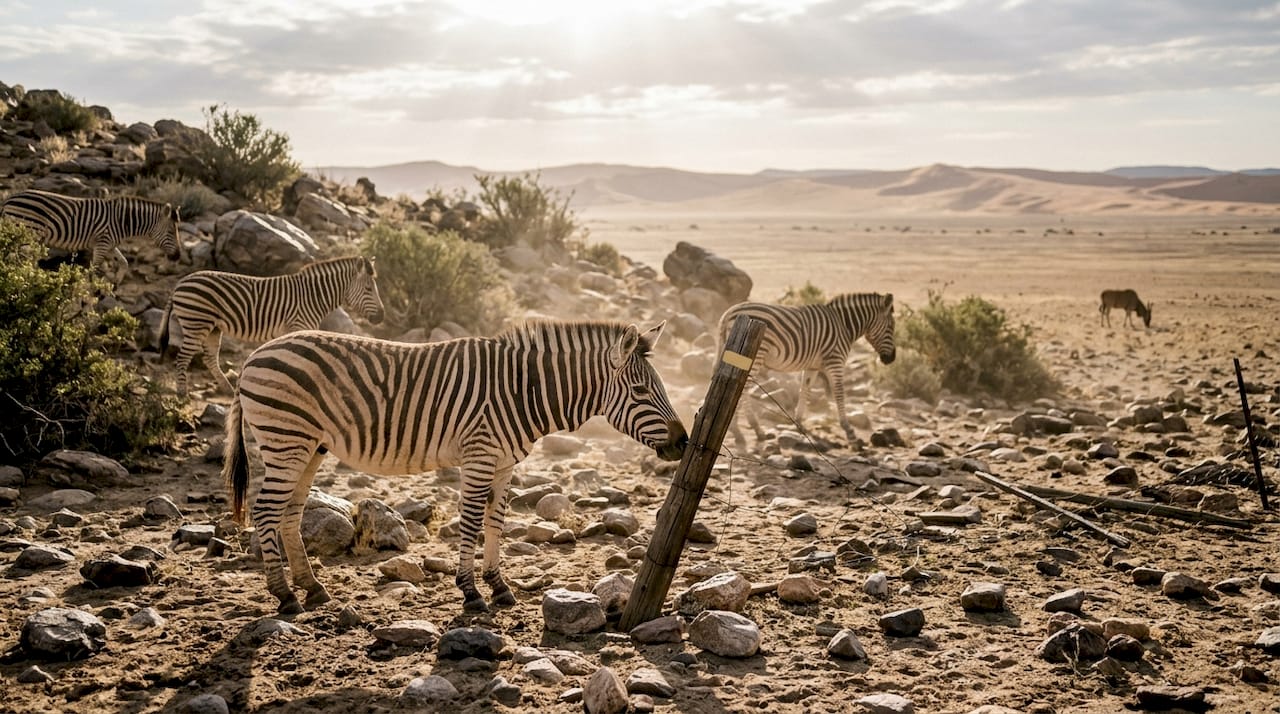
Perhaps the most remarkable comeback story in Namibia belongs to Hartmann’s mountain zebra. Historic fence removal has allowed zebra migration routes to recover, with herds now moving more freely between highland and lowland habitats in patterns not seen for decades. Watching these striking animals traverse rocky ridgelines is a genuinely moving experience.
Species | Migration timing | Movement type | Best viewing location |
|---|---|---|---|
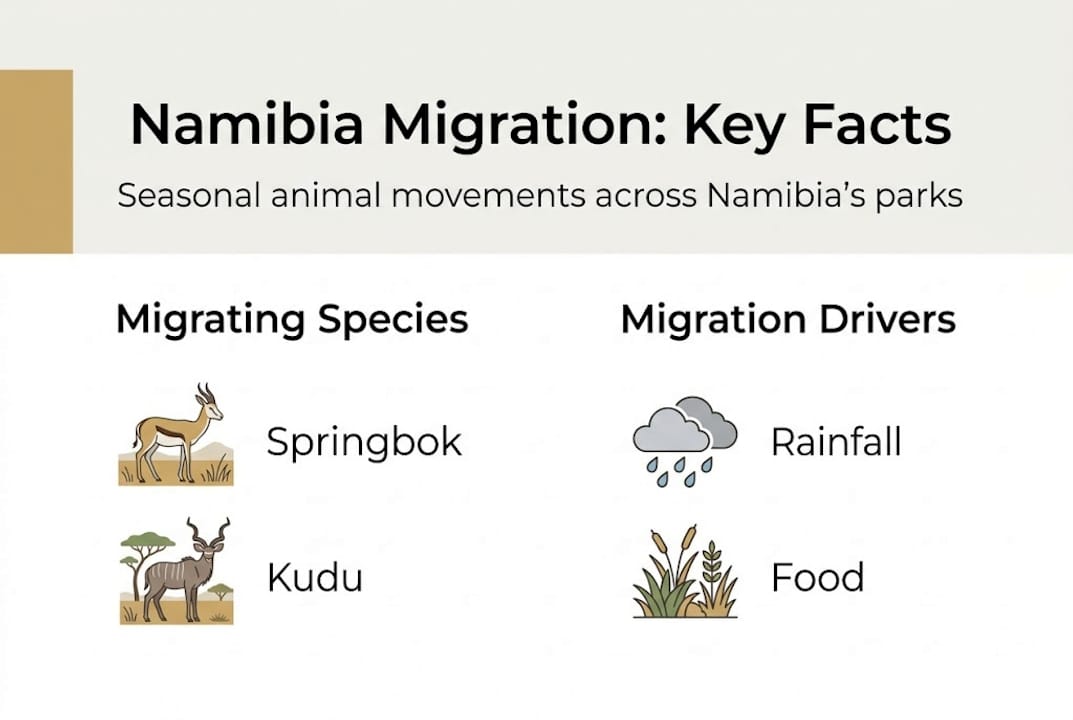
Springbok | Nov to Jan (green season) | Short-range nomadic | Etosha, Namib-Naukluft |
Kudu | Apr to Sep (dry season) | Altitudinal shifts | Waterberg, Etosha Heights |
Eland | Nov to Feb | Broad nomadic sweeps | Etosha, Kalahari |
Hartmann’s zebra | Year-round, peaks Apr to Jun | Highland to lowland | Damaraland, Palmwag |
Here’s how to position yourself for the best sightings:
Visit Etosha in the dry season when animals concentrate around permanent waterholes, creating extraordinary game-viewing density.
Head to Damaraland in April to June to catch Hartmann’s zebra on the move between highland and lowland terrain.
Explore the Namib-Naukluft in November when springbok begin their nomadic green-season sweeps.
Book a guided night drive to observe animals responding to moonlight cues, a fascinating and often overlooked aspect of migration behaviour.
Pro Tip: If you want to see the full diversity of wildlife to spot in Namibia across multiple migration phases, plan an itinerary that spans at least two distinct regions and crosses the seasonal boundary between dry and green.
Why seasonal migration matters for your safari experience
Understanding animal movement on the ground, let’s translate these cycles into remarkable moments for safari-goers. Migration is not just a biological event. It is the engine that drives the most memorable wildlife encounters you will have in Namibia.
Timing your visit to migration peaks) enables travellers to experience peak wildlife activity and rare gatherings that simply don’t exist at other times of year. During the dry season, game density around waterholes reaches its zenith, with lions, elephants, and antelope converging in scenes of raw, unscripted drama. During the green season, the landscape transforms and the sheer energy of animals feeding on fresh growth is electrifying.
Beyond mammals, the birdwatching seasons in Namibia are equally shaped by migration. Over 340 migratory bird species arrive in Namibia between October and April, including European rollers, carmine bee-eaters, and a spectacular array of raptors. The Etosha pan transforms into a flamingo and pelican haven after good rains. Truly, no other single factor shapes the safari calendar more profoundly.
Top migration-influenced activities for adventure seekers:
Waterhole vigils at Etosha’s floodlit hides during the dry season
Guided tracking walks following fresh springbok and kudu spoor after rains
Aerial game counts by light aircraft over Damaraland during zebra movement peaks
Sunrise photography sessions capturing animals silhouetted against green-season skies
Night drives timed to moonrise for observing nocturnal migration cues
For practical planning, knowing the best times for a Namibia safari is essential. The dry season (May to October) delivers concentrated game viewing, while the green season (November to April) offers dramatic landscapes, newborn animals, and migratory birds. Neither is objectively superior. They simply offer different, equally magnificent experiences.
Season | Wildlife highlights | Migration activity | Ideal for |
|---|---|---|---|
Dry (May to Oct) | High game density, predator activity | Concentration at waterholes | Classic game viewing, photography |
Green (Nov to Apr) | Newborns, migratory birds, lush scenery | Active nomadic movement | Birding, landscape photography, calving |
The ecological and conservation significance of migration
Beyond enhancing your visit, migration has deeper implications for the land and for conservation science. Seasonal migration is not merely a spectacle. It is a biological necessity that keeps Namibia’s ecosystems healthy, productive, and resilient.
In Namibia’s arid climate, energy conservation drives migration patterns as much as feeding does. Animals don’t simply chase food. They manage their energy budgets with extraordinary precision, choosing routes and timing that minimise caloric expenditure while maximising nutritional gain. This is a fundamentally different model from the calorie-rich migrations of East Africa, and it reveals a remarkable sophistication in how Namibia’s wildlife has adapted to one of the world’s harshest environments.
Historically, veterinary fences erected across Namibia to control livestock disease fragmented migration corridors and cut animals off from seasonal resources. The consequences were severe, with localised population crashes and disrupted breeding cycles. Modern conservation efforts are actively reversing this damage.
Conservation initiatives benefiting from migration research:
Corridor restoration projects linking Etosha to private conservancies
Community conservancy programmes that protect traditional migration routes
Fence removal initiatives restoring Hartmann’s zebra movement patterns
GPS tracking studies informing land-use planning across communal areas
Ecotourism revenue funding anti-poaching patrols along migration corridors
“Most visitors see the animals. The real story is the invisible map they’re following, a network of routes, resources, and memory that has shaped this landscape for millennia.”
If you’re passionate about the science behind what you’re witnessing, conservation safaris in Namibia offer an extraordinary opportunity to engage directly with researchers and conservationists working on the ground. These experiences add a layer of meaning to every sighting that standard game drives simply cannot match.
Why Namibia’s seasonal migration is often misunderstood
Popular wildlife documentaries have shaped our collective idea of migration into something almost theatrical: vast herds, churning rivers, and desperate crossings. Namibia quietly defies this image, and that’s precisely what makes it so fascinating.
The migrations here are subtle, strategic, and deeply tied to energy conservation rather than dramatic distance. An eland moving thirty kilometres to reach a patch of fresh growth is making a decision as sophisticated as any wildebeest crossing the Mara River. The difference is that you need knowledge and a skilled guide to fully appreciate it.
We believe this subtlety is actually Namibia’s greatest safari gift. It transforms you from a passive spectator into an active participant in reading the landscape. When you understand why that herd of springbok is moving northeast at dawn, the entire safari becomes richer and more personal.
For luxurious wildlife encounters that go beyond the surface, ask your guide about recent local animal movements. The most extraordinary sightings are rarely the ones on the itinerary.
Pro Tip: Before your safari, ask your lodge or guide for the latest movement reports. Local knowledge of where animals have been tracking in the past week is worth more than any general seasonal guide.
Plan your next adventure with migration in mind
Ready to turn knowledge into action? Understanding Namibia’s seasonal migrations transforms a great safari into an unforgettable one, and the key is planning with these natural rhythms at the centre of your itinerary.
At Secret Namibia, we specialise in crafting journeys that align with nature’s calendar. Whether you’re drawn to the dry-season drama of Etosha’s waterholes or the green-season magic of calving herds and migratory birds, our team can position you in exactly the right place at exactly the right time. Explore our luxury wildlife experiences and conservation-focused safaris to find the perfect fit. Browse our full range of tailored luxury Namibia safaris and let us help you plan a journey shaped by the land itself.
Frequently asked questions
What is the main driver of seasonal migration in Namibia?
The main driver) is the search for food and water triggered by changing seasons, particularly the flush of plant growth that follows Namibia’s unpredictable but life-giving rains.
How does migration affect safari wildlife viewing in Namibia?
Migration creates peak periods) of wildlife activity, with the dry season concentrating animals at waterholes for exceptional game density and the green season offering active nomadic movement and newborn sightings.
Which animals migrate in Namibia?
Commonly observed species include springbok, kudu, eland, and Hartmann’s mountain zebra, each following distinct seasonal routes shaped by rainfall, plant growth, and terrain.
Is migration in Namibia as dramatic as in East Africa?
Namibia’s migrations are subtler and more energy-efficient than the mass crossings of East Africa, but they are no less remarkable once you understand the sophisticated strategies animals use to navigate this arid landscape.
Recommended
相关
萨法里指南
2025年10月30日
Understanding What is Included in Luxury Safaris
Explore what is included in luxury safaris, from exclusive accommodations to bespoke experiences that cater to discerning travelers.
2026年2月24日
Why Namibia Adventures Matter: An In-Depth Look
Discover why Namibia adventures are essential for luxury travelers seeking unique, immersive experiences in nature and wildlife exploration.
2026年2月23日
What to Expect on a Luxury Safari: A Comprehensive Guide
Discover what to expect on a luxury safari and gain a deeper understanding of the unique experiences that await you in the wild.
2026年2月22日
Understanding Namibia Safari Costs Explained
Explore Namibia safari costs explained to uncover what influences pricing and what it means for your adventure.
2026年2月21日
Understanding the Role of Safari Experts in Wildlife Travel
Explore the role of safari experts and gain a comprehensive understanding of how they enhance wildlife travel experiences for all types of travelers.
2026年2月20日
Guide organisation safari all inclusive : vivez l'aventure de vos rêves
Découvrez notre guide organisation safari all inclusive étape par étape pour planifier un voyage inoubliable au cœur de la nature.