
Aug 13, 2026
Experience unforgettable Namibia outdoor adventures, featuring stunning dunes, unique wildlife, and tailored luxury safaris for your perfect getaway.
Namibia outdoor adventures: top regions and how to book
Namibia outdoor adventures span desert-dune thrills, coastal wildlife encounters, and magnificent wildlife safaris across Sossusvlei, Etosha National Park, Swakopmund, the Skeleton Coast, Damaraland, and the Kalahari — making this one of Africa’s most extraordinary destinations for active travellers. Whether you’re chasing a sunrise over crimson dunes, watching lions drink at a floodlit waterhole, or free-falling above the Atlantic, Namibia delivers experiences that are genuinely difficult to replicate anywhere else on the continent. Secretnamibia specialises in turning these raw, wild encounters into bespoke private-luxury safaris, so you can pursue every adventure on your terms.
Top must-dos that define a Namibia adventure:
Sossusvlei sunrise and Deadvlei walk — climb Dune 45 before dawn, then cross the salt pan to photograph the ghostly mummified camelthorn trees of Deadvlei
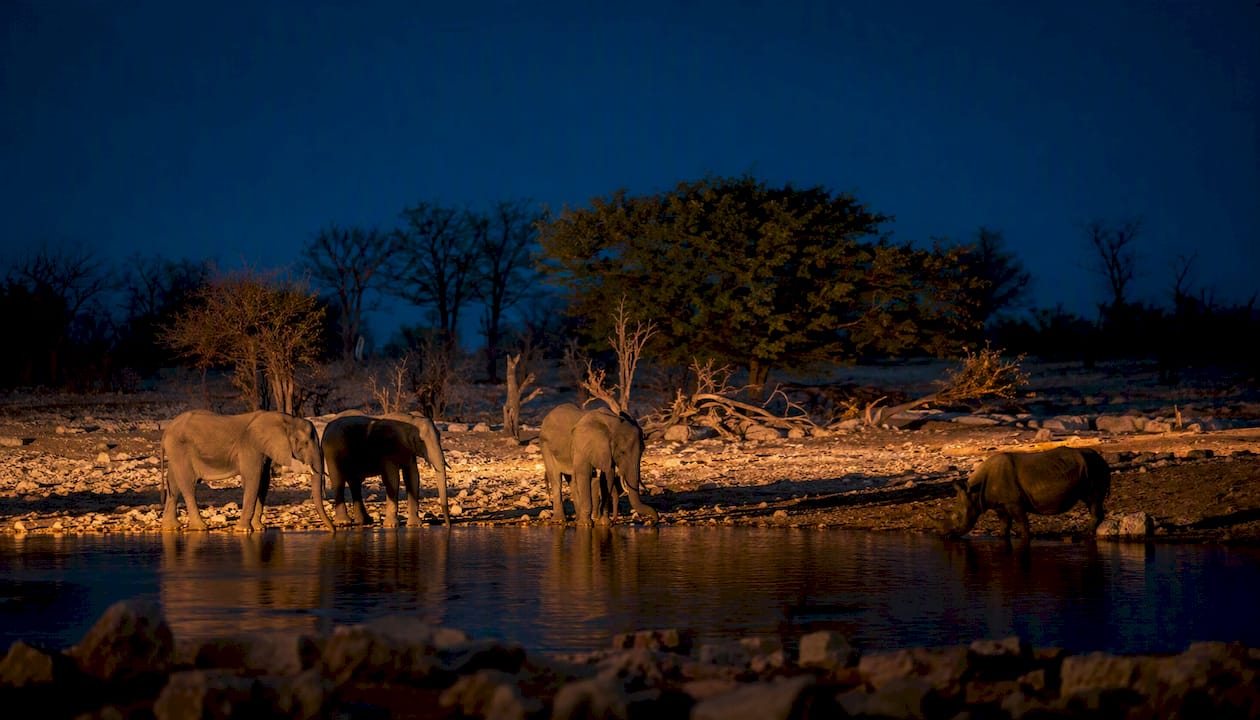
Etosha waterhole game viewing — position yourself at Okaukuejo or Halali as elephants, lions, and black rhino converge at dusk
Sandwich Harbour sea-to-desert excursion — kayak among Cape fur seals, then drive a 4x4 into towering dunes that plunge straight into the Atlantic
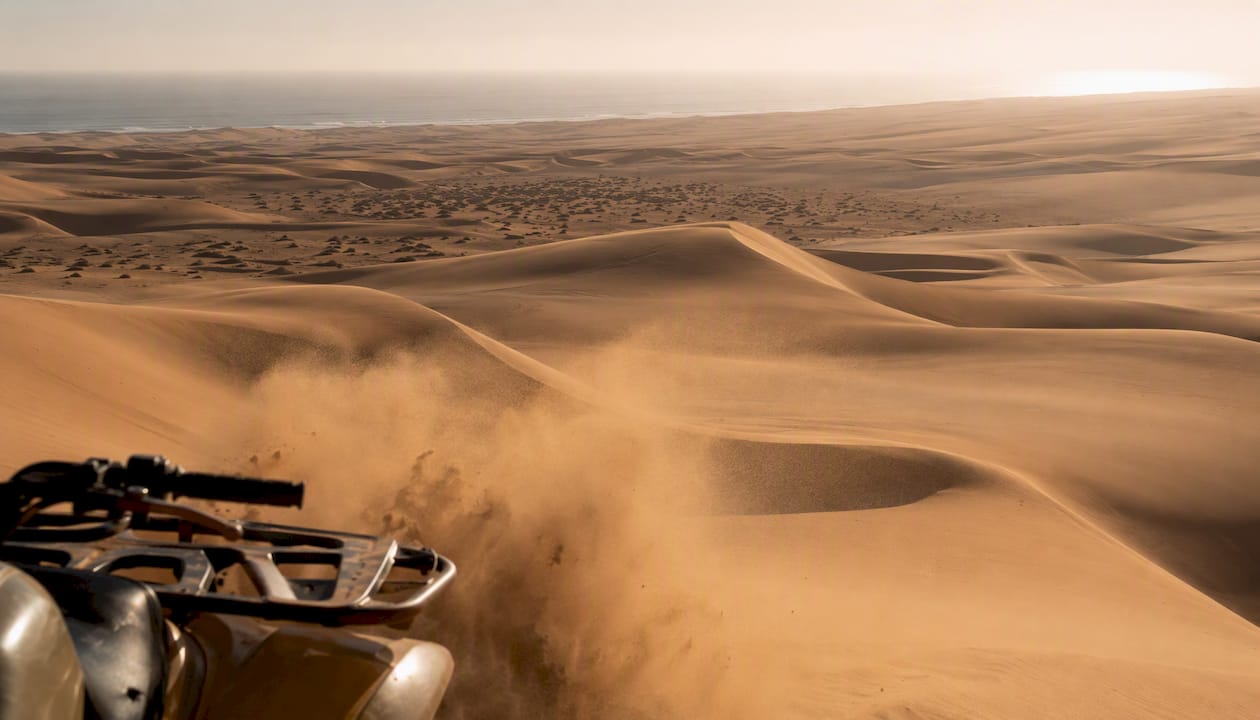
Swakopmund adventure hub — skydive, sandboard, or quad-bike along one of the world’s most dramatic coastlines
Fish River Canyon hiking — trek the second-largest canyon on earth through ancient rock formations
Damaraland rock art and desert-adapted wildlife — track desert-adapted elephants and rhino against a backdrop of San rock engravings
Key Takeaways
Namibia outdoor adventures reward travellers who plan by region and activity, choose the right delivery style for their comfort level, and book private-luxury options through a specialist like Secretnamibia for the most exclusive and personalised experience.
Point | Details |
|---|---|
Match region to activity | Sossusvlei for dunes, Etosha for wildlife, Swakopmund for adrenaline, Damaraland for tracking |
Choose your delivery style | Self-drive suits flexible planners; private-luxury reserves deliver exclusivity and tailored game drives |
Plan the right duration | 8–12 days covers the classic loop; 14+ days adds Fish River Canyon, Kalahari, or Skeleton Coast |
Budget realistically | Mid-range trips run roughly $180–$250/day; private-luxury ranges from $400 to $800+ per day |
Book with Secretnamibia | Bespoke itinerary design, private guides, and in-country support for a fully customised adventure |
Table of Contents
Where should you go? Namibia’s key regions for outdoor experiences
What are the top outdoor activities in Namibia?
How do you choose between self-drive, guided, fly-in, and private-luxury options?
What are the practical logistics for planning a Namibia trip?
Sample itineraries: how long does a Namibia adventure take?
What should you pack for a Namibia adventure?
Why choose a luxury private safari with Secretnamibia?
Secretnamibia makes your custom Namibia adventure possible
Sources
Where should you go? Namibia’s key regions for outdoor experiences
Namibia’s geography is vast and varied, and matching your activities to the right region saves you both time and disappointment. Here’s a region-by-region orientation.
Namib Desert and Sossusvlei
The Namib is the world’s oldest desert, and Sossusvlei’s towering red dunes and Deadvlei’s mummified trees are its most iconic features. Access is through the Sesriem gate, roughly 360 km southwest of Windhoek on a mix of tar and well-graded gravel. The inner road from Sesriem to Sossusvlei requires a 4WD or a shuttle from the gate; standard sedans can reach the Sesriem area but cannot proceed to the dune car park.
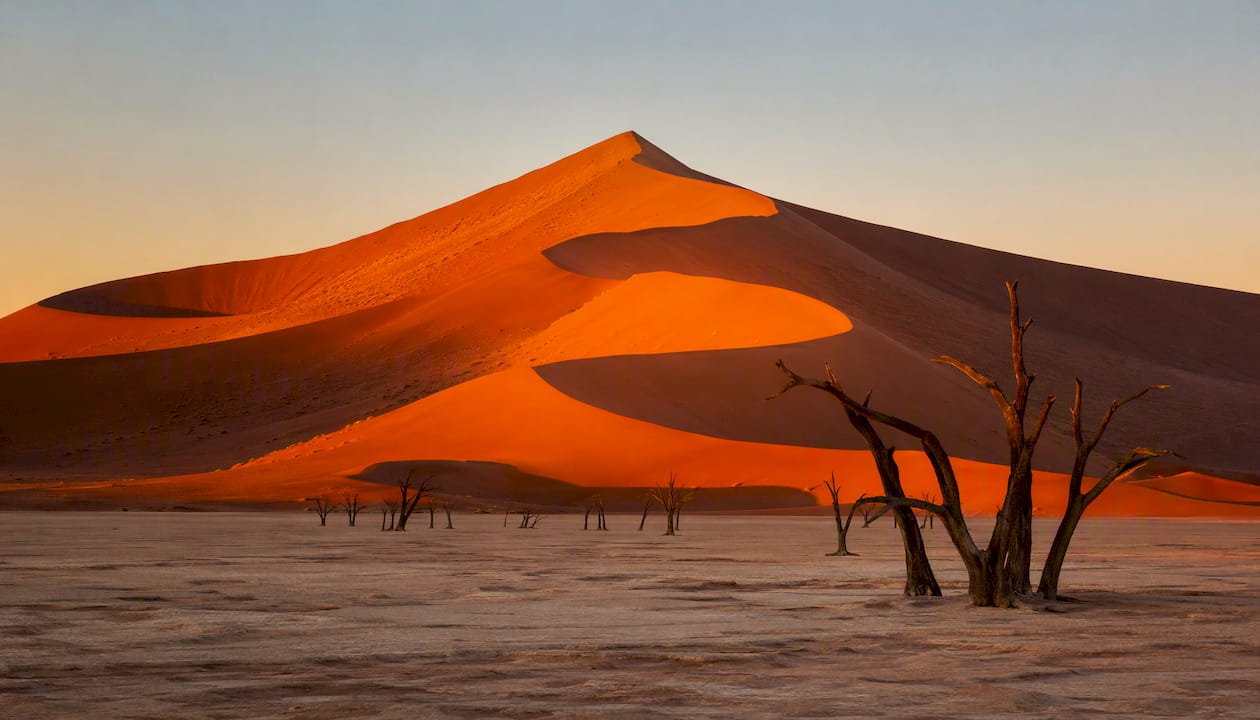
Pro Tip: Stay inside the Sesriem gate at one of the lodges or campsites there. Gates open at sunrise, giving you a 45-minute head start over day visitors driving from outside — that window is the difference between photographing empty dunes and sharing them with a crowd.
Etosha National Park
Etosha is Namibia’s premier wildlife destination, a vast salt pan surrounded by savanna where dense concentrations of game gather at waterholes year-round. The park sits roughly 450 km north of Windhoek on tar road. Self-drive is straightforward on the park’s internal gravel network, and the floodlit waterhole at Okaukuejo camp allows evening wildlife observation from the comfort of camp. For game drives in Etosha, the dry season from May through October concentrates animals most dramatically.
Skeleton Coast
Raw, remote, and genuinely haunting, the Skeleton Coast stretches along Namibia’s northern Atlantic shore. Shipwrecks half-buried in sand, vast Cape fur seal colonies, and desert-adapted brown hyena make this one of Africa’s most atmospheric wildernesses. The southern section is accessible by 4WD on gravel; the northern Skeleton Coast National Park requires a fly-in permit and is accessible only by light aircraft or licensed tour operators.
Damaraland and Kaokoveld
Damaraland offers some of Namibia’s most dramatic scenery: volcanic rock formations, ancient San rock engravings at Twyfelfontein (a UNESCO World Heritage Site), and the chance to track desert-adapted elephants and black rhino on foot with a licensed guide. Roads here are predominantly gravel and corrugated; a high-clearance 4WD is strongly recommended. The Kaokoveld, further north, is one of Africa’s last true wildernesses — the domain of the Himba people and extraordinary remoteness.
Kalahari
Namibia’s portion of the Kalahari is characterised by scarlet sand dunes, golden grass plains, and skies so dark at night that the Milky Way casts shadows. The Kalahari’s famed black-maned lions are a remarkable draw, and the region’s meerkats — foraging under the watchful guard of their sentries — are something not to be missed. Access from Windhoek is roughly 250 km southeast on tar, making this an achievable add-on to any southern circuit.
Swakopmund and Walvis Bay
Swakopmund functions as Namibia’s coastal adventure capital, a charming German colonial town perched between the Namib and the Atlantic. It’s roughly 360 km west of Windhoek on tar road. Outdoor activities here range from skydiving and sandboarding to quad-biking and sea kayaking, with multiple operators running daily departures. Walvis Bay, 30 km south, is the launch point for Sandwich Harbour excursions and flamingo-rich lagoon tours.
What are the top outdoor activities in Namibia?
TripAdvisor’s 2026 activity listings confirm consistent traveller demand for Sossusvlei tours, Sandwich Harbour excursions, Bushman walks, and coastal adventures — and the range on offer is genuinely remarkable. Here’s what to expect from each major activity.
Guided game drives and waterhole viewing
Game drives in Etosha are the backbone of most Namibia wildlife safaris. Self-drive is permitted on internal park roads, but a guided drive with a knowledgeable ranger adds context that transforms a sighting into a story. Waterhole viewing at Okaukuejo’s floodlit pan is particularly special after dark, when black rhino and elephant arrive in near-silence. Expect half-day drives of 3–4 hours; full-day drives covering multiple waterholes run 6–8 hours. Guided game drives typically cost $60–$150 per person depending on the operator and vehicle type.
Dune climbing and Deadvlei at Sossusvlei
Climbing Big Daddy or Dune 45 at sunrise is physically demanding — loose red sand at a steep gradient — but the reward is a panorama of apricot light spilling across the pan below. The walk across the cracked white clay of Deadvlei to the ancient camelthorn trees takes about 30 minutes and is one of the most photographed scenes in Africa. Allow a half-day minimum; a full morning from gate-open to midday is ideal before the heat becomes intense.
Sandboarding
Swakopmund’s dunes offer two styles: lie-down (faster, more adrenaline) and stand-up (harder, more skill required). Most operators run morning sessions of 2–3 hours. Prices from local Swakopmund operators typically cover equipment and transport to the dunes, with rates varying by provider.
Skydiving
Tandem skydiving above Swakopmund is one of the most dramatic experiences in Namibia adventure travel. You exit the aircraft above the desert-meets-ocean coastline and freefall with views of the Namib, the Atlantic, and Walvis Bay lagoon simultaneously. Sessions run roughly 3–4 hours including briefing and travel; Swakopmund operators list prices in the 2,100–2,500 NAD range for tandem jumps.
Quad-biking and 4x4 dune drives
Quad-biking through the dunes around Swakopmund is a half-day activity suitable for most fitness levels. Guided 4x4 dune drives are available both near Swakopmund and deeper into the Namib, offering a less physically demanding but equally thrilling way to experience the desert’s scale.
Sandwich Harbour excursion
This is one of Namibia’s most extraordinary day trips. Sandwich Harbour tours combine sea kayaking among Cape fur seals with a 4x4 drive into dunes that rise directly from the ocean. Access is tide-dependent — the track between the lagoon and the dunes floods at high tide — so operators schedule morning departures and build flexibility into the day. Tours typically include park fees, refreshments, and a dune picnic. Allow a full day from Walvis Bay.
Hiking: Naukluft Mountains and Fish River Canyon
The Naukluft Mountain Zebra Park offers multi-day trails through rugged quartzite gorges, with the 8-day Naukluft Trail regarded as one of Namibia’s most challenging long-distance hikes. Fish River Canyon, the second-largest canyon on earth, hosts the famous 85 km Fish River Canyon Trail, a 4–5 day hike through ancient rock formations available May through September only (permits required). Day hikes along the canyon rim are accessible year-round and require no permit.
Coastal wildlife viewing
Walvis Bay lagoon hosts one of Africa’s largest flamingo populations, and the Cape Cross Seal Reserve north of Swakopmund shelters a colony of roughly 100,000 Cape fur seals. Both are accessible by standard vehicle and make excellent half-day excursions.
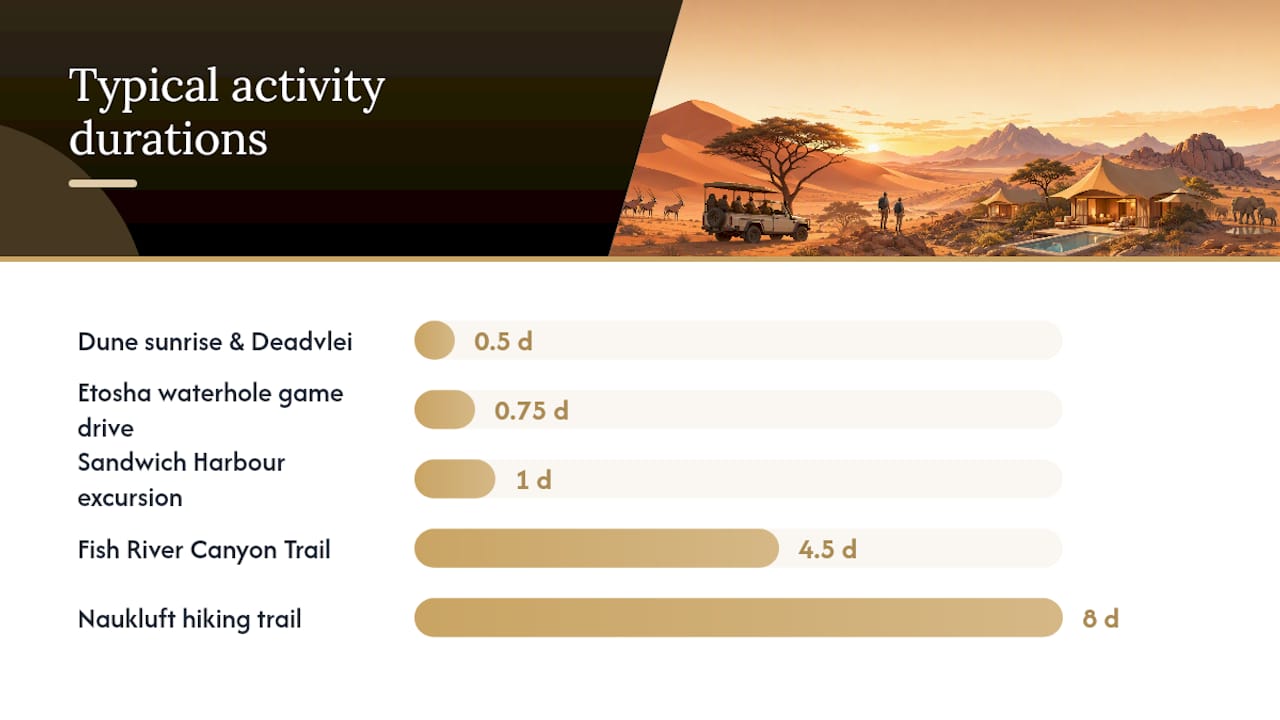
Activity time commitment at a glance:
Activity | Time Commitment | Difficulty |
|---|---|---|
Dune sunrise + Deadvlei walk | Half-day | Moderate |
Etosha waterhole game drive | Half-day to full-day | Easy |
Sandboarding (Swakopmund) | Half-day | Easy to moderate |
Skydiving (Swakopmund) | Half-day | Low (tandem) (prices vary by operator without a confirmed public source). |
Sandwich Harbour excursion | Full day | Easy |
Naukluft hiking trail | Multi-day (8 days) | Strenuous |
Fish River Canyon Trail | Multi-day (4–5 days) | Strenuous |
Quad-biking (Swakopmund) | Half-day | Easy |
Coastal wildlife viewing | Half-day | Easy |
How do you choose between self-drive, guided, fly-in, and private-luxury options?
The delivery style you choose shapes your entire trip. Each approach suits a different traveller, and understanding the tradeoffs upfront saves frustration in the field.
Self-drive gives you total flexibility and is genuinely achievable in Namibia, where roads are well-signed and most major routes are tar or graded gravel. You control your pace, your stops, and your budget. The constraint is logistics: fuel stations are sparse in remote areas, gravel roads can be punishing on standard vehicles, and breakdowns in the Kaokoveld or Skeleton Coast are serious situations. A 4WD with a rooftop tent is the classic self-drive setup.
Guided group tours remove the planning burden and suit travellers who prefer a social experience with a knowledgeable guide. The tradeoff is a fixed itinerary and shared game drives, which limits spontaneity. Multi-day adventure providers typically combine Sossusvlei, Naukluft, Spitzkoppe, and Etosha into classic loops, recommending early starts and overnight stays inside park boundaries for better access.
Fly-in safaris are the most time-efficient option for travellers with limited days. You cover vast distances in light aircraft, land at private airstrips, and move directly into lodge experiences without long drives. The cost is significantly higher, but the experience is unmatched for those who want to reach the Skeleton Coast or Kaokoveld without a week of driving.
Private-luxury reserves offer something the national parks cannot: exclusivity. No other vehicles at your sighting, flexible drive times, private guides who learn your interests, and accommodation designed to make the wilderness feel like a privilege rather than a campsite. For adventure travellers who want bold outdoor experiences without sacrificing comfort, this is the most rewarding route.
Questions to ask any provider before booking:
What vehicle type is used, and is it a 4WD with high clearance?
What is the guide-to-client ratio on game drives?
Which activities and park fees are included in the price?
What is the access situation for Skeleton Coast or Sossusvlei inner tracks in your chosen season?
What is the emergency protocol and nearest medical facility?
Pro Tip: For Sossusvlei, confirm whether your operator or lodge is inside the Sesriem gate. Operators based outside must wait for gate-open, losing the golden-hour advantage that makes dune photography so spectacular.
What are the practical logistics for planning a Namibia trip?
Best time to visit
Namibia’s dry season, May through October, is the prime window for wildlife viewing. Waterholes shrink, vegetation thins, and animals concentrate in predictable locations. June through August brings cooler temperatures, making hiking and game drives more comfortable. The wet season, November through April, transforms the Kalahari into a lush, green landscape and brings dramatic skies, but some gravel roads become impassable and the Skeleton Coast’s inner tracks can close entirely.
For coastal activities in Swakopmund and Walvis Bay, conditions are good year-round, though the Benguela Current keeps temperatures cool even in summer — pack a windproof layer regardless of the month.
How long should you stay?
4–6 days: A highlights sprint covering Sossusvlei and Swakopmund, or Etosha alone. Satisfying but leaves you wanting more.
8–12 days: The classic Namibia loop — Sossusvlei, Swakopmund, Damaraland, and Etosha. This is the sweet spot for most first-time visitors.
14+ days: Adds the Kalahari, Fish River Canyon, Skeleton Coast, or Kaokoveld. Genuinely in-depth and the format Secretnamibia recommends for travellers who want to experience Namibia’s full range.
For detailed day-by-day planning, the step-by-step safari itinerary guide on Secretnamibia walks through how to structure each length of trip.
Vehicle and fuel guidance
A 4WD is required for Sossusvlei’s inner tracks, the Skeleton Coast, Damaraland, and the Kaokoveld. Standard sedans manage Windhoek to Etosha and Windhoek to Swakopmund comfortably. Rooftop-tent 4WD rentals are widely available in Windhoek from operators like Asco Car Hire and Odyssey Car Hire; expect to pay roughly $80–$150 per day for a 4WD with camping equipment versus $30–$60 for a standard sedan. Carry at least 20 litres of extra fuel when venturing into remote areas.
Rough USD cost ranges
Etosha park entry fees are denominated in Namibian dollars (NAD); check the Etosha National Park official site for current rates, as fees are set by Namibia Wildlife Resorts and updated periodically.
Visas, health, and safety
US citizens receive a 90-day visa-free entry stamp on arrival.
Yellow fever vaccination is required if you are arriving from a yellow fever endemic country.
Malaria risk exists in the Caprivi Strip (Zambezi Region) and parts of northern Namibia; consult a travel health clinic before departure. The main safari regions (Etosha, Sossusvlei, Swakopmund) carry low to negligible malaria risk.
Namibia’s roads are generally safe, but wildlife on the road at night is a serious hazard — avoid driving after dark outside of fenced areas.
Emergency medical evacuation is available through operators like AMREF Flying Doctors; consider travel insurance that includes medical evacuation cover.
Pro Tip: Namibia’s fuel stations in remote areas often close early and may not accept foreign credit cards. Carry a combination of NAD cash and a Visa card, and top up whenever you pass a station.
Sample itineraries: how long does a Namibia adventure take?
6-day Namibia highlights
Day 1: Fly into Windhoek; overnight in the capital
Day 2: Drive to Sesriem (4.5 hrs on tar); afternoon at Sesriem Canyon; overnight inside the gate
Day 3: Pre-dawn dune climb at Dune 45, Deadvlei walk; afternoon drive to Swakopmund (4 hrs)
Day 4: Full day in Swakopmund — sandboarding or skydiving in the morning, Walvis Bay flamingo cruise in the afternoon
Day 5: Sandwich Harbour full-day excursion from Walvis Bay
Day 6: Drive back to Windhoek (4 hrs); depart
Budget callout: approximately $150–$200/day mid-range, $350–$500/day private-luxury
10-day classic Namibia loop
Day 1: Arrive Windhoek
Days 2–3: Sossusvlei and Deadvlei (stay inside Sesriem gate)
Day 4: Drive to Swakopmund via Solitaire (5 hrs)
Day 5: Swakopmund adventure activities
Day 6: Sandwich Harbour excursion
Day 7: Drive north through Damaraland; Twyfelfontein rock engravings
Days 8–9: Etosha National Park — two full days of game drives and waterhole viewing
Day 10: Drive back to Windhoek; depart
Budget callout: approximately $180–$250/day mid-range, $400–$600/day private-luxury
14-day in-depth adventure
Follow the 10-day loop, then add:
Days 11–12: Kalahari — black-maned lion tracking, meerkat walks, night-sky stargazing
Day 13: Fish River Canyon rim walk or fly-in to Skeleton Coast
Day 14: Return to Windhoek; depart
Budget callout: approximately $200–$280/day mid-range, $500–$800/day private-luxury
8-day family-friendly safari
Day 1: Arrive Windhoek; city orientation
Days 2–3: Etosha National Park — self-drive game drives, waterhole viewing from camp
Day 4: Drive to Damaraland; afternoon guided walk
Day 5: Twyfelfontein and desert-adapted elephant tracking
Days 6–7: Swakopmund — sandboarding, seal colony visit, Walvis Bay boat trip
Day 8: Return to Windhoek; depart
Budget callout: approximately $160–$220/day mid-range, $380–$550/day private-luxury
Secretnamibia can customise any of these frameworks around your travel dates, preferred accommodation style, and specific activity priorities — including arranging private guides, fly-in legs, and exclusive lodge access that isn’t available through standard booking channels.
Pro Tip: On the 10-day loop, spend two nights inside Etosha rather than one. The second morning drive almost always delivers the sighting you missed on day one — Etosha rewards patience.
What should you pack for a Namibia adventure?
Clothing and gear checklist
Sun protection: SPF 50+ sunscreen, wide-brim hat, UV-protective sunglasses — Namibia’s UV index is extreme
Layered clothing: Mornings in the desert and at altitude can be cold (below 10°C in winter); afternoons reach 35°C+. Lightweight merino layers work well
Breathable fabrics: Moisture-wicking shirts and convertible trousers for game drives and hikes
Wind protection: A windproof fleece or softshell jacket is non-negotiable in Swakopmund, where the Benguela Current keeps coastal temperatures cool and gusty year-round
Sturdy footwear: Closed-toe hiking boots for canyon and Naukluft trails; sandals for camp
Binoculars: 8x42 or 10x42 are the standard for game viewing; bring your own rather than relying on lodge pairs
Camera and spare batteries: Cold mornings drain batteries faster than expected; carry at least two
Hydration system: A 2-litre water bottle minimum; a hydration bladder for hiking days
Lightweight daypack: For game drives, hikes, and day excursions
Personal medications: Bring more than you need; pharmacies in remote areas are limited
Health and safety essentials
Drink at least 3 litres of water per day in the desert; dehydration sets in faster than most travellers expect
Apply sunscreen every 90 minutes during outdoor activities, not just at the start of the day
Carry a basic first-aid kit including blister treatment, antihistamine, and rehydration sachets
For the Caprivi Strip and northern regions, take malaria prophylaxis as advised by your travel health clinic; the main safari circuits carry low risk but confirm with a medical professional before departure
Register your trip with the US Embassy in Windhoek and carry emergency contact numbers including AMREF Flying Doctors
Pro Tip: Pack a headlamp with fresh batteries for Etosha camps. The floodlit waterhole at Okaukuejo is a short walk from the accommodation, and the path is unlit — you’ll want both hands free for your camera.
Why choose a luxury private safari with Secretnamibia?
Namibia’s national parks are magnificent. But they are also shared. At peak season, Etosha’s popular waterholes attract a queue of vehicles, and Sossusvlei’s dunes fill with day-trippers by mid-morning. Private reserves and bespoke safari planning offer something fundamentally different: the wilderness on your own terms.
Why private game reserves outperform national parks for serious adventurers
Exclusivity: Private concessions operate with strict vehicle limits, meaning your sighting is yours alone — no jostling for position, no engine noise from a dozen other 4x4s
Flexible timing: Private guides can follow an animal off-road and stay with a sighting as long as you want, unconstrained by park closing times
Tailored itineraries: Your guide learns your interests on day one and shapes subsequent drives around them — whether that’s tracking desert-adapted rhino on foot or spending an hour with a leopard and her cubs
Conservation partnerships: Many private reserves in Namibia operate active conservation programmes, including rhino monitoring and community-based wildlife management, so your visit directly funds protection
Personalised guest experience: From pre-arrival dietary preferences to private sundowner setups in the dunes, the level of attention at a private lodge is simply not replicable in a public park camp
Top private reserves and lodges Secretnamibia features
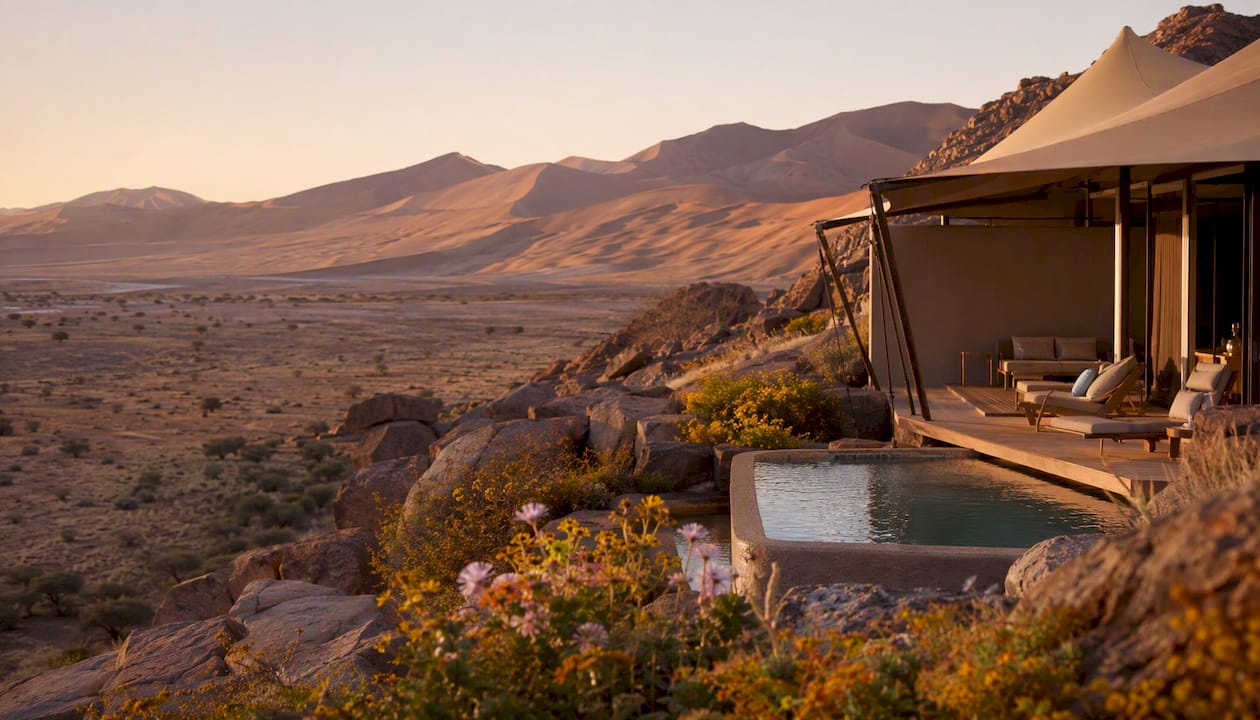
Wolwedans Dunes Lodge (NamibRand Nature Reserve) Located in the NamibRand Nature Reserve, the largest private reserve in southern Africa, Wolwedans sits among rolling red dunes and vast open plains. Elevated wooden chalets with canvas walls frame uninterrupted desert views. Wildlife here includes oryx, springbok, and cheetah, and the reserve’s dark-sky status makes it one of the finest stargazing destinations on the continent.
Accommodation: elevated timber chalets, private decks, open-air showers
Key USPs: exclusive desert wilderness, guided nature walks, exceptional night-sky access
Hoanib Skeleton Coast Camp Positioned in the remote Hoanib River Valley near the Skeleton Coast, this fly-in camp is one of Namibia’s most exclusive addresses. Access is by light aircraft only, which keeps visitor numbers extraordinarily low.
Accommodation: six tented chalets with en-suite bathrooms and private viewing decks
Key USPs: desert-adapted lion and elephant tracking, proximity to the Skeleton Coast, near-zero light pollution
Ongava Private Game Reserve (adjacent to Etosha) Ongava shares a fence with Etosha’s southern boundary, giving guests access to both the private reserve and the national park in a single stay. White rhino are regularly seen on the reserve itself.
Accommodation: Ongava Lodge and Ongava Tented Camp, ranging from stone chalets to canvas tents
Key USPs: white and black rhino on private land, dual-access to Etosha, night drives permitted (not allowed inside the national park)
Damaraland Camp (Torra Conservancy) A pioneering community-owned lodge in the Torra Conservancy, Damaraland Camp helped establish the model for community-based conservation in Namibia. Desert-adapted elephant and black rhino are tracked on foot with local guides.
Accommodation: stone-and-canvas chalets blending into the rocky landscape
Key USPs: community conservation model, desert-adapted wildlife tracking, extraordinary geological scenery
For luxury group lodges and eco-friendly stays across these regions, Secretnamibia’s curated collections cover the full spectrum from tented camps to architect-designed lodges.
What to expect from a private luxury safari
Across all of these reserves, certain themes hold. Game drives go out at dawn and dusk, guided by specialists who read tracks and behaviour rather than simply driving to known spots. Meals are often served in the bush, under a sky that most travellers have never seen this dark. Conservation briefings from reserve managers give you context that transforms a sighting into an understanding. And the accommodation — whether canvas or stone, elevated or ground-level — is designed to make you feel the wilderness rather than be protected from it.
Secretnamibia’s bespoke planning service handles every element of your private-reserve experience, from luxury safari features and private guide arrangements to flight coordination and in-country support.
Pro Tip: Ask your Secretnamibia consultant which private reserves are currently running active rhino monitoring programmes. Joining a tracking session with a conservation team is one of the most powerful wildlife experiences available in Namibia — and it’s rarely advertised.
The single-day experiences you cannot afford to skip
If your schedule is tight and you need to prioritise, these are the picks that earn a “can’t miss” rating — and the type of traveller each one suits best.
Sossusvlei sunrise and Deadvlei walk. The combination of Dune 45 at first light and the walk across Deadvlei’s cracked white clay is Namibia’s defining image. Every type of traveller will be moved by it, but photographers and first-time visitors in particular will find it life-changing. Repeat visitors often say it still stops them in their tracks.
Sandwich Harbour sea-to-desert excursion. Nowhere else on earth do you kayak among seals and then drive a 4x4 into dunes that drop into the ocean within the same morning. This one suits adventure-seekers and travellers who want something genuinely unusual rather than a classic safari tick.
Etosha afternoon and evening waterhole viewing. The afternoon session at Okaukuejo builds slowly and then delivers — elephant, lion, rhino, and jackal all arriving within an hour of each other as the light turns gold. First-time safari visitors will find this the most emotionally intense wildlife experience of the trip.
Swakopmund skydive or sandboarding. The skydive is for adrenaline-seekers who want a perspective of Namibia that no game drive can offer. Sandboarding suits those who want physical adventure without the altitude. Both are half-day activities that leave the rest of the day free.
First-time visitor pick: Sossusvlei sunrise and Deadvlei walk — nothing else introduces Namibia’s scale and beauty as powerfully. Repeat visitor pick: Sandwich Harbour, for its sheer improbability and the fact that most first-timers skip it.
Secretnamibia makes your custom Namibia adventure possible
Planning a Namibia adventure from the United States involves more moving parts than most destinations: park permits, 4WD logistics, private reserve access, fly-in legs, and the kind of insider knowledge that separates a good trip from a great one. Secretnamibia handles all of it.
The team designs bespoke itineraries around your travel dates, activity priorities, and comfort preferences — whether that means a self-drive route with hand-picked campsites, a fly-in circuit to the Skeleton Coast, or a fully private-luxury safari across NamibRand, Damaraland, and Etosha. Private guides, in-country support, and flight and transfer coordination are all included in the planning process. Every itinerary is built from scratch; nothing is off-the-shelf.
For travellers ready to move from inspiration to a real trip, the starting point is an enquiry. Secretnamibia’s adventure safari planning team responds with a tailored proposal based on your specific dates and interests. Flexible, personalised, and built around what Namibia does best — start your enquiry here.
Sources
The following sources informed this guide and are worth exploring for deeper planning detail:
Recommended
RELATED
Safari Guides
Oct 30, 2025
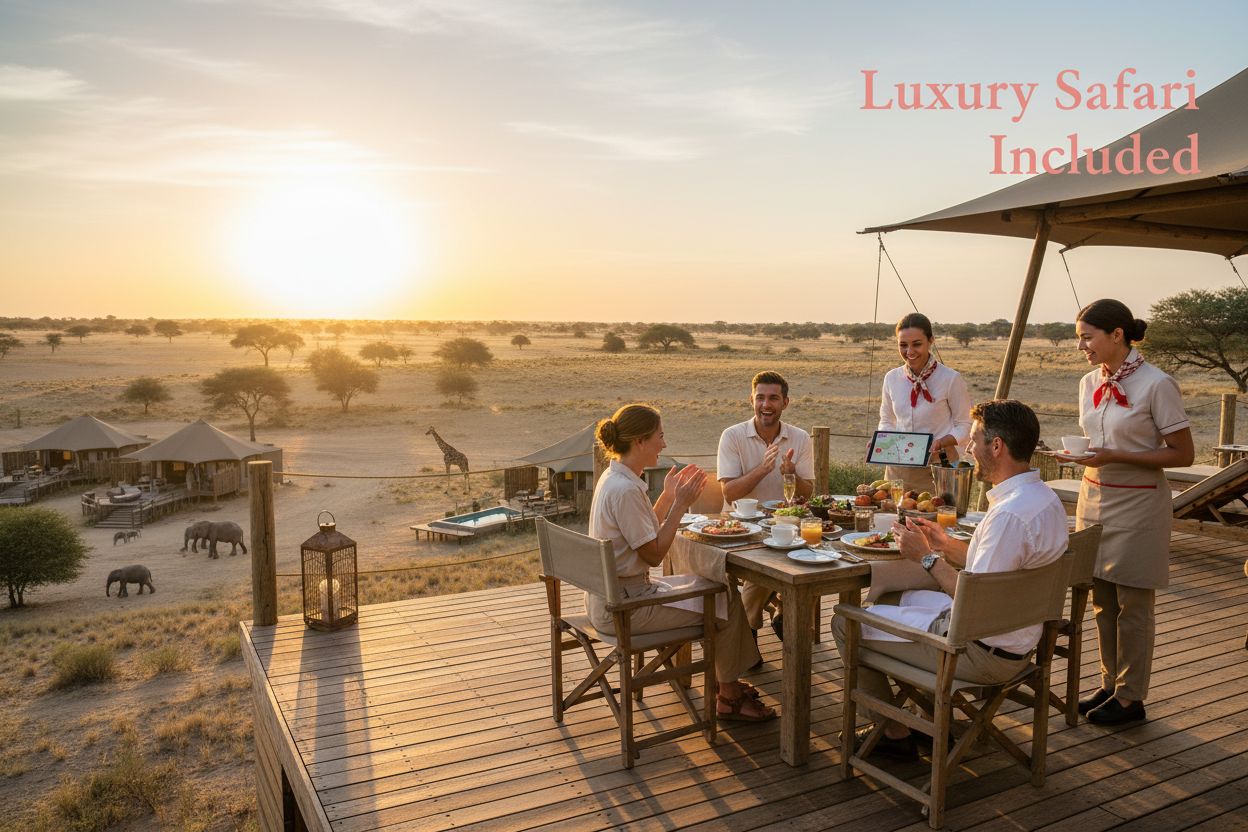
Understanding What is Included in Luxury Safaris
Explore what is included in luxury safaris, from exclusive accommodations to bespoke experiences that cater to discerning travelers.
Feb 24, 2026
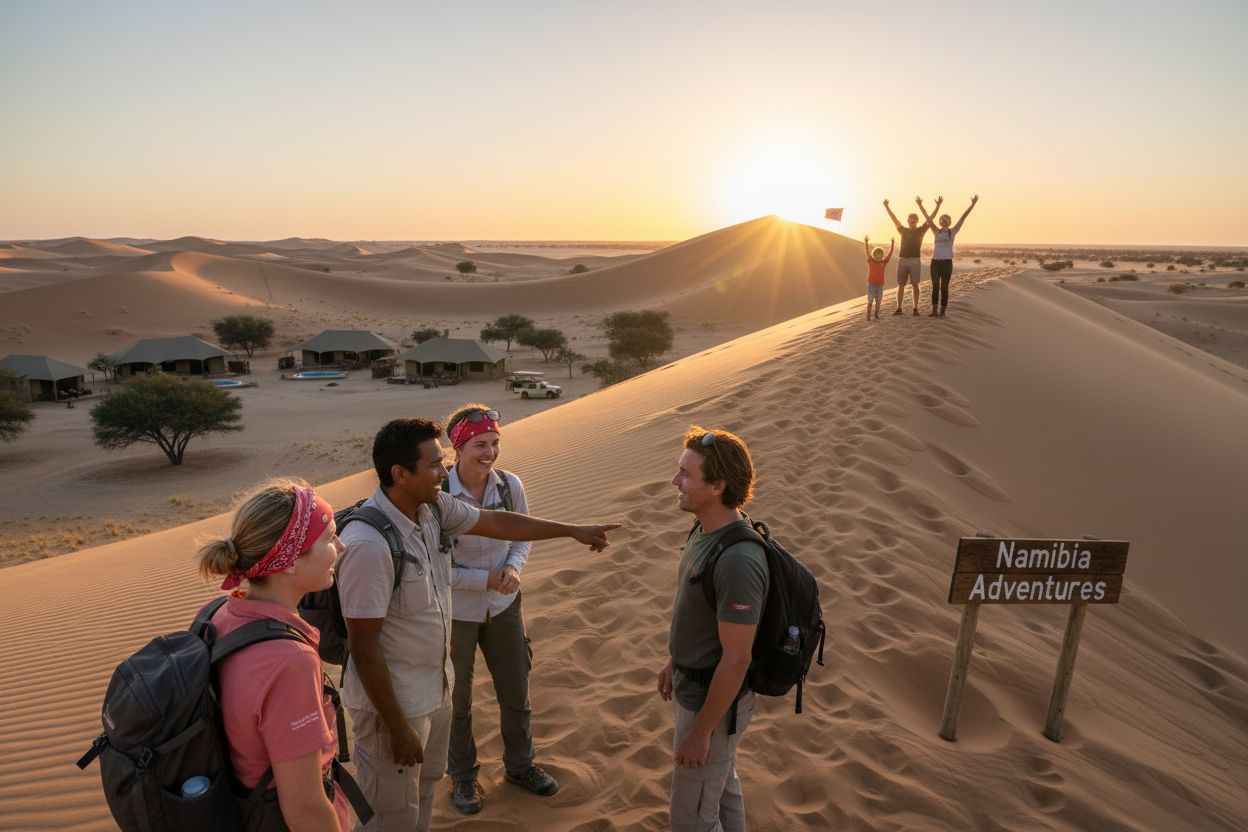
Why Namibia Adventures Matter: An In-Depth Look
Discover why Namibia adventures are essential for luxury travelers seeking unique, immersive experiences in nature and wildlife exploration.
Feb 23, 2026
What to Expect on a Luxury Safari: A Comprehensive Guide
Discover what to expect on a luxury safari and gain a deeper understanding of the unique experiences that await you in the wild.
Feb 22, 2026
Understanding Namibia Safari Costs Explained
Explore Namibia safari costs explained to uncover what influences pricing and what it means for your adventure.
Feb 21, 2026
Understanding the Role of Safari Experts in Wildlife Travel
Explore the role of safari experts and gain a comprehensive understanding of how they enhance wildlife travel experiences for all types of travelers.
Feb 20, 2026
Guide organisation safari all inclusive : vivez l'aventure de vos rêves
Découvrez notre guide organisation safari all inclusive étape par étape pour planifier un voyage inoubliable au cœur de la nature.