Aug 7, 2026
Discover how to plan luxurious safaris in Namibia with bespoke itineraries, exclusive lodges, and curated wildlife experiences.
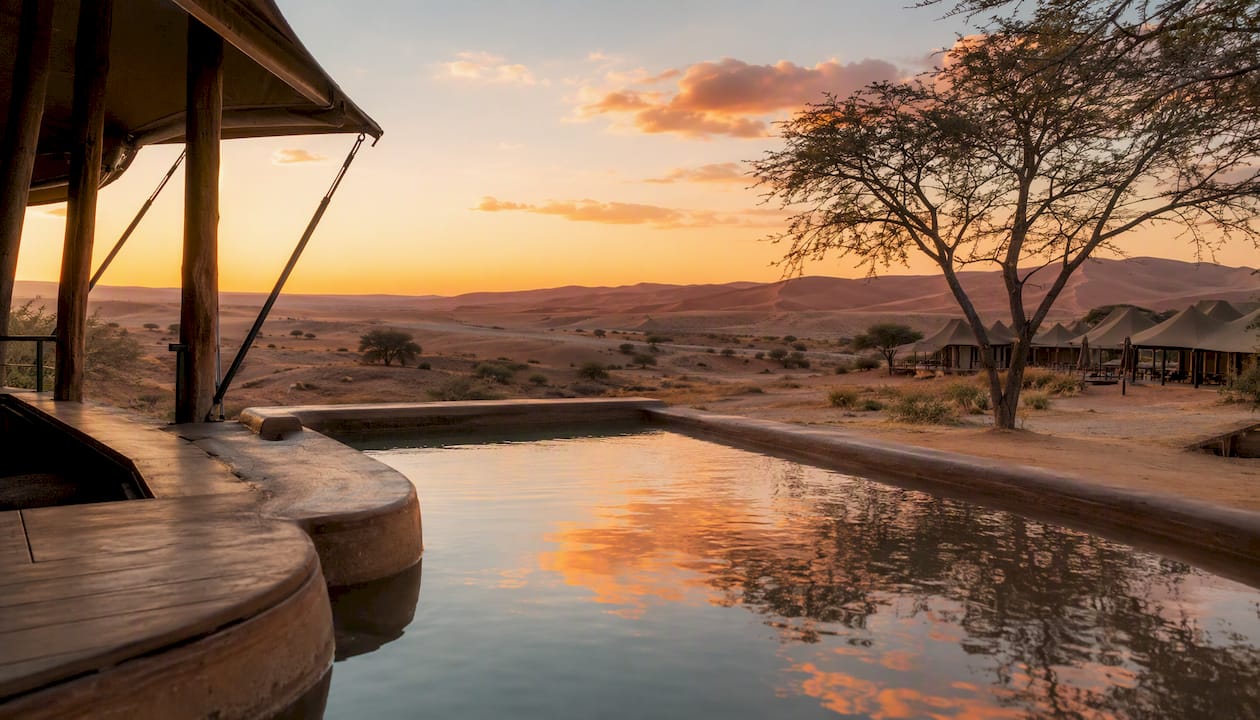
Luxury safaris in Namibia: the expert planning guide
The fastest way to secure a truly private, high-end Namibia safari is to book a bespoke, fly-in lodge circuit through a specialist planner like Secretnamibia. Private concession access, curated luxury wildlife experiences, and USD-transparent pricing are simply not available through generic booking platforms. Top suites at Wolwedans, Little Kulala, and Ongava Lodge often fill well in advance of peak season, so the single most important step you can take right now is to request a tailored quote and lock in your preferred dates before availability closes.
Namibia rewards the traveller who plans with intention. The towering crimson dunes of Sossusvlei, the vast salt pans of Etosha shimmering under an endless sky, the fog-laced Skeleton Coast where desert meets ocean, each landscape is so distinct that the right itinerary structure matters as much as the lodges themselves. National Geographic Expeditions frames Namibia’s luxury safari circuit as one of Africa’s most photogenic and least crowded, and that combination of drama and exclusivity is exactly what draws discerning travellers here year after year.
Key takeaways
The single most important decision for a luxury Namibia safari is choosing a specialist planner who can access private concessions, secure peak-season suites, and build a bespoke itinerary around your exact priorities.
Point | Details |
|---|---|
Book 12–18 months ahead | Peak suites at Wolwedans, Little Kulala, and Ongava fill far in advance; early deposits unlock value-adds. |
Match region to your priority | Sossusvlei for landscape photography, Etosha concessions for big game, Skeleton Coast for true wilderness. |
Budget $750–above $1,200 per person per night | Fully inclusive rates cover meals, drives, and park fees; international flights and gratuities are always extra. |
Verify conservation credentials | Ask lodges for anti-poaching budgets, community employment figures, and annual conservation reports. |
Use Secretnamibia for bespoke planning | Secretnamibia builds tailor-made fly-in circuits with direct lodge access and USD-transparent pricing. |
Table of Contents
Why private game reserves deliver luxury safaris in Namibia differently
Namibia’s top private reserves and luxury lodges, region by region
How do you choose the right luxury lodge or safari style?
What does a luxury Namibia safari actually cost?
Three sample luxury itineraries: 7, 10, and 14 days
When is the best time for luxury safaris in Namibia?
Travel logistics for US travellers: flights, visas, and health
How do luxury safaris support conservation in Namibia?
Why bespoke planning changes everything on a Namibia safari
Plan your luxury Namibia safari with Secretnamibia
Sources
Why private game reserves deliver luxury safaris in Namibia differently
National parks like Etosha are magnificent, but they operate under strict public-access rules: you stay on designated roads, share waterholes with other vehicles, and check in and out of gates at fixed times. Private reserves and concessions change all of that. Off-road tracking, walking safaris, night drives, and private waterhole hides become possible the moment you step onto a concession that a lodge manages exclusively.
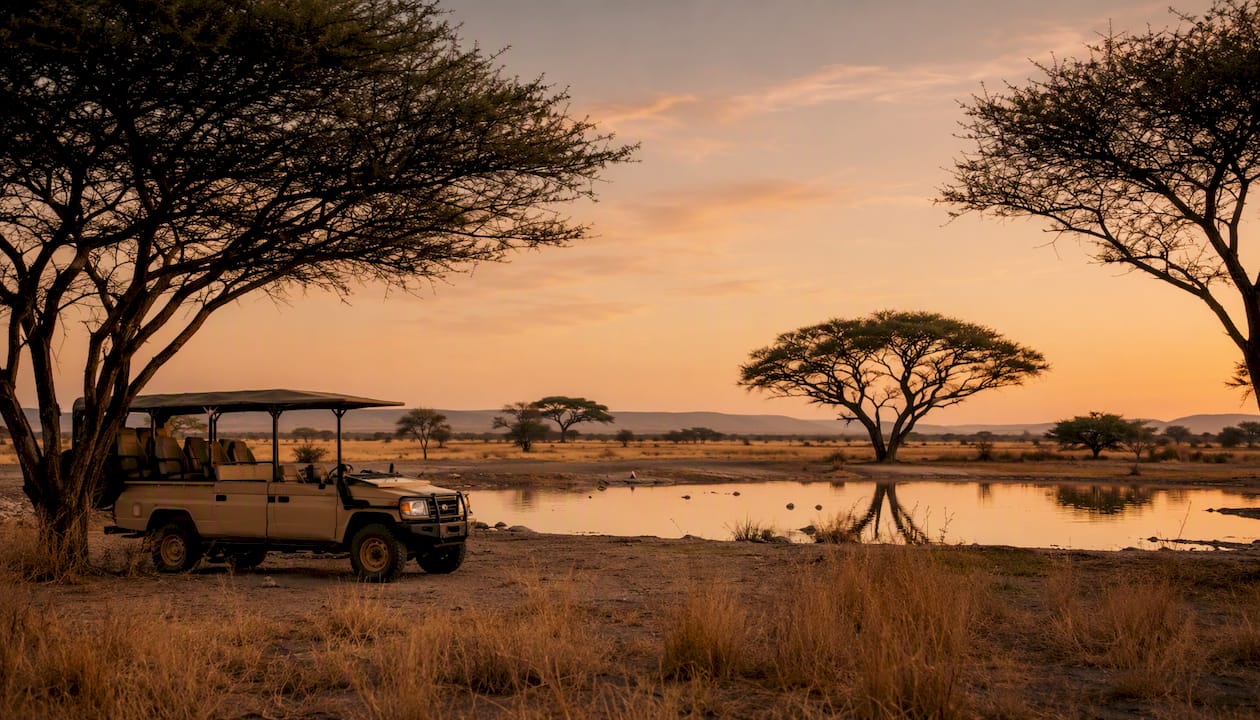
The difference in guest experience is tangible. A private reserve typically hosts far fewer vehicles per sighting, which means your guide can position the Land Cruiser for the best light and hold the spot as long as the wildlife cooperates. Guides on private land also tend to hold higher field qualifications — FGASA Level 2 or above is a reasonable benchmark to ask for — because the lodge’s reputation depends on the depth of interpretation they deliver.
Flexibility is the other major advantage. A bespoke itinerary built around a private concession can shift a morning game drive by two hours to catch golden-hour light over a dune, or extend a walking safari when a desert-adapted elephant herd moves through camp. That kind of responsiveness simply cannot happen inside a national park’s regulated framework. For affluent travellers who have already done the classic African circuits, Namibia’s private reserves offer something genuinely different: solitude, spectacle, and a level of personalisation that feels less like a tour and more like the country is yours for the week.
Namibia’s top private reserves and luxury lodges, region by region
The top luxury safari lodges in Namibia span five distinct ecosystems, each with its own character, wildlife, and access logic. Here is the expert shortlist, organised so you can match your priorities to the right region at a glance.
Namib Desert and Sossusvlei
The Namib is the world’s oldest desert, and Sossusvlei sits at its photographic heart. Towering apricot dunes, bleached white pans, and the ghostly skeletons of Deadvlei’s ancient camelthorn trees create a landscape unlike anything else on the continent.
Little Kulala (Wolwedans Collection, private Kulala Wilderness Reserve): thirteen free-standing “kulala” suites with private plunge pools and rooftop sleeping decks for star-gazing. Exclusive reserve access means early-morning dune walks before the day-visitor crowds arrive. Fly-in from Windhoek (WDH) to Kulala airstrip, roughly 45 minutes.
Sossusvlei Desert Lodge (NamibRand Nature Reserve): ten suites designed as low-profile stone pavilions that almost disappear into the desert floor. The NamibRand is a certified International Dark Sky Reserve, making the night-sky experience here extraordinary. Fly-in to Sossusvlei airstrip.
Wolwedans Dunes Lodge (NamibRand Nature Reserve): elevated wooden platforms with canvas walls frame 360-degree dune panoramas. The lodge’s conservation programme actively monitors desert-adapted species including brown hyena and aardwolf. Fly-in or a scenic four-hour self-drive from Windhoek.
Damaraland
Damaraland is raw, ancient, and strikingly beautiful — a terrain of volcanic rock formations, dry riverbeds, and desert-adapted elephants that travel extraordinary distances between water sources.
Damaraland Camp (Torra Conservancy): one of Namibia’s pioneering community-partnership lodges, built on a joint-venture model with the local Torra Conservancy. Guided walks and drives focus on tracking desert-adapted elephant and black rhino. Road transfer from Windhoek (approximately five hours) or fly-in to a nearby private airstrip.
Mowani Mountain Camp: dramatic boulder-perched chalets with sweeping views across the Huab River valley. The camp is small — twelve units — which keeps the experience genuinely intimate. Best accessed by fly-in.
Etosha and private concessions
Etosha National Park’s floodlit waterholes deliver some of Africa’s most theatrical wildlife viewing, but the private concessions bordering the park’s western and eastern edges add the off-road flexibility the park itself cannot offer.
Ongava Lodge (Ongava Private Game Reserve, adjacent to Etosha’s southern boundary): the reserve’s own white rhino population is a remarkable drawcard, and guided walks with armed rangers are a signature experience. Two airstrips serve the reserve; fly-in from Windhoek takes about 90 minutes.
Andersson’s at Ongava: a more intimate sister camp on the same reserve, with just nine rooms and a strong focus on photographic hides at a private waterhole. Shared airstrip access with Ongava Lodge.
Skeleton Coast and coastal lodges
The Skeleton Coast is one of Africa’s last true wildernesses — a fog-shrouded shoreline where desert dunes collapse into the cold Atlantic and brown fur seals haul out by the thousand. Access is tightly controlled, which keeps it spectacularly uncrowded.
Hoanib Skeleton Coast Camp: eight tented suites on the Hoanib River floodplain, with fly-in-only access via a private airstrip. Desert-adapted lion, giraffe, and elephant are regularly tracked from camp. The coastal excursion to the seal colony and shipwreck coast is a highlight unlike anything in the Namibian interior.
Swakopmund serves as a more accessible coastal base for travellers combining desert and ocean: quad-biking on the dunes, dolphin cruises, and Swakopmund’s adventure activities make it a natural add-on night between lodge stays.
Fish River Canyon and southern Namibia
The Fish River Canyon is the second-largest canyon in the world by volume, and the southern reaches of Namibia feel genuinely remote — a landscape of quiver trees, vast plains, and silence.
Canyon Lodge (near Fish River Canyon): stone chalets built into the canyon rim with private terraces overlooking the gorge. Guided canyon hikes and sundowner drives round out the experience. Road transfer from Windhoek (approximately five hours) or a short charter flight to Lüderitz or Keetmanshoop.
Africa Safari Magazine’s regional lodge roundup is a useful cross-reference for honest trade-off notes on each area.
How do you choose the right luxury lodge or safari style?
Start with one honest question: what is the single experience you would be most disappointed to miss? The answer usually points directly to the right region and lodge style.
Experience type vs. access trade-off
If landscape photography is your priority, the NamibRand reserves (Wolwedans, Sossusvlei Desert Lodge) offer the most extraordinary light, but they are fly-in destinations with limited road access. If big-game density matters most, Ongava’s private concession adjacent to Etosha gives you both the park’s waterhole spectacle and off-road tracking on the reserve. For romance and total privacy, a small camp like Andersson’s at Ongava or Mowani Mountain Camp — where you may be one of only a handful of guests — delivers an intimacy that larger lodges cannot match.
Guide qualifications and vehicle ratios
Ask every operator for their guides’ FGASA certification level and the maximum number of guests per vehicle. A ratio of four guests per vehicle is the luxury standard; six is acceptable, eight is not. Night-drive permits and walking-safari authorisation are worth confirming separately, as not every concession holds both.
Sustainability credentials
Look for lodges that publish anti-poaching budgets, name their community partners, and can tell you what percentage of staff are hired locally. The luxury safari features that genuinely distinguish Africa’s finest properties almost always include transparent conservation reporting, not just a logo on a brochure.
Booking windows and cancellation terms
Peak season (June–October) suites at top lodges typically sell out well in advance. Refundable-rate windows typically close 90–120 days before arrival, so booking early and securing a refundable deposit is the smarter play than waiting for a discount. Ask specifically: what is the cancellation penalty at 60 days, 30 days, and 14 days? Rigid 100%-non-refundable policies from the moment of booking are a red flag worth pressing on.
Red flags to watch for: opaque all-in pricing that bundles international flights without itemising them, conservation “partnerships” that amount to a donation box in the lobby, vehicle-to-guest ratios above six, and operators who cannot name the specific guide assigned to your trip.
What does a luxury Namibia safari actually cost?
Fully inclusive luxury safari packages at top private lodges typically start in the mid-$700s to $1,200+ per person per night. Ultra-luxury private villas, exclusive-use camps, and mobile tented expeditions sit above that range. Fly-in circuits add charter costs that vary by routing and group size but are often the most efficient way to cover multiple regions without losing days to road transfers.
Price bracket (per person per night) | Typically included | Typically excluded |
|---|---|---|
mid-$700s to $1,000 | All meals, house wines and spirits, twice-daily guided drives, laundry | International flights, gratuities, premium private charters, spa treatments |
up to $1,200+ | Above, plus scheduled charter transfers, private guide, curated activities | International flights, gratuities, exclusive-use supplements |
above $1,200 | Above, plus exclusive villa or camp, private vehicle, bespoke activity scheduling | International flights, premium alcohol, specialist equipment hire |
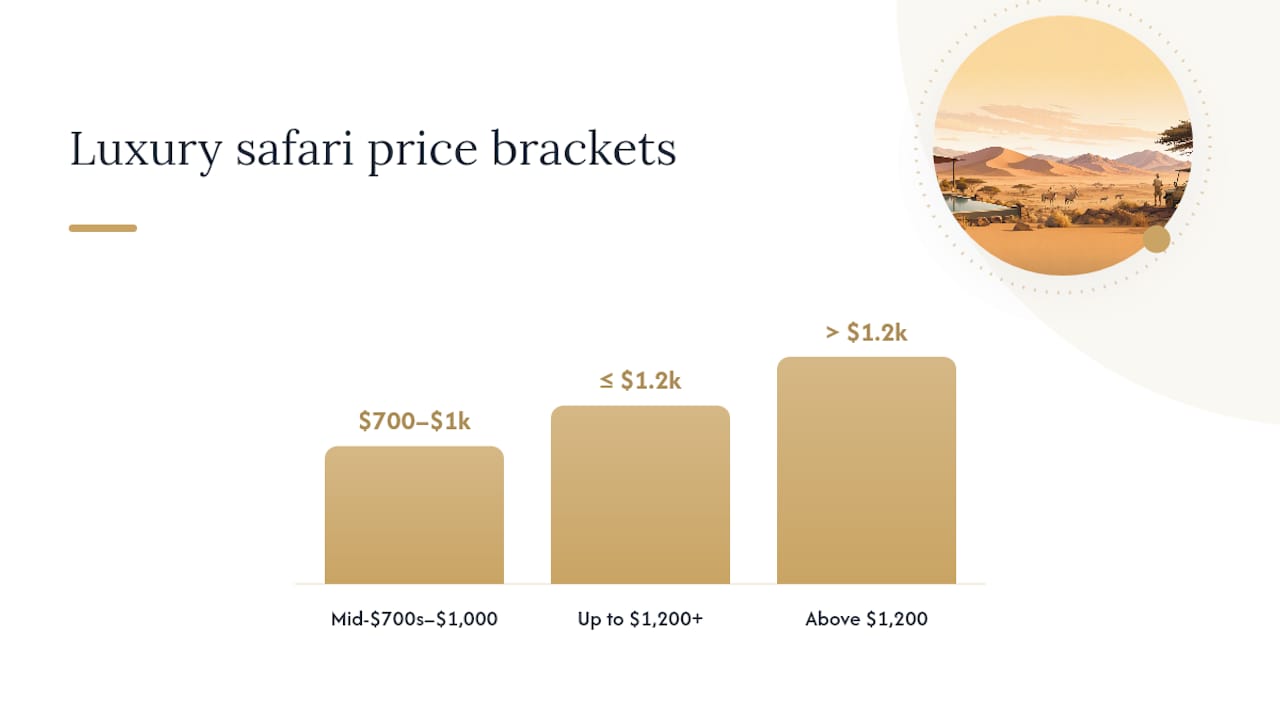
The distinction between per-night and per-trip pricing matters when you are comparing operators. A lodge quoting $950 per person per night on a fully inclusive basis may represent better value than a $700 rate that excludes activities, transfers, and drinks. Always request a fully itemised quote.
Inclusions vs. exclusions at a glance:
Included at most luxury lodges: all meals, house beverages, twice-daily game drives, park fees, laundry, Wi-Fi
Excluded at most luxury lodges: international flights, gratuities, premium spirits, spa, private charter upgrades, curated specialist experiences (photography workshops, cultural visits)
Tipping guideline (USD, per day): guide $15–$25; tracker $10–$15; lodge staff pool $10–$20 per room; transfer driver $5–$10
Pro Tip: Rather than negotiating a rate discount — lodges rarely move on rack rates — ask for value-adds: a private transfer upgrade, a complimentary spa credit, or a private dining experience under the stars. These are far easier for a lodge to grant and add genuine experiential value.
Three sample luxury itineraries: 7, 10, and 14 days
These itineraries are designed as frameworks; a specialist planner can adjust pacing, swap lodges, and add extensions based on your priorities. Secretnamibia’s custom itinerary service covers all three formats and more.
7-day fly-in honeymoon circuit (for couples seeking privacy and drama)
Estimated cost: $7,000–$10,000 per person, excluding international flights.
Days 1–2: Fly into Windhoek (WDH), overnight at a boutique guesthouse. Morning charter flight to Kulala airstrip; check in to Little Kulala. Afternoon dune walk, private sundowner on the dune crest.
Days 3–4: Early-morning access to Sossusvlei and Deadvlei before day visitors arrive. Afternoon at leisure with plunge pool and spa. Night under the stars on the rooftop sleeping deck.
Days 5–6: Charter flight to Ongava airstrip; check in to Andersson’s at Ongava. Two game drives daily, private waterhole hide session, guided walk with armed ranger.
Day 7: Morning drive, charter back to Windhoek, international departure.
Charter flights replace road transfers throughout, keeping the pace relaxed and the scenery spectacular from above.
10-day photographer’s circuit (for serious landscape and wildlife photographers)
Estimated cost: $10,000–$15,000 per person, excluding international flights.
Days 1–2: Windhoek arrival, overnight. Charter to NamibRand; check in to Sossusvlei Desert Lodge. Two nights for dune photography at dawn and dusk, dark-sky stargazing session.
Days 3–4: Charter to Damaraland; check in to Mowani Mountain Camp. Desert-adapted elephant tracking, Twyfelfontein rock-engraving site visit.
Days 5–7: Charter to Hoanib Skeleton Coast Camp. Desert-adapted lion tracking, coastal excursion to seal colony and shipwreck sites, fog-belt photography at sunrise.
Days 8–9: Charter to Ongava; two nights at Ongava Lodge. White rhino walks, Etosha waterhole drives at dusk.
Day 10: Charter to Windhoek, international departure.
Luggage on charter flights is typically limited to 15–20 kg in soft bags; camera gear counts toward that limit, so pack accordingly.
14-day grand circuit with coastal extension (for multi-destination explorers)
Estimated cost: $14,000–$22,000 per person, excluding international flights.
Days 1–3: Windhoek arrival. Self-drive south to Fish River Canyon; two nights at Canyon Lodge. Guided canyon rim walk, sundowner drive.
Days 4–6: Drive north to NamibRand; two nights at Wolwedans Dunes Lodge. Guided walks, private dining on the dune.
Days 7–8: Charter to Damaraland Camp. Community conservancy game drives, elephant tracking.
Days 9–11: Charter to Hoanib Skeleton Coast Camp. Coastal excursion, desert-adapted wildlife tracking.
Days 12–13: Charter to Ongava; two nights. Etosha day drives, private waterhole hide.
Day 14: Charter to Windhoek, international departure.
For honeymooners considering a Southern Africa extension, the top honeymoon destinations in South Africa pair beautifully with a Namibia circuit for a two-week combined trip.
Book peak-season suites (June–October) at least 12 months ahead. The Skeleton Coast camps in particular have very limited capacity and are often fully committed well in advance.
When is the best time for luxury safaris in Namibia?
The dry season from May through October is prime for wildlife concentrations and crisp photographic light. The green season from November through April suits birding, newborn wildlife, and the dramatic thunderstorm skies that transform the desert into something almost surreal.
Seasonal highlights at a glance:
May–June: Cooling temperatures, excellent game viewing as animals concentrate around water. Etosha waterholes begin their peak season. Comfortable nights require a fleece.
July–August: Peak dry season. Best waterhole action at Etosha; desert-adapted species most reliably tracked in Damaraland. Mornings can be cold (near freezing in the desert), afternoons warm.
September–October: Hot and dry; wildlife density at waterholes is extraordinary. Skeleton Coast fog season begins to lift. Book the furthest ahead for this window.
November–December: First rains arrive. Etosha fills with migratory birds; desert flowers briefly bloom. Fewer visitors, lower rates at some lodges.
January–March: Green season peak. Dramatic skies, lush NamibRand grasslands, newborn springbok and oryx. Birding in Etosha is exceptional. Some roads in Damaraland become impassable after heavy rain.
April: Transitional month; rains ease, temperatures moderate, and the landscape retains its green flush while wildlife viewing improves.
Packing note: desert nights drop sharply even in summer. Bring a warm layer for early-morning drives regardless of the month. Neutral colours (khaki, olive, grey) are standard for game drives; most lodges have a relaxed smart-casual dress code for evening dining.
Travel logistics for US travellers: flights, visas, and health
Plan international flights into Hosea Kutako International Airport in Windhoek (WDH). Most US travellers route through Johannesburg (JNB) on South African Airways, Ethiopian Airlines via Addis Ababa, or Lufthansa via Frankfurt. Allow at least two hours for connections in Johannesburg, and confirm that your checked luggage is re-tagged through to Windhoek.
Flights and internal transfers:
Scheduled charter flights within Namibia are operated by companies including Wilderness Air and Scenic Air, connecting Windhoek to private airstrips at lodges across the country.
Charter luggage limits are typically 15–20 kg in soft-sided bags; hard-shell suitcases are not permitted on most light aircraft.
Road self-drive is viable for the southern circuit (Fish River Canyon, NamibRand) on well-maintained gravel roads, but a 4x4 vehicle is strongly recommended.
Visas:
US passport holders receive a free visa on arrival in Namibia for stays up to 90 days. No advance application is required, but your passport must be valid for at least six months beyond your travel dates.
Health precautions:
The Windhoek area, NamibRand, and Fish River Canyon are considered malaria-free. Etosha, Damaraland, the Caprivi Strip, and the Skeleton Coast carry low-to-moderate malaria risk, particularly during the green season. Consult your physician about prophylaxis before travel.
Recommended vaccinations for Namibia include hepatitis A, typhoid, and routine boosters. Yellow fever vaccination is required if you are arriving from a country with yellow fever risk.
Comprehensive travel medical insurance with emergency evacuation coverage is non-negotiable for remote lodge stays. Medevac distances in northern Namibia can be significant.
Packing essentials for luxury safaris:
Layering system: lightweight base, fleece mid-layer, windproof shell
Binoculars (8x42 or 10x42 recommended)
Camera gear in a soft bag that fits within charter weight limits
Neutral-coloured clothing for game drives
Smart-casual evening wear for lodge dining (no jacket required at most lodges, but collared shirts are appreciated)
High-SPF sunscreen and lip balm for desert conditions
Pro Tip: Confirm all special requests — private dining setups, spa bookings, photography hide access — at least 30 days before arrival. Lodge operations teams can arrange remarkable experiences with notice, but last-minute requests often cannot be accommodated at small, fully-staffed camps.
How do luxury safaris support conservation in Namibia?
Many of Namibia’s finest private reserves reinvest a meaningful portion of their revenue directly into on-site conservation and community programmes. The conservation model behind luxury safaris is one of the most compelling arguments for choosing a private reserve over a national park: your nightly rate funds anti-poaching patrols, wildlife monitoring, and local employment in ways that a national park entrance fee simply cannot replicate at the same scale.
What to ask any lodge before booking:
Does the reserve run its own anti-poaching unit, and how is it funded?
What wildlife monitoring programmes are active on the concession (camera traps, tracking databases, species surveys)?
What percentage of staff are hired from local communities, and does the lodge support community benefit schemes beyond employment?
Is there a transparent annual conservation report available to guests?
Does the lodge participate in any carbon-offset or charter-consolidation programme?
Private reserves vs. national parks: Private reserves permit off-road tracking, walking safaris, night drives, and bespoke activity scheduling. National parks like Etosha enforce strict on-road-only rules and fixed gate hours, which limits the depth of wildlife interpretation a guide can offer. Both have value, and the best itineraries often combine a private concession stay with a day or two inside a national park for the sheer scale of its waterhole spectacle.
For carbon-conscious travellers, consolidating charter legs (flying with other guests rather than booking a private charter for two) meaningfully reduces per-person emissions. Ask your planner whether shared charter scheduling is available on your preferred routing.
Why bespoke planning changes everything on a Namibia safari
There is a version of a Namibia trip that ticks the boxes: a rental car, a few nights at a well-reviewed lodge, a day at Sossusvlei. It is a fine trip. But it is not the same as arriving at a private waterhole at 5:30 AM, positioned by a guide who has been watching a desert-adapted lion pride for three days and knows exactly where they will drink. That kind of access comes from a planner who has relationships with lodge managers, knows which suites face the waterhole, and can call ahead when a rare sighting develops.
Bespoke planning also matters for safety and flexibility. When a charter is delayed by weather or a road washes out after unexpected rain, a specialist planner has the contacts to reroute quickly, hold your next lodge, and keep the experience intact. A generic booking platform cannot do that. The tailor-made safari approach is not a luxury add-on; for a country as logistically complex as Namibia, it is the difference between a trip that flows and one that fragments.
Private villa dining after a guided walk, a timed photography drive at a floodlit waterhole, a San cultural experience woven into a Damaraland itinerary — these are the details that make a safari genuinely memorable, and they are the details a specialist planner builds in as a matter of course.
Plan your luxury Namibia safari with Secretnamibia
Secretnamibia specialises in tailor-made fly-in circuits, private-guided drives, villa and group options, and conservation-partnership itineraries across Namibia’s finest private reserves. Every trip is built from scratch around your priorities: the landscapes you want to photograph, the wildlife you want to track, the pace you want to keep.
After you enquire, you receive a detailed itinerary outline, a fully itemised USD quote, and an availability check on your preferred suites — all within a few working days. The team’s direct relationships with lodges like Wolwedans, Little Kulala, and Ongava mean access to suites and experiences that are not available through general booking channels. Read more about what defines a world-class experience on the luxury safari features page, or browse the full range of Namibia safari options to find the style that fits your trip.
Peak-season suites fill 12–18 months ahead. An early deposit secures your preferred dates and opens the window for value-adds that later bookings cannot access. Send your enquiry today and let Secretnamibia build the Namibia trip you have been imagining.
Sources
Recommended
RELATED
Safari Guides
Oct 30, 2025
Understanding What is Included in Luxury Safaris
Explore what is included in luxury safaris, from exclusive accommodations to bespoke experiences that cater to discerning travelers.
Feb 24, 2026
Why Namibia Adventures Matter: An In-Depth Look
Discover why Namibia adventures are essential for luxury travelers seeking unique, immersive experiences in nature and wildlife exploration.
Feb 23, 2026
What to Expect on a Luxury Safari: A Comprehensive Guide
Discover what to expect on a luxury safari and gain a deeper understanding of the unique experiences that await you in the wild.
Feb 22, 2026
Understanding Namibia Safari Costs Explained
Explore Namibia safari costs explained to uncover what influences pricing and what it means for your adventure.
Feb 21, 2026
Understanding the Role of Safari Experts in Wildlife Travel
Explore the role of safari experts and gain a comprehensive understanding of how they enhance wildlife travel experiences for all types of travelers.
Feb 20, 2026
Guide organisation safari all inclusive : vivez l'aventure de vos rêves
Découvrez notre guide organisation safari all inclusive étape par étape pour planifier un voyage inoubliable au cœur de la nature.