
2026年4月5日
Discover what wildlife conservation really means and how your luxury Namibian safari choices directly fund protection, biodiversity, and community impact.
What is wildlife conservation? The traveller’s guide to impact
TL;DR:
Wildlife conservation involves protecting ecosystems and human communities, not just individual species.
Tourism revenue, especially from luxury safaris, funds conservation efforts and supports local livelihoods.
Traveller choices and responsible bookings directly influence conservation success and community benefits.
Most people picture wildlife conservation as rangers protecting lions or scientists tagging elephants. That picture is real, but it’s only a small part of a much larger story. True conservation covers entire ecosystems, the plants and soils and rivers that hold wildlife together, and the human communities that live alongside nature every day. As a traveller choosing a Namibian safari, you sit right at the centre of this story. Your decisions about where to stay, which operator to book, and how you move through wild spaces directly shape whether conservation efforts succeed or quietly fall apart.
Table of Contents
What wildlife conservation really means
How wildlife conservation works: Core strategies and tools
Economic drivers: How tourism and luxury safaris fund lasting impact
Making a difference: What every eco-conscious traveller should know
The uncomfortable truth: Conservation only works when travellers get involved
Plan your luxury safari for impact
Frequently asked questions
Key Takeaways
Point | Details |
|---|---|
Conservation goes beyond animals | Wildlife conservation protects entire ecosystems, not just rare animal species. |
Your travel choices have impact | Eco-conscious safari decisions directly support conservation and community welfare. |
Tourism funds real change | Well-managed luxury safaris provide lasting revenue for protection, research, and local empowerment. |
Actions matter | Choosing credible operators, eco-lodges, and authentic experiences maximizes your positive footprint. |
What wildlife conservation really means
Laying the groundwork for why wildlife conservation matters, let’s clarify what it truly involves.
Wildlife conservation is the planned protection, management, and sustainable use of wild animal and plant species and their habitats, aimed at preventing extinction, maintaining biodiversity, and ensuring ecological balance while considering human needs. That last part is crucial. Conservation is not about locking nature away from people. It is about finding ways for nature and people to thrive together, which is exactly why your safari experience matters so deeply.
Biodiversity, meaning the variety of life in a given area, is the foundation of every healthy ecosystem. When one species disappears, the effects ripple outward in surprising ways. Remove a predator and prey populations explode. Lose a pollinator and plant communities collapse. Drain a wetland and the animals that depended on it scatter or vanish. These connections are why conservation targets whole systems, not just individual animals.
For travellers, this has a very practical meaning. The magnificent landscapes you photograph in Namibia, the vast salt pans of Etosha, the ancient dunes of the Namib, the riverine forests of the Caprivi Strip, exist because ecosystems have been protected and managed over decades. Without that sustained effort, the wildlife encounters that define a great safari simply would not be possible.
Some common misconceptions are worth addressing directly:
Conservation is not anti-development. Managed land use and regulated tourism are central tools.
Conservation does not ignore local people. Community involvement is essential, not optional.
Conservation is not a government-only responsibility. Travellers, operators, and private landowners all play active roles.
Understanding the role of conservation in luxury safaris helps you see why the choices you make before you even board a plane carry real weight.
Conservation goal | What it protects | Why it matters for travellers |
|---|---|---|
Prevent extinction | Rare and iconic species | Ensures wildlife encounters remain possible |
Maintain biodiversity | Ecosystems and food webs | Keeps landscapes wild and spectacular |
Sustainable use | Habitats and natural resources | Supports long-term safari viability |
Community benefit | Local livelihoods | Creates stable, safe destinations |
“The health of an ecosystem is measured not by its most famous species, but by the invisible connections holding all of its parts together.”
How wildlife conservation works: Core strategies and tools
With a clear understanding of what conservation entails, we can explore the practical tools and approaches that make it happen.
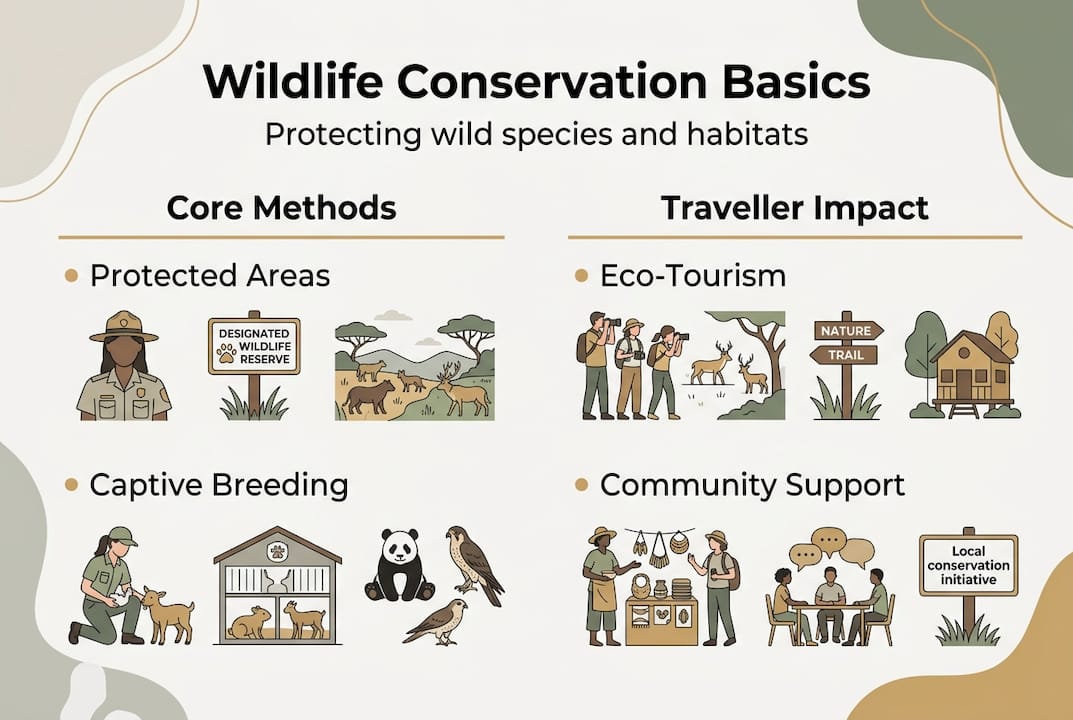
Conservation professionals use two broad categories of approach. In-situ conservation protects species in their natural habitats through national parks, private reserves, and community conservancies. Ex-situ conservation involves removing animals from the wild to breed them in controlled environments, then reintroducing them once populations are stable. Both approaches are essential, and Namibia uses both actively.
Key conservation methodologies include protected areas, habitat restoration, captive breeding, reintroduction programmes, law enforcement, community involvement, anti-poaching patrols, wildlife monitoring, and sustainable use through regulated ecotourism.
Here is how in-situ and ex-situ conservation compare in practice:
| Approach | Where it happens | Namibian example | Traveller connection |
|—|—|—|
| In-situ | Wild habitats | Etosha National Park, communal conservancies | Game drives, walking safaris |
| Ex-situ | Captive facilities | Cheetah breeding programmes | Sanctuary visits, education centres |
On the ground, conservation in Namibia relies on several practical strategies working together:
Anti-poaching patrols staffed by trained community members who protect animals from illegal hunting.
Wildlife monitoring using camera traps, GPS collaring, and aerial surveys to track population health.
Habitat restoration that repairs degraded land so it can support wildlife again.
Regulated ecotourism that generates income while limiting environmental impact.
Community education that builds local support for conservation goals.
As a traveller, you connect most directly with regulated ecotourism, but your booking choices also fund the other four strategies. Choosing operators committed to sustainable tourism in Namibia means your trip supports the full chain of conservation work, not just the parts you see.
Pro Tip: When evaluating a safari operator, ask specifically which conservation projects they fund and whether they partner with community conservancies. Operators with genuine commitments will answer this question with specifics, not generalities. Those who cannot are worth reconsidering. Visiting private reserves in Namibia is one of the most direct ways to ensure your tourism spend reaches active conservation programmes.
Economic drivers: How tourism and luxury safaris fund lasting impact
Understanding the strategies is key, but achieving real-world impact depends on how these efforts are funded, especially through tourism.
Conservation costs money. Anti-poaching units need salaries, vehicles, and equipment. Researchers need funding. Habitat restoration requires labour and materials. The single most powerful and sustainable source of this funding in Namibia is tourism, and specifically the kind of high-value, low-volume tourism that luxury safaris represent.
Tourism revenue in conservancies consistently exceeds hunting revenue, while also supporting more jobs, generating broader community income, and creating long-term incentives to protect wildlife rather than consume it.
Namibia’s communal conservancy model is one of the most celebrated conservation success stories on the continent. Communities that once had little reason to protect wildlife now earn meaningful income from it. That income funds schools, clinics, and infrastructure, making conservation genuinely attractive rather than an external imposition.
Here is a snapshot of how tourism funding flows through conservation systems:
Funding source | What it supports | Community benefit |
|---|---|---|
Lodge fees | Anti-poaching, habitat work | Employment, local procurement |
Guided safari fees | Ranger salaries, training | Skills development |
Conservation levies | Research, monitoring | Long-term wildlife security |
Community conservancy fees | Direct community income | Schools, health, infrastructure |
The practical benefits for travellers choosing luxury eco-lodges are significant:
You fund conservation directly through lodge fees and levies.
You create employment for local guides, trackers, and hospitality staff.
You generate demand that makes wildlife more economically valuable than poaching.
You support research that improves conservation outcomes over time.
Exploring eco-lodges in Namibia gives you a clearer picture of how specific properties channel their revenue into measurable conservation results. If you want to see this in action, browsing sustainable stays in Namibia reveals properties where every night you spend directly funds wildlife protection.
Making a difference: What every eco-conscious traveller should know
The power of your safari experience lies in how you make choices that reinforce or undermine wildlife conservation goals.
Conservation outcomes depend heavily on community involvement and sustainable use through ecotourism. That means your individual choices genuinely shift the balance. This is not marketing language. It is the operational reality of how conservation funding works.
Here are the most impactful actions you can take as a traveller:
Book certified operators. Look for membership in recognised bodies like the Namibia Tourism Board or affiliations with conservation organisations.
Choose lodges with verifiable projects. Ask for specifics: which conservancy do they support, how many rangers do they fund, what research do they contribute to?
Use local guides. Local knowledge is irreplaceable, and local employment keeps conservation revenue within communities.
Respect wildlife distances. Keeping appropriate distance reduces stress on animals and protects the natural behaviours that make wildlife viewing extraordinary.
Avoid single-use plastics. Waste management in remote areas is a genuine conservation challenge, and reducing your footprint matters.
Avoiding greenwashing is equally important. Some operators use conservation language without the substance to back it up. Here is how to verify genuine impact:
Ask for the name of the specific conservancy or project they support.
Request evidence of funding, such as annual reports or project updates.
Check whether local community members are employed in senior roles, not just entry-level positions.
Look for third-party certifications rather than self-awarded labels.
Pro Tip: The most powerful question you can ask any operator is: “What percentage of my safari fee goes directly to conservation and community projects?” A genuine operator will know the answer. Discovering ways to support endangered species in Namibia gives you concrete actions beyond the safari itself. Understanding safari sustainability in Namibia will show you how the broader industry is evolving to meet conservation demands.
The uncomfortable truth: Conservation only works when travellers get involved
Rounding out the practical takeaways, it is time for some hard truths and an unfiltered look at what really determines the fate of Namibian wildlife.
Conservation is often spoken about as though it is the exclusive domain of scientists, governments, and NGOs. The uncomfortable reality is that in destinations like Namibia, it survives or fails based almost entirely on traveller demand and traveller dollars. No amount of goodwill from conservation organisations can substitute for the economic engine that tourism provides.
This means that every itinerary choice you make reallocates resources. Booking a lodge inside a conservancy rather than a city hotel sends money to rangers. Choosing a fly-in safari over a self-drive in sensitive areas reduces habitat pressure. These are not abstract ethical positions. They are direct resource allocation decisions.
There is also a more complex truth worth sitting with. Combining photo tourism and regulated hunting maximises economic and conservation benefits without over-exploiting wildlife. Namibian conservancies earned N$460 million from hunting and tourism combined, a figure that funds conservation at a scale no single approach could achieve alone. Many travellers are uncomfortable with this reality, but dismissing it does not make conservation more effective. It makes it less so.
The travellers who make the greatest difference are those who engage honestly with these complexities, choose luxury wildlife experiences that are transparent about their funding models, and ask the hard questions before they book.
Plan your luxury safari for impact
With the essential role of the eco-conscious traveller established, here is how you can take practical action, starting with your own safari experience.
At Secret Namibia, every luxury safari in Namibia we design is built around properties and operators with genuine conservation commitments. We do not simply list beautiful lodges. We partner with those who fund anti-poaching, employ local communities, and contribute to the long-term health of Namibia’s wild places.
If you are ready to experience luxury wildlife encounters that leave a positive mark on the landscapes you love, we would love to help you plan every detail. Reach out to our team through Secret Namibia enquiries and let’s create a safari that is as meaningful as it is magnificent.
Frequently asked questions
What is the main purpose of wildlife conservation?
Wildlife conservation is the planned protection and sustainable use of wild species and their habitats, aimed at preventing extinction, maintaining biodiversity, and keeping ecosystems balanced while accounting for human needs.
How do luxury safaris support conservation in Namibia?
Luxury safaris in conservancies generate more revenue than hunting alone, directly funding anti-poaching operations, habitat protection, research, and community employment across Namibia’s conservancy network.
What actions can travellers take to support wildlife conservation?
Book with certified eco-operators, choose lodges with verifiable conservation projects, use local guides, and ask specifically what percentage of your fees reaches conservation and community programmes.
Why is community involvement important in wildlife conservation?
Local communities manage conservation areas daily, benefit economically from tourism, and are the most effective barrier against poaching, making their active involvement essential to any conservation programme’s long-term success.
Recommended
相关
萨法里指南
2025年10月30日
Understanding What is Included in Luxury Safaris
Explore what is included in luxury safaris, from exclusive accommodations to bespoke experiences that cater to discerning travelers.
2026年2月24日
Why Namibia Adventures Matter: An In-Depth Look
Discover why Namibia adventures are essential for luxury travelers seeking unique, immersive experiences in nature and wildlife exploration.
2026年2月23日
What to Expect on a Luxury Safari: A Comprehensive Guide
Discover what to expect on a luxury safari and gain a deeper understanding of the unique experiences that await you in the wild.
2026年2月22日
Understanding Namibia Safari Costs Explained
Explore Namibia safari costs explained to uncover what influences pricing and what it means for your adventure.
2026年2月21日
Understanding the Role of Safari Experts in Wildlife Travel
Explore the role of safari experts and gain a comprehensive understanding of how they enhance wildlife travel experiences for all types of travelers.
2026年2月20日
Guide organisation safari all inclusive : vivez l'aventure de vos rêves
Découvrez notre guide organisation safari all inclusive étape par étape pour planifier un voyage inoubliable au cœur de la nature.