
Where to Stay in Etosha: Okaukuejo, Halali, Namutoni or a Private Lodge Outside the Gate?
Quick answer
Stay inside Etosha for at least a night or two if you want floodlit waterholes beside your camp and to be on the road at sunrise. Stay at a private reserve outside the gate, such as Ongava or Onguma, for night drives, guided walks and more personal service. Most trips work best with both, split between west and east.
At a glance
| Short answer | Combine both: 1 to 2 nights inside the park for the camp waterholes, 2 or more at a private lodge for guided activities |
|---|---|
| Camps inside the park | Okaukuejo (west), Halali (centre), Namutoni (east), run by Namibia Wildlife Resorts |
| Private reserves outside the gate | Ongava (next to Anderson Gate) and Onguma (next to Namutoni), plus other lodges around the park |
| Night drives and walks | Not available to self-drivers inside the park; offered by some private lodges (check per property) |
| Park gates | Anderson, von Lindequist, King Nehale and Galton |
| Gate times | Tied to sunrise and sunset, so they change through the year; check Namibia Wildlife Resorts before you travel |
| Booking | As soon as your dates are fixed; May to October is the busiest period |
| Our Etosha trips from | US$2,210 per person (5 days, self-drive), as of November 2026 |
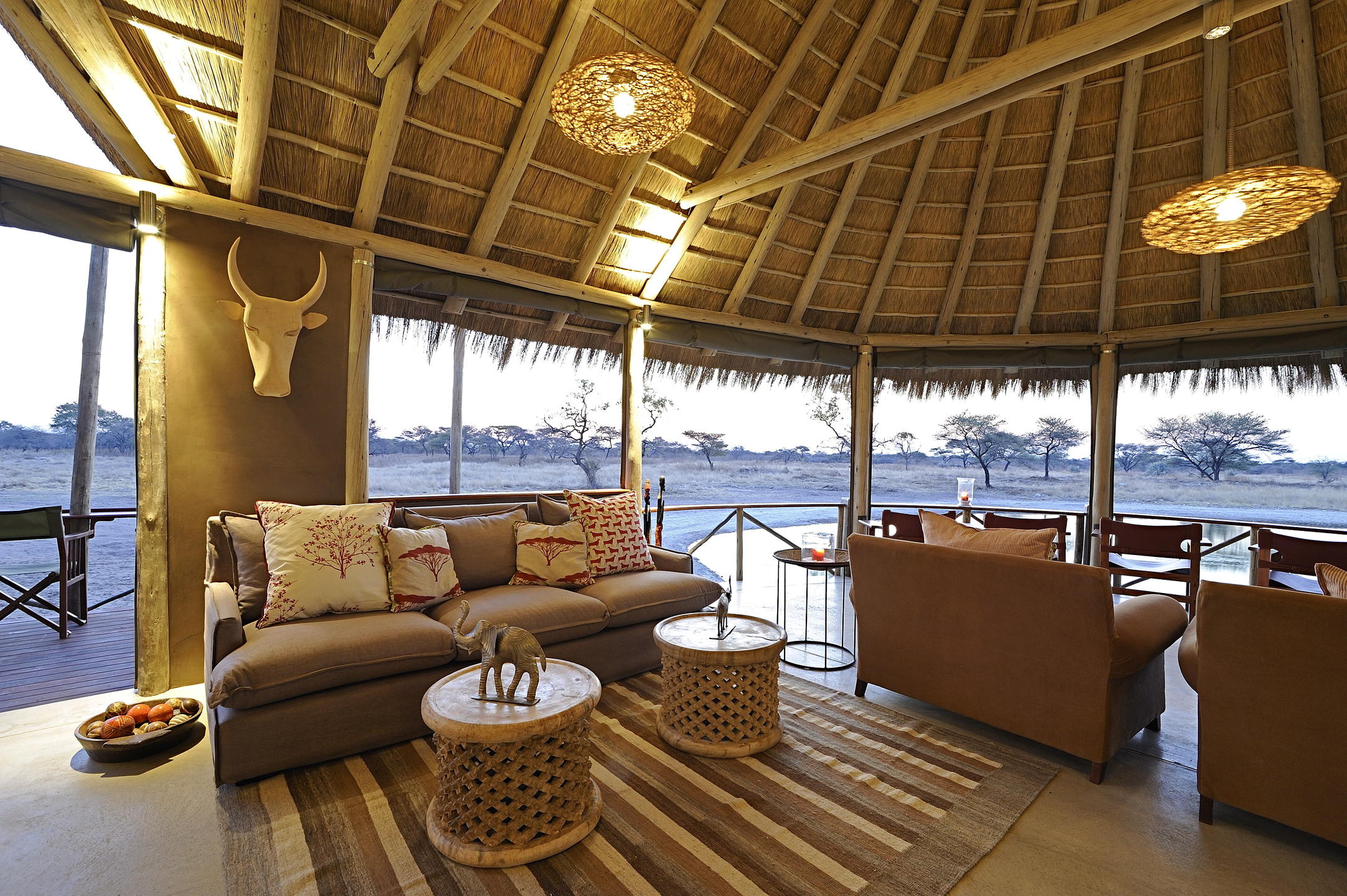
Should I stay inside or outside Etosha?
For most travellers the best answer is both. Stay inside the park for one or two nights to get the camp waterholes and an early start, then add a night or more at a private lodge outside the gate for guided activities and a quieter, more comfortable base.
Which one you lean towards depends on what you want from the trip. The table below is the rule we use when we plan Etosha stays.
| You care most about | Lean towards | Why |
|---|---|---|
| Watching a floodlit waterhole after dinner | Inside the park | The camp waterholes are a short walk from your room, with no driving after dark |
| Being at a waterhole at sunrise | Inside the park | You are already past the gate when it opens |
| Night drives and guided walks | Private reserve outside the gate | Self-drivers cannot drive inside the park after dark; private reserves set their own rules |
| Service, food and room quality | Private reserve outside the gate | Smaller lodges with guides and a more personal style |
| Lowest cost | Depends on the property | Compare current rates for the exact dates; we do not quote rack rates here because they change |
| Fewer vehicles at a sighting | Private reserve outside the gate | Private reserves usually run guided drives with only a few vehicles |
One caution before we go further. Park rules, gate times and camp rates change, so we point you to the official source wherever a fact is time-sensitive. Namibia Wildlife Resorts publishes booking and park information at nwr.com.na.
How do the camps compare (waterholes, condition)?
The three state-run camps are Okaukuejo in the west, Halali in the middle and Namutoni in the east. Okaukuejo is the strongest for watching game from the camp itself, Halali is the smallest and quietest, and Namutoni is the most atmospheric, built around a white fort.
| Camp | Where | Waterhole | Character |
|---|---|---|---|
| Okaukuejo | West, near Anderson Gate | Floodlit waterhole beside the camp; black rhino, elephant and lion often come after dark | Largest and most resort-like, with a pool and a viewing tower |
| Halali | Centre of the park | Floodlit Moringa waterhole, reached on a short path against a rocky outcrop | Smallest and quietest; a useful midpoint stop |
| Namutoni | East, near von Lindequist Gate | Klein Namutoni, more a lookout than a floodlit show | Colonial fort setting, close to the pans and good for birding |
Okaukuejo: the best waterhole to sit at
If you only spend one night in a state-run camp, we would usually make it Okaukuejo. The waterhole is next to the camp, so you can watch after dinner without driving anywhere, and it has a reputation for black rhino at night.
The size is the trade-off. It is the busiest of the three, and you share the waterhole benches with other guests.
Halali: smaller, quieter and less predictable
Halali's Moringa waterhole is a short walk up a path from the camp, tucked against rock. It is often described as hit-and-miss, but it can be very good for leopard and rhino, and a quiet evening there feels different from a crowded one at Okaukuejo. We cover it in more detail in our Halali guide, and our piece on floodlit waterholes and things to do in Etosha explains how to watch one well.
Namutoni: fort, pans and birds
Namutoni is the one to choose for atmosphere. The whitewashed fort is the focal point, the pans are close, and the eastern side suits birders. Its Klein Namutoni waterhole is a lookout rather than a floodlit spectacle, so do not expect the Okaukuejo experience at night.
Other state-run options
Namibia Wildlife Resorts also runs Dolomite Camp in the restricted western area and the Onkoshi chalets at Namutoni. We check the current status of both before we recommend them, and you should too.
What condition are the camps in?
Guest reviews of the state-run camps have been mixed for some time, mostly on service, food and maintenance. The location and the waterholes are the draw, not the standard of the rooms. We do not assume that any camp has been refurbished or is fully open. Check recent reviews and the Namibia Wildlife Resorts site for the dates you want, or ask us and we will check before we book.
What do private reserves add (Ongava, Onguma: night drives, rhino walks)?
Private reserves add guided activities that self-drivers cannot do inside the national park: night drives, guided walks and sundowner drives with a guide who finds the animals for you. They also add smaller lodges, more personal service and fewer vehicles at a sighting.
The main reason is the driving rule. Inside the park, self-drive visitors drive only in daylight, between the gate opening and closing times. Once the gates close, a camp waterhole is the only game viewing available. A private reserve next to the park can offer night drives, walks and other guided activities on its own land.
Ongava: the southwest, beside Anderson Gate
Ongava Game Reserve lies next to Anderson Gate, the southern entrance used by most visitors coming from Windhoek or Outjo. It has several camps, including Ongava Lodge, Andersson's Camp and Little Ongava. The reserve is known for its rhino and offers guided activities. The exact list differs by property, so we confirm which camp offers which activity (night drives, walks, rhino tracking) when we plan your stay.
Onguma: the east, beside Namutoni
Onguma sits beside Namutoni and has several camps in different styles, from the fort-style property to the simpler Onguma Bush Camp. It offers guided drives, and the closeness to the von Lindequist Gate makes it a convenient base for the eastern half of the park.
Other lodges outside the gates
There is a wider band of lodges around the park, including Etosha Safari Lodge, Mokuti, Taleni Etosha Village, Hobatere, Toshari, Epacha and Mushara. They differ a lot in style and in how far they sit from the nearest gate. We would not choose between them on a name alone. Distance to the gate matters more than any other factor for your day, as we explain below.
What a private reserve does not give you
You are not in the park when the gate opens, so your first game drive starts with a transfer. You may also pay park entry separately for each day you enter, so ask whether it is included in the lodge rate. Finally, the camp waterhole at Okaukuejo is something no private lodge can replicate. Our guide to private game reserves explains the wider benefits.
How far ahead should you book?
Book Etosha as soon as your dates are fixed, and book it before anything else on your itinerary. Etosha has a limited number of beds, and the camps and small private lodges are widely reported to fill early in the dry season, roughly May to October.
We cannot give you a verified release date for the state-run camps. We would rather tell you that than quote a guess. What we can say is practical:
- Peak months (May to October): plan in terms of many months ahead, not weeks. Small lodges with a handful of rooms go first.
- Shoulder and wet-season months: there is usually more choice, but the best-positioned rooms still go early.
- Fixed route trips: if you are driving Etosha as part of a longer journey, Etosha is the stop with the least flexibility. Build your other stops around it.
- Specific rooms: if you want a particular chalet or a camp close to the waterhole, ask early.
If your dates are close, ask us anyway. We check availability across both state-run camps and private lodges before we tell you what is realistic.
Should you split east and west?
Yes, on a stay of three nights or more. The east and west feel different, and splitting the stay saves you a long drive on the day you leave. The west has the Okaukuejo waterhole and its rhino. The east has the fort, the pans and a quieter feel.
How far is it between camps?
As a rough guide, Okaukuejo to Halali and Halali to Namutoni are each about 70 to 75 km, so the whole stretch from west to east is in the region of 145 km. Park speed limits are low and you will stop for game, so allow most of a day for it. Confirm current distances and road conditions with us when you plan.
How our itineraries split it
Our own trips show the pattern. Prices are per person, from, as of November 2026. We list the number of Etosha nights as they appear on each itinerary, and the areas follow our destination pages for Etosha West, Etosha South and Etosha East.
| Trip | Length | Etosha nights | From (per person) |
|---|---|---|---|
| 5 Day Etosha National Park Self Drive Safari | 5 days | East 2, South 1 (starts at Okonjima Private Reserve) | US$2,210 |
| 8 Day Etosha Self Drive Adventure | 8 days | East 3, South 2 | US$3,423 |
| Namibia Highlights Safari | 11 days | South 1, East 2 | US$3,272 |
| Classic Namibia Safari | 16 days | West 1, South 2, East 2 | US$4,979 |
These are guides to the pattern, not the only option. Because we plan tailor-made, you can change the balance, for example more nights in the west if rhino are your priority.
Which direction should you drive?
Let your route decide. If you arrive from Damaraland or Kaokoland, enter from the west and finish in the east. If you arrive from Windhoek and Central Namibia, the southern Anderson Gate is the usual entry, and you can finish in the east before heading back. We plan the order so that your longest park day is not also your departure day.
What do gate times mean for your day?
Inside the park, your day runs from gate opening to gate closing, and both are tied to sunrise and sunset. You must be at your camp, or out of the gate, by sunset. As a self-driver you cannot drive in the park after dark, so your best game viewing hours are the first ones after sunrise and the last ones before sunset.
We do not quote exact opening and closing times here. They shift through the year, with noticeably shorter days in June and July than in December, and we have not verified the current published times. Check Namibia Wildlife Resorts for the dates you travel.
A typical day inside the park
- Dawn: leave camp as the gate opens and go straight to a waterhole. Animals tend to drink early.
- Mid-morning: drive between waterholes, or return to camp for breakfast.
- Midday: rest at the pool, since game thins out in the heat.
- Afternoon: head out again, planning to be back well before sunset.
- Evening: dinner, then the floodlit waterhole.
A typical day from a lodge outside the gate
The structure is the same, but you add a transfer at each end. The time rule for lodges outside the gate, including when you must be out of the park, is worth checking with your lodge. Distance matters here. A lodge right beside a gate, as Ongava is beside Anderson Gate, costs you very little at dawn. A lodge further away takes a bigger bite out of your best light.
Ask each lodge three things: how far is the nearest gate, what time do they advise leaving to be there at opening, and what do they advise for the return so you are not racing the sunset. We ask these questions for you when we plan, and we also use the gates that suit your direction: Anderson, von Lindequist, King Nehale or Galton.
Which is best for families?
For families the easiest set-up is usually a camp with a pool and flexible rooms, so children can rest in the midday heat between drives. Inside the park that means the state-run camps. Outside the park, it means checking each lodge's child policy first.
We could not verify minimum ages at any property for this guide. Some private lodges restrict young children, or restrict them from night activities and walks. That matters if a night drive or a rhino walk is part of the reason you chose a private reserve. Namibia Wildlife Resorts also lists family accommodation options, which are worth asking about.
Tips that help in practice
- Keep park days short with young children. A dawn drive and an afternoon drive with a pool break between is easier than a long day in the car.
- Use the floodlit waterhole for the evening. It needs no driving and an early bedtime is no loss.
- Tell us the ages of your children when you enquire, so we only shortlist properties that accept them.
For a wider look at the country with children, see Why Namibia for Families. If you would rather fly between camps than drive, our 13 Day Namibia Luxury Family Fly-in Safari includes four nights in Etosha and is from US$14,384 per person as of November 2026.
So what would we book?
The answer depends on how long you have. These are the patterns we use as a starting point, and we adjust them to your dates and budget.
| Etosha nights | Our usual split |
|---|---|
| 2 | One night at a private lodge near the gate you enter by, one night at a camp with a waterhole |
| 3 to 4 | One or two nights in the west (Okaukuejo or Ongava), one or two in the east (Namutoni or Onguma) |
| 5 or more | West, centre and east, mixing state-run camps with a private lodge for guided activities |
If your trip continues beyond Namibia, Secret Namibia also plans Botswana, Victoria Falls and South Africa, and we can join them to your Etosha stay.
Frequently asked questions
Can I visit Etosha as a day trip from a lodge outside the park?
Yes. Many people sleep outside the gate and drive in each morning. The catch is the transfer at each end and the gate times, which follow sunrise and sunset. Choose a lodge close to the gate you will use, and ask how long the drive takes. If you want two or more days of game driving, staying close to a gate saves you the most time.
Can I do a night drive in Etosha as a self-driver?
Not inside the national park. Self-drive visitors drive only in daylight, so the camp waterholes are the way to see animals after dark. Guided night drives are offered by some private reserves next to the park. Whether a particular lodge offers them differs by property, so confirm this before you book rather than assuming it.
How many nights do you need in Etosha?
We suggest at least two nights, and three or four if you can. Two nights gives you a full day and two partial ones. Three or four lets you split the stay between two areas, such as west and east, and see different habitat. Our shortest Etosha trip is five days overall, and our longer routes allow up to five nights in the park.
Do I pay park entry if I stay outside Etosha?
Normally yes, because you pay to enter the park each day you drive in. Whether entry is included in a lodge's rate varies, so ask. Fees depend on whether you are Namibian, SADC or international, and they change, so check the current figures with Namibia Wildlife Resorts or the Ministry of Environment, Forestry and Tourism before you travel.
Do I need a 4x4 to drive in Etosha?
For the main park roads between the camps, a standard vehicle is often sufficient, but road conditions change with weather and use. Gravel roads outside the park, on the way to some lodges, can be rougher. We match the vehicle to your route and travel dates, so tell us where you are staying and we will advise.
Do I need malaria tablets for Etosha?
Etosha is in northern Namibia, where malaria is a consideration, and the risk is generally higher in the wet season. We are not medical professionals and have not verified current guidance for this article. See a travel clinic or doctor well before you travel, and check the latest official health advice for the months you plan to visit.
Is Halali worth staying at?
It can be, especially as a midpoint. Halali is the smallest of the three camps and the quietest, and its Moringa waterhole is good for leopard and rhino on the right night. It is less predictable than Okaukuejo, so it suits travellers who like a calmer base. It also breaks the long drive between west and east.