
Do I Need a 4x4 in Namibia? 2WD vs 4x4 and Rooftop Tents by Route
Quick answer
No, you do not need a 4x4 for most classic Namibian routes. A 2WD car with good tyres handles tar and well-kept gravel to Sossusvlei, Swakopmund, Etosha and Damaraland's main roads in dry weather. You need a 4x4 for the last 5 km to Deadvlei, Kaokoland, Khaudum and other sand tracks, and nearly all rooftop-tent campers are 4x4 double cabs.
At a glance
| Short answer | 2WD is fine for most classic routes in dry weather; 4x4 for sand and remote areas |
|---|---|
| 4x4 needed | Deadvlei last 5 km (or take the shuttle), Kaokoland, Khaudum, rough Kunene and sand tracks |
| Rooftop tent | Almost always means a 4x4 double cab |
| Camper from (as of November 2026) | About US$100 to US$165 per vehicle per day base rate, before cover |
| Cover add-ons | Roughly US$25 to US$35 per day for lower excess plus tyre and windscreen cover |
| Contract check | Gravel, sand track, speed limit, border and night-driving clauses |
| Deadvlei shuttle (as of August 2026) | About US$14 per adult return, about US$7 per child under 12 |
| Rate used | About N$18 to US$1, for illustration only |
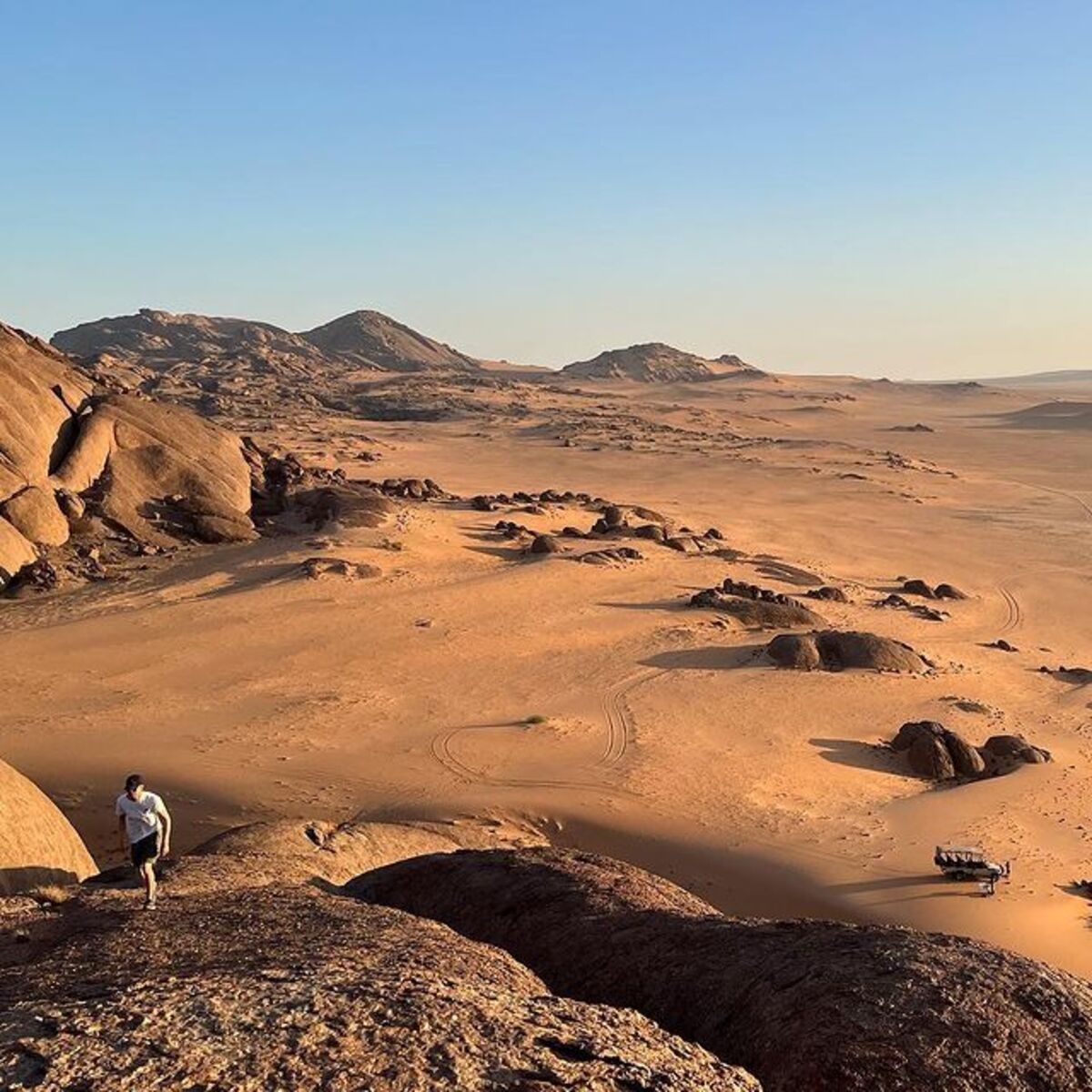
Do I need a 4x4 in Namibia?
Not for most first trips. A 2WD car with good tyres covers the tar and well-graded gravel between Windhoek, Sossusvlei, Swakopmund, Etosha and the main roads of Damaraland in normal dry conditions. A 4x4 becomes necessary for soft sand and remote tracks, and for anyone choosing a rooftop-tent camper, because almost all of those are 4x4 double cabs.
So the real question is not 2WD versus 4x4 in the abstract. It is which roads your route uses, what your rental contract allows, and whether you want to sleep in a tent or a lodge. We take each in turn below. For the wider picture of driving yourself, start with our self-drive safari guide.
One note on sources. The rental prices and the 2026 Sossusvlei rules below come from operator and travel-site pages, not from a government notice we could open ourselves, so we flag where you should confirm before you travel. Everything is as of November 2026.
Which routes are 2WD-able?
Most of the standard circuit is. Namibia has a very large unpaved network, reported at over 40,000 km, and much of it is graded gravel that an ordinary car handles at sensible speeds. A 2WD works on the main roads to the big-name stops, provided the car has good tyres, decent ground clearance and you drive to the surface.
The table below is our own assessment of normal dry-season conditions. It is a guide, not a road report, and surfaces change after grading or rain.
| Route | Typical surface | Vehicle in normal dry conditions |
|---|---|---|
| Windhoek to Sesriem and Sossusvlei (to the 2x4 car park) | Tar and gravel; tar from the Sesriem gate to the car park, about 60 km | 2WD is fine |
| Swakopmund, Walvis Bay, Cape Cross | Tar and salt road | 2WD is fine |
| Etosha main roads (Okaukuejo, Halali, Namutoni) | Graded gravel inside the park, tar to the gates | 2WD is fine |
| Damaraland (Twyfelfontein, Spitzkoppe, Brandberg) | Gravel, some stony and corrugated stretches | 2WD with higher clearance usually copes; 4x4 is more comfortable and needed for riverbed tracks |
| Fish River Canyon and Luderitz | Gravel and tar | 2WD is fine |
| Kalahari, Central Namibia, Waterberg | Tar and gravel | 2WD is fine |
| Zambezi region | Tar on the main road, sand on side tracks | 2WD on the main road; 4x4 for sand tracks |
| Deadvlei, last 5 km | Soft sand | 4x4, or the shuttle |
| Kaokoland, Marienfluss, Van Zyl's Pass | Rough, stony and sandy tracks | High-clearance 4x4 |
| Khaudum National Park | Deep sand tracks | High-clearance 4x4 |
You will find blanket advice online that Damaraland or the Skeleton Coast always needs a 4x4. We would not repeat that unchecked. The main gravel roads to Twyfelfontein or Spitzkoppe are regularly driven in ordinary cars, while the riverbed and sand routes around them are not. Ask your lodge about the exact road on the day.
What does a 2WD still need on gravel?
Good tyres matter more than drive type. A puncture is the most common gravel problem, so check the spare, ask whether you get two spares (one rental guide recommends two for gravel), and know where the jack and wheel spanner are before you leave Windhoek.
Keep below 80 km/h on gravel, avoid sharp braking or sudden turns, and slow right down for corrugations, soft patches and oncoming dust. We cover this further in the driving section near the end.
Is the rainy season a problem for 2WD?
It can be. Namibia's heaviest rain usually falls from about January to April, though some online guides stretch the wet season back to November. After heavy rain, gravel can wash out, and dry riverbeds can run. Ask your lodge about conditions a few days ahead, and treat the 2WD advice above as a dry-weather rule.
Our own routes are planned with the road in mind. The Namibia Highlights Safari (11 days, from US$3,272 per person) links Sossusvlei, Swakopmund, Damaraland and Etosha, the classic circuit where vehicle choice is flexible. Our specialists confirm the right car for each itinerary when we plan it.
Where is a 4x4 required (Deadvlei last 5 km, Kaokoland, Khaudum)?
A 4x4 is required for the soft-sand last 5 km to Deadvlei if you drive yourself, and for the remote areas of Kaokoland and Khaudum. Elsewhere it is a comfort rather than a rule. Here is how each one works.
Deadvlei: the last 5 km
The tar road from the Sesriem gate runs about 60 km to the 2x4 car park, passing Dune 45 at about 45 km. Beyond that, a track of about 5 km of soft sand leads towards Deadvlei, then it is roughly 1 km on foot each way to the pan. Hiddenvlei is a walk of about 2 km each way. Distances are from sossusvlei.com and deadvlei.org.
The access rule changed twice in 2026. According to Inside Namibia's account of the ministry updates, a 15 April announcement said that from 1 May only the concession shuttle and registered guides could use the stretch. A new notice of 2 May then said 4x4 self-drivers may continue to Deadvlei, with the shuttle optional and buses and trucks banned. As of August 2026, sossusvlei.com still said self-drivers in a proper 4x4 may drive the last five kilometres.
We could not open the ministry notice itself, so please confirm on the day. Phone your lodge a few days before and ask again at the gate.
| Option | Vehicle | Cost (as of August 2026) | Notes |
|---|---|---|---|
| Drive the last 5 km yourself | Proper 4x4, with the rental contract allowing the sand track | No extra fee reported | Deflate tyres at the 2x4 car park and re-inflate after |
| Concession shuttle (run by About Africa) | Any car to the 2x4 car park | About US$14 per adult return, about US$7 per child under 12 (N$250 and N$125) | About 10 minutes each way |
| Walk from the car park | Any car | Free | Long and hot; not recommended midday |
If you are in a 2WD, the shuttle solves the problem neatly. Several guides suggest reaching Deadvlei before 07:30 for fewer people and cooler air.
Kaokoland and the Kunene
Kaokoland, in the far north-west, is the clearest case for a high-clearance 4x4. The tracks to Marienfluss, Van Zyl's Pass and the Himba areas are rough, stony and sandy, and help is far away. We could not verify current permit or closure details for this edition, so check before you plan.
Practical rules we apply here: travel with fuel and water reserves, carry full recovery gear, know how to change a wheel, and ideally drive in two vehicles. Many self-drivers instead go in with a guide or fly in. Read more on our Kaokoland destination page.
Our Classic Namibia Safari (16 days, from US$4,979 per person) includes a night in Kaokoland, so we plan the vehicle and arrangements for that leg carefully.
Khaudum National Park
Khaudum, in the north-east, is known for deep sand tracks. It is a high-clearance 4x4 park, and a solo vehicle is not advisable. We could not verify the current entry fee, minimum number of vehicles or wet-season restrictions for this guide, so check the latest requirements with the park authority before booking and do not rely on a 2WD in any case.
Other remote areas
The same logic applies to sandy riverbed routes in Damaraland and the far north, such as the Hoanib and Hoarusib, and to the Nyae Nyae and Tsumkwe sand tracks. If your route includes any of them, either take a proper 4x4 with recovery gear and an experienced driver, or let a guide do the driving.
Rooftop tent vs lodges: what are the trade-offs?
A rooftop tent buys you freedom and a lower nightly cost. Lodges buy you comfort, security, meals and a guide who knows the roads. The choice also decides your vehicle, because a rooftop-tent camper in Namibia is almost always a 4x4 double cab, such as a Hilux-type vehicle.
| Factor | Rooftop-tent camper | Lodges |
|---|---|---|
| Vehicle | 4x4 double cab, usually | 2WD or 4x4, your choice |
| Cost | Higher vehicle rate, lower accommodation spend | Lower vehicle rate, higher accommodation spend |
| Flexibility | High, within campsite availability | Fixed bookings, tied to the itinerary |
| Daily effort | Pitching, cooking, packing and washing up | Arrive, check in, eat |
| Comfort | Basic; desert nights can be cold | Beds, showers and meals; heating in some |
| Timing | Arrive at camp before dark; gate times apply | Same driving limits, but staff can help |
| Local knowledge | Yours | Lodge hosts and guides |
On cost, one published 22-day two-person trip report put camper hire including insurance at roughly two and a half times what the traveller spent on campsites and accommodation combined (about 40 per cent). That does not prove camping is cheaper overall, because the page does not give a lodge comparison. The camper is the big line, which is why you should price both versions of your route. Our Namibia travel budget article breaks down typical spend.
Who suits a rooftop tent?
It suits confident drivers who enjoy camping, want to stay flexible and are comfortable with basic facilities. It also suits groups of three or four, since the vehicle and tents are shared across the group.
Who suits lodges?
Lodges suit first-time visitors, anyone short of time, and travellers who want to spend the evening watching wildlife rather than cooking. They also let you use a 2WD for most of the circuit.
What if I do not want to drive at all?
Guided and fly-in safaris remove the vehicle question entirely. Our Namibia Explorer Luxury Fly In Safari (13 days, from US$12,716 per person) links Sossusvlei, the Skeleton Coast, Kaokoland and Etosha by light aircraft, which is a practical way to reach the roughest areas. Our Damaraland page shows how guided options work in that region.
Does the rental contract allow 2WD on gravel?
Often yes, but the wording decides. In Namibia gravel roads are normal public roads, and a forum poster on Tripadvisor notes that contracts commonly say you must stay on public roads, not on tar. But standard insurance is built around tarred roads, and gravel damage to tyres, windscreen and underbody is often excluded unless you buy extra cover.
One South African agreement quoted on that thread voids cover if damage results from driving on a road the lessor reasonably considers unsuitable for the vehicle. That is not a Namibian contract, and we could not review contracts from named Namibian companies, so treat it as an example of why you must read yours.
Before you sign, check each of these (per deadvlei.org's rental guide):
| Clause | What to look for |
|---|---|
| Gravel speed limit | Contracts may set 60 or 80 km/h; breaking it can void cover |
| Sand tracks | The contract must explicitly allow them, for example the last 5 km to Deadvlei |
| Exclusions | Rollovers, unapproved roads, water damage and underbody damage |
| Spare wheels | Two spares are recommended on gravel |
| Night driving | Check for restrictions |
| Border crossings | Prior written approval and border papers |
Three practical points follow. First, tyre and windscreen cover is described by one insurance guide as arguably the most essential add-on. Second, credit-card cover often excludes 4x4s and bakkies as well as gravel damage, so get written confirmation if you rely on it. Third, single-vehicle accidents such as rollovers or swerving into a tree are often excluded or costly, which is a good reason to keep speeds down.
If your trip crosses into Botswana, Victoria Falls or South Africa, you need that written approval and the right papers first. Secret Namibia also plans these trips and can handle the paperwork side.
What does a camper cost?
Expect a base rate of about US$100 to US$165 per day for a rooftop-tent 4x4 double cab from Namibian operators, before cover. Cover can add about US$25 to US$35 per day or more, so compare base plus cover. All prices below are per vehicle per day, excluding fuel, park fees, campsites and flights, as of November 2026.
Operators quote in Namibian dollars. We convert at an illustrative N$18 to US$1, so check the live rate before you budget.
| Operator and product | Approx. price per day | Notes |
|---|---|---|
| Viatu: budget camping double cab (Hilux) | From US$147 (N$2,640) | Roof tent, fridge, gas cooker, full kitchen kit |
| Viatu: comfort camping double cab | US$162 (N$2,910) | Upgrade on the budget version |
| Viatu: non-camping 4x4 Jimny | US$70 (N$1,268) | For lodge-based trips |
| Viatu: non-camping Hilux or Fortuner | US$133 (N$2,400) | For lodge-based trips |
| Viatu: non-camping Prado | US$222 (N$4,000) | For lodge-based trips |
| Advanced Car Hire: Hilux camper | From US$101 (N$1,822) to US$118 (N$2,119) | Older Hilux, low season, 15+ days; newer Hilux for the higher figure |
| Namibia Destinations: Hilux with one rooftop tent | From US$114 (N$2,050) | High-season base; cover is extra |
| Namibia Destinations: green season 4x4 | From US$86 (N$1,550) | 15 November to 14 March |
The listed rates are operator rack rates and some pages show low-season and long-hire discounts. One comparison site shows far lower or higher figures depending on dates, so do not mix those with operator prices. Viatu's prices match one other operator's listing, so they may share a fleet, and it is worth confirming the live price.
What do cover and extras add?
| Extra | Approx. price |
|---|---|
| Excess waiver | About US$16 per day (N$280) |
| Zero-excess cover | About US$25 to US$26 per day (N$449 to N$475) |
| Tyre waiver, or tyre and windscreen cover | About US$8 to US$9 per day (N$145 to N$170) |
| Full cover bundle quoted by one operator | About US$34 per day (N$620) |
| Cleaning fee | About US$22 once (N$400) |
As a worked example, a 14-day hire at US$150 to US$200 per day, base plus cover, comes to roughly US$2,100 to US$2,800. That is our arithmetic from the quoted rates, not an operator quote. Add fuel, park entry, campsites and flights. Unlimited kilometres and VAT are included at some operators but not all, so ask.
What gear is included?
Most camper rentals include the rooftop tent or tents, bedding on some, a fridge, a gas cooker and a boxed kitchen kit. But lists vary by company, so ask for the inventory in writing before you pay.
What the operator pages we reviewed show:
- Namibia2Go Hilux camper: two soft-cover rooftop tents (or two hard-shell tents on the comfort option), camping boxes with cutlery and crockery for four, full-time four-wheel drive, five seats and sleeping for four (operator page).
- Viatu budget camper: roof tent, electric fridge, gas cooker and a complete kitchen kit.
- Namibia Destinations: a full camping kit with one or two rooftop tents.
- Advanced Car Hire Luxury Cruiser: onboard shower, toilet and fresh-water tank, plus live GPS tracking and 24-hour support.
Ask specifically about the items that differ most between companies:
- Tables, chairs and bedding
- Water containers and a compressor for tyre pressures
- Tyre repair kit, jack and recovery gear
- Second spare wheel and a second battery
- GPS or paper maps
Check the lot at pick-up, not at the first campsite. Switch the fridge on, open every box and make sure the spare, jack and spanner all work.
How should I drive gravel and sand safely?
Drive slowly and early. Keep below 80 km/h on gravel, which is the advice from forum posters and a common contract limit, and which we recommend too. Avoid hard braking, take corrugations steadily and move over for oncoming vehicles to avoid stones.
For sand, deflate your tyres at the 2x4 car park, where there is room to do it, and re-inflate afterwards. Keep your momentum, avoid sudden steering and never stop on a soft slope. Plan fuel at every opportunity, because distances between pumps can be long, and avoid driving after dark, since wildlife and livestock are on the roads. For wider route ideas, our Namibia road trip guide covers 4x4 planning in more detail.
Frequently asked questions
Can I drive to Sossusvlei in a normal car?
Yes. The road from Windhoek to Sesriem is a mix of tar and graded gravel, and the tar continues from the Sesriem gate to the 2x4 car park, about 60 km. A normal car works for the dunes along that road, including Dune 45. Only the last 5 km of soft sand towards Deadvlei needs a 4x4 or the shuttle.
Is a Toyota Corolla or similar saloon okay in Namibia?
It can be, on tar and well-graded gravel in dry weather, and some travellers do it. The risks are low ground clearance, vulnerable tyres and contract limits. Many rental contracts exclude damage on gravel unless you buy extra cover, so an SUV or higher-clearance car is a safer choice for a multi-week route.
Do I need two vehicles in Kaokoland?
Travelling in two vehicles is widely recommended for the remote parts of Kaokoland, because help is far away and recovery from sand or rock is much easier with a second car. We could not verify any formal rule, so check current guidance. Many travellers choose a guide or a fly-in option instead.
Can I take a rental car into Botswana or South Africa?
Only with prior written approval from the rental company and the right border papers. Contracts typically treat unapproved border crossings as a breach, which can void insurance. Ask at booking, not at pick-up. Secret Namibia also plans trips that continue into Botswana, Victoria Falls and South Africa.
Is credit-card insurance enough for a Namibian rental?
Not always. Cover offered with credit cards often excludes 4x4s, bakkies and gravel damage, which describes much of a Namibian trip. If you plan to rely on it, get written confirmation that it covers the exact vehicle and road types. Otherwise, buy tyre and windscreen cover and an excess waiver from the rental company.
Is it safe to drive in Namibia at night?
We advise against it. Wildlife, livestock and pedestrians are hard to see on unlit roads, and some rental contracts restrict night driving. Park gates and camps also close around sunset. Plan each day so you arrive at your lodge or camp with daylight left.
Should I rent a 4x4 just in case?
Only if your route or tent choice needs one. A 4x4 costs more per day and uses more fuel, and it does not remove the need for careful gravel driving. If you stay on main roads and use the Deadvlei shuttle, a 2WD usually saves money. If you plan Kaokoland, Khaudum or a rooftop tent, rent the 4x4.
Sources
- Sossusvlei permits, gates and park rules (sossusvlei.com) sossusvlei.com
- Sossusvlei: Dunes, Pans and How to Visit from Sesriem (deadvlei.org) deadvlei.org
- Sossusvlei Deadvlei Access: May 2026 Ministry Update (Inside Namibia) inside-namibia.travel
- A Complete Guide to Sossusvlei (Viatu) viatu.com
- Namibia Car Rental 2026 (deadvlei.org) deadvlei.org
- Namibia 4x4 Rental: How to Choose (Viatu) viatu.com
- 4x4 Camping Car Rental in Namibia (Advanced Car Hire) advancedcarhire.com
- 4x4 Camping Vehicle Rental Namibia (Namibia2Go) namibia2go.com
- 4x4 Rental Namibia (Namibia Destinations) namibiadestinations.com
- Namibia Road Trip Cost 2026 (Sheroams the Globe) sheroamstheglobe.com
- Car hire for gravel roads? (Tripadvisor Namibia Forum) tripadvisor.com.ph
- Namibian Car Rental Insurance Guide (Qeeq) qeeq.com