Three Floodlit Waterholes and Things to Do in Etosha

Three Floodlit Waterholes and Things to Do in Etosha

Aug 29, 2026

Plan a slow, wildlife first Etosha trip. Learn where to base, which three rest camps have floodlit waterholes to watch at dusk, how long to stay, and...
Three Floodlit Waterholes and Things to Do in Etosha


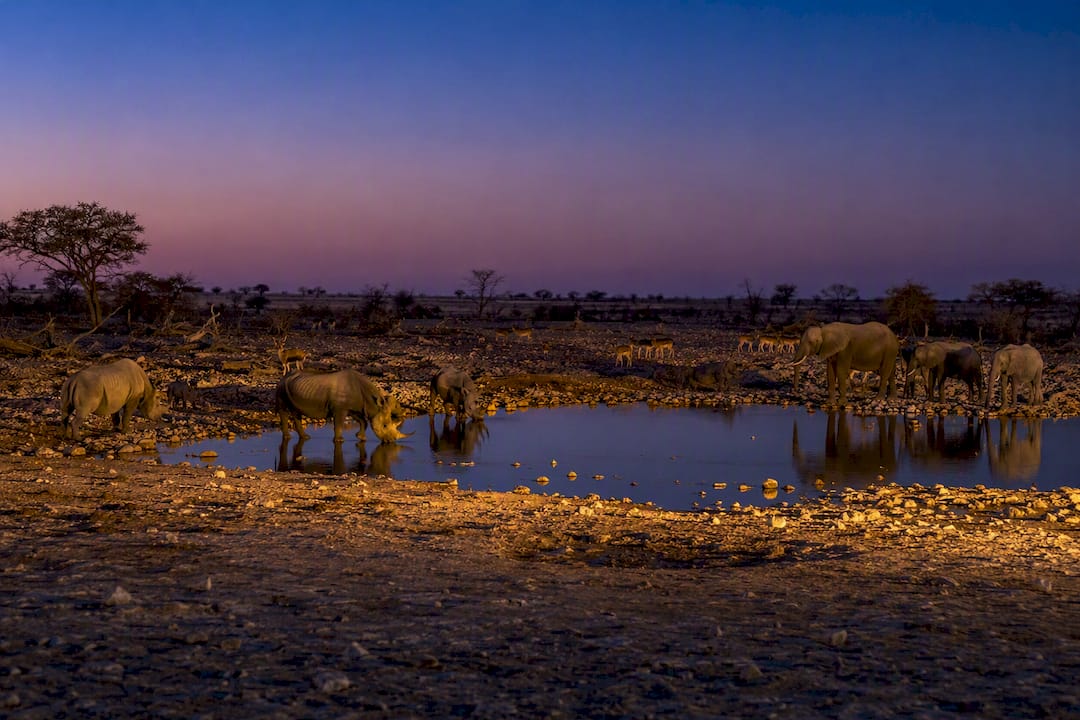
Floodlit waterhole with rhinos at dusk

The most unforgettable thing to do in Etosha is sit at a floodlit waterhole at dusk and watch elephant, rhino, and lion arrive to drink under the lights. Pair that with a guided game drive or a self-drive loop around Etosha Pan, and you have covered the park’s essentials. Plan for several days, ideally in the dry season when wildlife concentrates at waterholes, and book your rest camp well ahead of that period.

TL;DR:

  • Waterhole viewings at Okaukuejo, Halali, and Namutoni provide reliable sightings, especially for rhino and elephant, but camps book out months ahead during peak season.

  • Guided night drives offer deeper animal behavior insights and access to black rhino, while self-driving grants flexibility but cannot include night excursions.

  • The dry season from May to October is optimal for spotting wildlife concentrated at waterholes, requiring early booking of lodges and camps.

  • Photographers should prioritize high ISO, steady tripods, and avoid flash, with low-light waterhole techniques highly recommended for quality images.

  • Patience and a slow safari approach, focusing on a few waterholes at dawn or dusk, yield more wildlife encounters than rapid cross-park driving.

Table of Contents

  • Top things to do in Etosha National Park

  • Comparing the floodlit waterholes: Okaukuejo, Halali and Namutoni

  • Guided drives versus self-drive: which suits your trip?

  • Visiting Etosha Pan and its viewpoints

  • Birdwatching in Etosha: timing and hotspots

  • Special experiences worth booking ahead

  • Planning your trip: timing, fees and where to stay

  • Getting better photos and being a considerate guest

  • Why trust Secret Namibia for your Etosha planning

  • Adopting a slow safari mindset in Etosha

  • Plan your Etosha safari with Secret Namibia

  • Sources

Top things to do in Etosha National Park

Etosha rewards patience more than mileage. The best plans mix one or two high-energy activities with long, unhurried stretches parked beside water.

  1. Floodlit waterhole viewing at Okaukuejo, Halali, or Namutoni. This is Etosha’s signature experience, and it costs nothing beyond your park entry and camp fee. Sit on the viewing benches after dinner and animals materialize out of the dark in a slow, mesmerizing parade. Okaukuejo, Halali and Namutoni are the only three rest camps with this floodlit access, and each delivers a different mood.

  2. Early morning guided walks. These typically start around 5am and put you on foot with a certified naturalist guide who reads tracks, dung, and alarm calls most visitors miss entirely from a vehicle. Book this if you want interpretation over speed, expect to pay roughly $60 to $80 per person.

  3. Self-drive safari around Etosha Pan. A self-drive route gives you total control over pace, letting you park at a productive waterhole for an hour instead of moving on because a guide has a schedule to keep. Budget roughly $70 to $100 a day for a rental plus park fees, on top of your own fuel and time.

  4. Etosha Pan viewpoints and the Dolomite area. The pan itself is a photographic set piece, blinding white in the dry months and a shallow, bird-thick lake after good rains. The Dolomite camp area to the west sits in hillier terrain and sees fewer vehicles than the eastern loops.

  5. Birdwatching hotspots. Etosha’s edge pans and waterholes pull in flamingos, pelicans, and raptors, especially once the rains arrive.

  6. Cultural visits. Several buffer-zone lodges arrange respectful visits to nearby Himba or Damara communities as an add-on to a game-viewing itinerary.

  7. Etosha Ecological Institute. The park’s research base near Okaukuejo is open to curious visitors and gives real depth to what you’re seeing at the waterholes.

  8. Photography workshops. A handful of specialist operators run short courses focused specifically on low-light waterhole technique.

  9. Guided rhino tracking. A small number of experiences let you follow a conservation team on the trail of black rhino, at a higher price point than a standard drive.

A few things worth noting before you build your own list:

  • Night drives are only permitted with a licensed operator, not in a self-drive vehicle.

  • Midday is largely a dead zone for wildlife activity, so most camps encourage rest between roughly 11am and 3pm.

  • Fuel and supplies inside the park are limited, so top up before you commit to a full-day loop.

Comparing the floodlit waterholes: Okaukuejo, Halali and Namutoni

Each rest camp waterhole has its own personality, and picking the right base camp shapes your whole trip more than almost any other decision.

Okaukuejo is the busiest and most famous of the three, and for good reason. Its waterhole is particularly reliable for black rhino sightings after dark, often with several animals arriving within the same hour. The camp has a small museum, a tower with sweeping views over the plains, and enough seating that first-time visitors and photographers chasing dramatic nocturnal shots rarely feel crowded out.


Black rhinos at floodlit Okaukuejo waterhole

Halali sits roughly in the middle of the park and offers a quieter, more intimate waterhole ringed by rock and trees. Elephant herds favor this spot, and the setting makes for gentler sunset light than Okaukuejo’s more open pan.


Elephants at Halali waterhole in sunset light

Namutoni occupies a restored German colonial fort, giving it a historic atmosphere unlike anything else in the park. Its waterhole is floodlit and productive during the day, but the night show is generally calmer and less theatrical than Okaukuejo’s.

Practical notes for whichever camp you choose:

  • Keep voices low at the viewing benches. Sound carries over water, and a noisy group scatters animals before they drink.

  • Give a session at least 45 minutes to an hour. The best sightings often arrive in waves, not immediately.

  • Rest camps with waterhole access often sell out months ahead during the dry season, so lock in dates as early as you can.

Pro Tip: If you can only pick one camp, choose based on your priority species. Okaukuejo for rhino, Halali for elephant and atmosphere, Namutoni for daytime birding and history.

Guided drives versus self-drive: which suits your trip?

A guide’s real value is access and interpretation. Certified naturalist guides can run night drives, which self-drive visitors cannot do under park rules, and they read behavior in ways that turn a routine sighting into a story. Guides also carry radios connecting them to other vehicles, which often means faster tip-offs on predator activity.

Self-driving trades some of that expertise for freedom. You decide how long to linger at a productive waterhole, and the cost per day is typically lower once you factor in vehicle rental against a multi-day guided package.

A workable daily rhythm looks like this:

  • 5am to 8am: guided walk or early game drive, when predators are most active and light is soft for photography.

  • 11am to 3pm: rest at camp, since most animals bed down in shade during the heat.

  • 4pm to 9pm: late-afternoon game drive transitioning into floodlit waterhole viewing after dark.

Indicative price bands run around $60 to $80 for a guided walk, $70 to $90 for a guided late-afternoon or night drive, and $70 to $100 a day for a self-drive rental before fuel and park fees.

Visiting Etosha Pan and its viewpoints

Etosha Pan spans nearly 4,800 square kilometers, and for most of the year it is a cracked, blinding white salt desert stretching to the horizon. During good rains, that same pan floods into shallow lakes that draw large flocks of flamingos and pelicans, transforming the entire landscape within weeks.

Vantage points along the southern edge, near Salvadora and the Etosha lookout areas, give the clearest sightlines across the pan without leaving your vehicle, which park rules require at all times outside designated rest areas.

  • Early morning and late afternoon light flattens the harsh midday glare and brings out the pan’s color shifts.

  • Wet season visits reward patience with wading birds along the flooded margins.

  • Dry season visits favor animals gathering at the pan’s remaining waterholes rather than the pan surface itself.

Birdwatching in Etosha: timing and hotspots

Etosha holds roughly 340 recorded bird species alongside its mammal populations, making it a serious birding destination as well as a big-game one. The wet season, typically November through April, floods pans and draws migrants and waterbirds in far greater numbers than the dry months.

  • Fischer’s Pan and the flooded edges of the main pan are strong bets for flamingos and pelicans after good rains.

  • Waterholes near Namutoni tend to produce good raptor and kori bustard sightings even in drier months.

  • Camp hides and viewing benches double as birding posts, especially at dawn when calls carry furthest.

Birders visiting in the wet season should expect a genuinely different photographic experience from dry-season regulars, with large mixed flocks replacing the solitary raptors and ground birds more typical of winter.

Special experiences worth booking ahead

A few Etosha activities go beyond the standard drive and reward advance planning.

  • Rhino tracking puts you alongside a conservation team following black rhino on foot or by vehicle, usually running a half day and priced well above a standard guided drive given the specialist access involved.

  • Photography workshops focus on the specific technical challenge of floodlit waterhole shooting, low light, long exposures, and unpredictable animal movement, typically run over one or two evenings.

  • Cultural visits to Himba or Damara communities near buffer-zone lodges offer a respectful, guided introduction to local life and usually run a few hours at modest added cost.

  • The Etosha Ecological Institute near Okaukuejo gives visitors a working look at the park’s conservation research, a worthwhile stop for anyone who wants context behind the wildlife they’re watching.

Planning your trip: timing, fees and where to stay

Dry season, roughly May through October, concentrates wildlife at waterholes as surface water elsewhere disappears, making it the strongest window for reliable sightings. Plan for a minimum of two to three days inside the park, and stretch to four or seven if you want to cover both the eastern and western sections properly.

  1. Choose your gate and camp. The park has multiple entrance gates feeding into Okaukuejo, Halali, and Namutoni, and official park information lists current opening hours and gate locations.

  2. Book your rest camp early. Camps with waterhole access sell out months ahead in peak dry season.

  3. Decide on accommodation style. Rest camps inside the park are intentionally basic, their appeal is 24 hour waterhole access, not luxury finishes. Buffer-zone lodges outside the park trade that immediacy for private guided walks, higher-end suites, and more comfort.

  4. Confirm health preparations. Check current malaria and vaccination guidance for northern Namibia with a travel health provider before departure.

A few essentials to keep in mind:

  • Gates open at sunrise and close at sunset; arriving after closing risks being turned away.

  • Park fees are charged per person per day, on top of any vehicle fee.

  • Speed limits inside the park are strictly enforced, and driving off marked roads is prohibited.

For a full sample schedule, Secret Namibia’s ultimate guide to Etosha and its five-day self-drive itinerary both work through day-by-day logistics in more detail.

Getting better photos and being a considerate guest

Floodlit waterhole photography rewards a fast lens and a steady tripod far more than an expensive camera body. Push your ISO higher than feels comfortable, shoot in bursts to catch fleeting movement, and never use flash, it startles animals and ruins the shot for everyone beside you. For pan vistas, shoot low and wide in the first and last hour of light to capture the color shift across the salt crust.


Camera and tripod set for floodlit waterhole photography

Basic etiquette matters as much as gear. Stay quiet at the waterhole, follow your guide’s instructions without exception, and pack out everything you bring in.

Pro Tip: Choose lodges and operators with visible conservation partnerships. It’s a simple way to make sure your trip supports the same wildlife you came to photograph.

Why trust Secret Namibia for your Etosha planning

Secret Namibia builds bespoke Etosha itineraries backed by relationships with buffer-zone lodges and local guiding teams who know these waterholes in every season. For deeper planning, our guides to game drives, self-drive routes, and the park overview cover the logistics this article only summarizes.

Adopting a slow safari mindset in Etosha

The best advice we can offer is to resist the urge to chase a checklist. Park at a waterhole at first light, when the air is still cool and the pan holds a kind of hush broken only by a distant jackal call, and simply wait. Smaller species, a black-backed jackal circling for scraps, a flock of guinea fowl skittering to drink, reveal themselves to travelers who sit still, not to those constantly moving toward the next stop. Build your itinerary around two or three high-impact anchors, then leave the rest of the day unscheduled.

— Secret

Plan your Etosha safari with Secret Namibia

Secret Namibia is the alternative to piecing together your own Etosha trip from scattered guide sites and rental bookings, we build the whole itinerary around your priorities, from floodlit waterhole time at Okaukuejo to a private guided walk at dawn.

Secretnamibia

Our planning team pairs you with buffer-zone lodges and rest camp bookings suited to your pace, whether that means a fast-paced photography trip or several unhurried days watching one waterhole. Every itinerary is built around conservation-minded partners and can flex around family travel, honeymoons, or a longer Southern Africa route. Ready to see what a tailored Etosha safari looks like for your dates? Enquire with Secret Namibia or browse current luxury Namibia safari options to get a custom plan started.

Sources

Check the official Etosha National Park site for gate hours and fees, and see Secret Namibia’s Etosha overview for lodge and itinerary options.

Recommended

Your Safari Concierge

Planning a Namibia Safari Can Feel Overwhelming

Every Secret Namibia safari begins with a private Safari Concierge consultation. We set aside 30 minutes, though most clients have everything they need in 5 to 10. Reserve your preferred time below.

BOOK A FREE 30 MINUTE DISCOVERY CALL